A sequel three decades late
Blade Runner 2049 arrives thirty-five years after Ridley Scott’s original, built by producers who had held the rights since the 1990s and waited out licensing disputes before Denis Villeneuve took the chair Scott vacated for Alien: Covenant. Ryan Gosling plays K, an LAPD blade runner assigned to retire old-model replicants, who stumbles on evidence that could unravel the arrangement between human society and the synthetic workforce built to serve it. Harrison Ford returns as Rick Deckard, decades into hiding. Hampton Fancher, who co-wrote the first film, returns alongside Michael Green to extend rather than repeat the original’s premise. At 164 minutes the film treats itself less as a plot machine than a mood piece, willing to let a scene sit long after its information has already been delivered.
K’s investigation
The plot moves K from a lonely apartment shared only with a holographic companion, Joi, played by Ana de Armas, through interrogations that lead him toward Deckard and a child whose existence would prove replicants can reproduce. Gosling plays the role almost entirely through restraint, a performance built on stillness rather than reaction, which suits a character trained not to feel. Sylvia Hoeks, as the replicant enforcer Luv, supplies the film’s few bursts of physical violence. Roger Deakins shot the film, and his frames do storytelling work dialogue is deliberately withheld from: vast interiors lit by single coloured sources, exteriors scaled to make people look incidental. Joe Walker’s editing lets those images run long. Hans Zimmer and Benjamin Wallfisch’s score leans on distorted low frequencies rather than the synthesizer melodies of the original.
Deakins’ light and Ford’s return
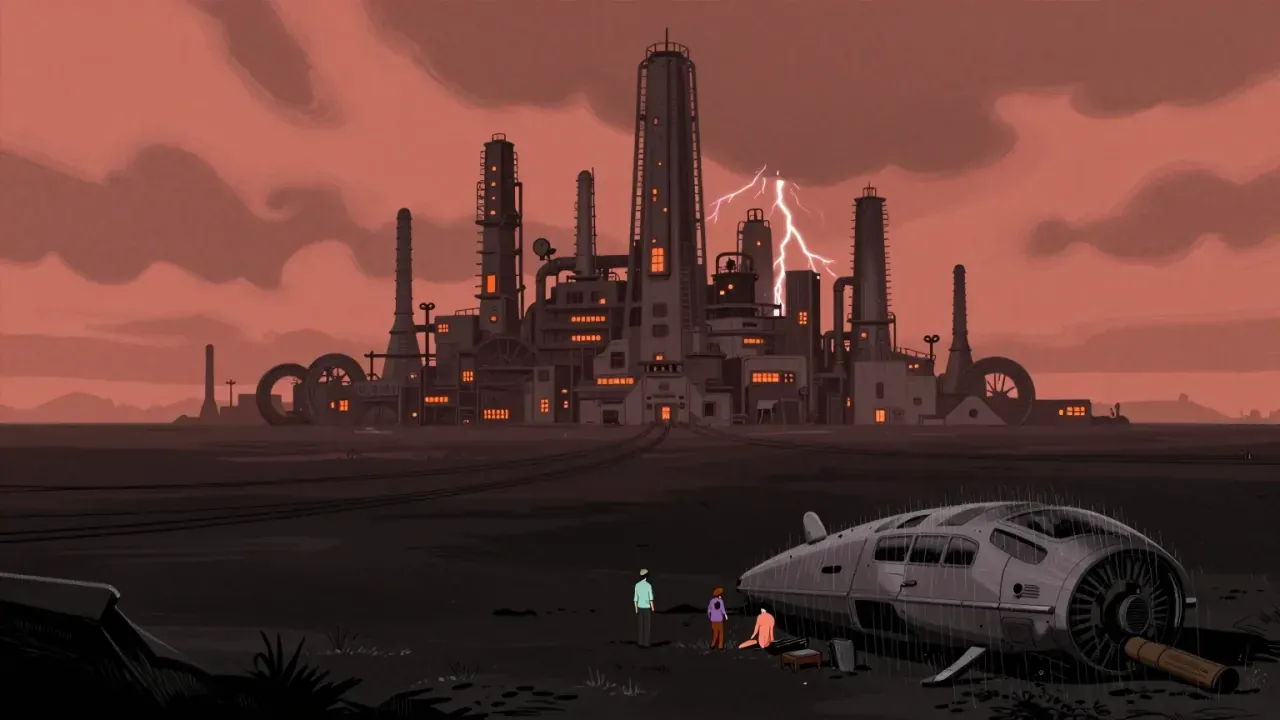
What lands is the world itself. Deakins earned the film’s Academy Award for cinematography, and it is deserved: the orange dust of a ruined Las Vegas, the submerged neon of San Diego’s landfill coast, and a Los Angeles rebuilt as a wall of advertising are each staged with a clarity the plot doesn’t always earn. The visual effects, also Oscar-winning, integrate de Armas’s hologram character into physical space without drawing attention to the trick. Ford’s handful of scenes with Gosling carry real weight, an old performance recognising a new one. And the film’s best individual sequence, a three-way negotiation between K, Joi and a hired escort, stages loneliness as a technical problem rather than a feeling.
A slow back half
What doesn’t land is pacing and, at points, purpose. Jared Leto’s Niander Wallace, the blind industrialist who wants replicants that can breed, is written as portentous rather than dangerous, and his scenes slow a film that was already unhurried by choice. Several stretches exist to extend runtime rather than character: a mid-film detour to an irradiated Las Vegas takes its time arriving at information the audience could have been given faster. The screenplay’s central revelation, once delivered, doesn’t reshape what came before it the way the strongest mystery structures do; it clarifies a feeling the film had already made clear visually. At 164 minutes, some of that length is spent underlining rather than building.
Memory as a manufactured thing
The film’s real subject is manufactured memory: K possesses implanted recollections he knows are fake, made convincing by a specialist, played by Hiam Abbass, whose job is to design falsehoods precise enough to comfort their owner. That premise lets the film ask what a self is worth if its foundations were written by somebody else, and whether a memory’s origin matters if its effect on the person holding it is real. Joi, a hologram sold as a product, runs the same question from another angle: her affection for K is manufactured too, and the film never fully resolves whether that makes it worthless. Los Angeles as rendered here is itself a kind of manufactured memory, retrofitted from the 1982 city rather than reimagined.
Who this is for
This suits anyone who found the first Blade Runner’s slowness a feature rather than a flaw, and anyone drawn to production design as a storytelling tool in its own right; the film rewards pausing on a frame more than following a plot twist. Fans of Deakins’ other work, or of Villeneuve’s earlier Prisoners and Arrival, will recognise his patience with silence. It is not for viewers wanting the momentum of Aliens or a conventional detective plot resolved at speed; K’s investigation unfolds through implication as often as dialogue, and Leto’s underused villain will frustrate anyone expecting a clear antagonist. Newcomers to the franchise should watch the original first, since the sequel assumes familiarity with Deckard’s fate and withholds context accordingly.
Worth the evening
At 259.2 million dollars in worldwide takings against a 150 million dollar budget, Blade Runner 2049 made back less than double its cost, a soft result for a film built at that scale, even as critics and the Academy rewarded it with cinematography and visual effects wins from five nominations. That gap between critical standing and commercial appetite is the most honest way to read it: a film built with unusual craft and unusual patience, aimed at an audience willing to sit with both. Judged as a two-and-a-half-hour argument about memory and manufactured selfhood dressed as a detective story, it earns most of its length. Judged as a thriller, it runs long. Set aside an evening where you are not in a hurry.