Writing the ending first
Akira is Katsuhiro Otomo’s 1988 adaptation of his own manga, made while that manga still had two years of serialisation left to run. Otomo took the job only on the condition that he keep creative control, and he built the film’s ending first, then worked backward to decide which parts of an unfinished, two-thousand-page story could fit into two hours. Set in a rebuilt Neo-Tokyo in 2019, it follows biker-gang leader Kaneda trying to stop his childhood friend Tetsuo, whose body starts destroying itself and everything nearby after a motorcycle collision with an escaped child esper leaves him with escalating telekinetic power.
A budget that bought a whole city
A consortium of seven companies, from Kodansha to Toho, backed a budget of roughly ¥700 million to give Otomo a fully realised city rather than the sparse settings anime budgets usually allowed. The film used pre-scored dialogue, recording the voice performances before animating lip movement, which was unusual even by today’s standards and gives the delivery an unforced, naturalistic rhythm. More than 160,000 cels went into the animation, and early computer graphics were used for lighting, falling-object paths and the pattern displays tracking Tetsuo’s condition. Shōji Yamashiro’s score, performed by Geinoh Yamashirogumi, draws on gamelan and noh chanting rather than orchestral cues.
Tetsuo’s body as the special effect
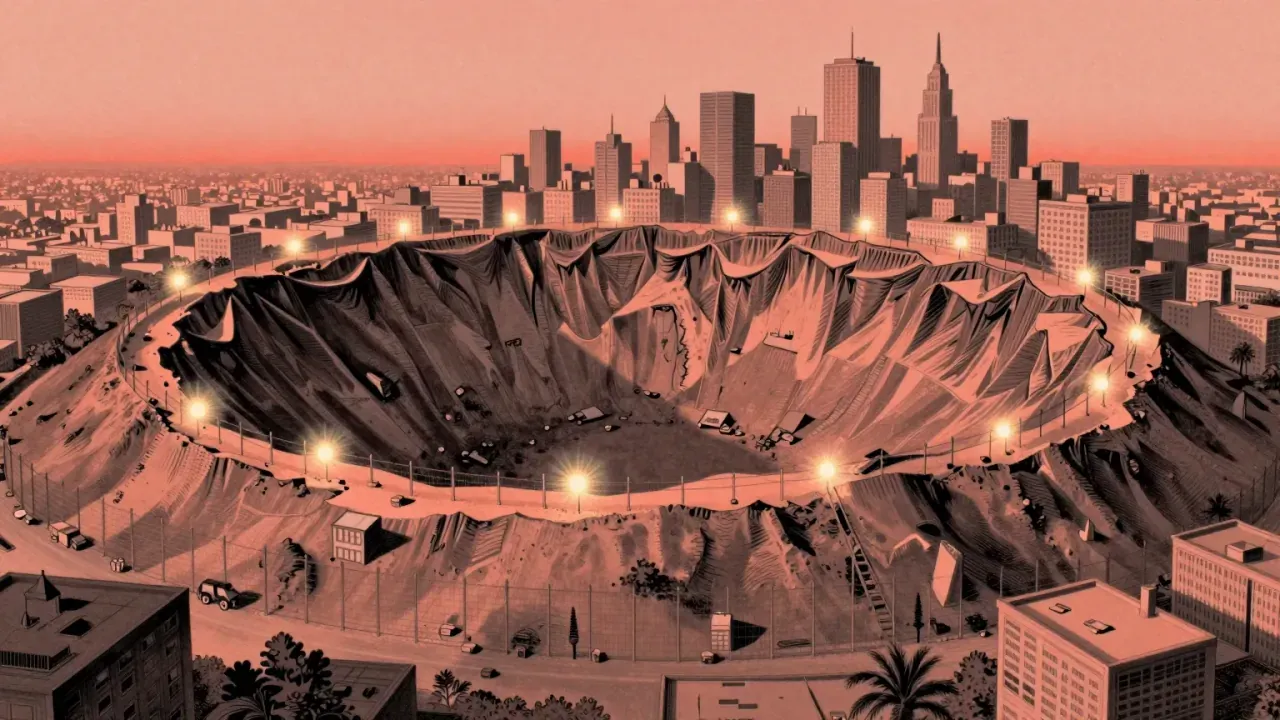
The body horror of Tetsuo’s transformation is where the film commits hardest: his arm swells, splits and regenerates in ways that keep escalating past the point most productions would stop, and the destruction that spreads across Neo-Tokyo toward the military complex at the story’s centre has a scale and specificity that the budget makes possible rather than merely gestures at. Kaneda and his gang read as a functioning social unit rather than a collection of types, their loyalty tested credibly rather than declared. The gamelan-driven score gives even the quiet aftermath scenes a tension the visuals alone might not sustain.
The manga’s unfinished shadow
Compressing an unfinished two-thousand-page manga into two hours leaves visible gaps: the psychic children Akira, Kiyoko, Takashi and Masaru are given weight through design and stillness rather than explanation, and viewers coming in cold may find their purpose in the plot underexplained until well into the film’s second half. Otomo has since called making the film before finishing the manga the worst possible way to do it, and some of that strain shows in a third act that resolves through spectacle and implication rather than argument, leaving Tetsuo’s final state more felt than understood.
A body the city cannot metabolise
The film sits inside a specifically post-war Japanese anxiety about uncontrolled power, dressed as biker-gang science fiction: Tetsuo’s escalating ability reads as a metaphor for a body and a rebuilt city that cannot metabolise the forces a secret government programme unleashed inside it. Kaneda’s loyalty to a friend turning into something monstrous, rather than heroism against an external enemy, keeps the film’s stakes personal even as the scale of the destruction grows to threaten the military complex that the government has spent the whole film trying to keep secret, contained and, above all, protected from outside eyes.
Not the soft introduction to anime its reputation suggests
Viewers drawn to hard-edged, R-rated animation with a genuine sense of scale and consequence, and anyone curious where a large share of Western cyberpunk imagery originated, will find the film still delivers on both fronts. It asks for tolerance of narrative gaps and a plot that trusts imagery over exposition; those who need clean character arcs and tidy resolutions may find the ending frustrating rather than awe-inducing. It is also intense enough, in its body horror and civic destruction, that it is not the introduction to anime some might expect from its reputation.
Nine times its budget, and still finding new audiences
Akira earned almost nine times its $5.5 million budget worldwide and later took in tens of millions more through home video, and its critical standing, a 91 percent Tomatometer score against a comparatively modest 68 on Metacritic, has only firmed up with each restoration since. The film’s continuing theatrical re-releases, including a 2020 IMAX run and further screenings planned for 2026, suggest an audience still finding it for the first time, decades on. For anyone who has absorbed its influence secondhand through other films and games, seeing the source is still worth the evening.