A war given one final chance to end
The Matrix Revolutions is a 2003 American science fiction film, written and directed by the Wachowskis, that closes out the trilogy begun with The Matrix in 1999. Neo, having been pulled out of a strange subway-station limbo between the digital and machine worlds, learns from the Oracle that Agent Smith intends to destroy both the Matrix and the physical world, and sets out toward the machine city to strike a deal that might stop him. Meanwhile Zion, the last human city, comes under direct assault from a horde of machine Sentinels, splitting the film’s attention between an intimate two-hander in Neo’s storyline and a large-scale siege back home.
Two films shot as one production
Production ran concurrently with The Matrix Reloaded, both shot largely at Fox Studios in Sydney, Australia, with additional filming at the disused tunnels of St James railway station and the Royal Botanic Garden for the Oracle and Architect’s closing scenes. The reported budget ran as high as $150 million, and Carrie-Anne Moss injured her ankle during the Australian shoot. Revolutions arrived in theatres only three weeks after Reloaded had already reached DVD, an unusually tight turnaround that reflected the films’ back-to-back production rather than the normal spacing of a franchise sequel.
A choir singing Sanskrit over the final battle
Composer Don Davis, working again with Juno Reactor, used far fewer external source tracks than the previous two films, leaning instead on an expanded orchestral and choral score. For the climactic battle theme, titled Neodammerung after Wagner’s Gotterdammerung, Davis and the Wachowskis chose to have a full choir sing actual extracts from the Pavamana Mantra in Sanskrit rather than simple wordless vocalising, reasoning that plain English lyrics would undercut the moment’s intended weight. The choice gives the final Neo-Smith confrontation an operatic quality distinct from the more minimal, industrial soundscape of the first film.
Trinity’s death and a widest-ever simultaneous release
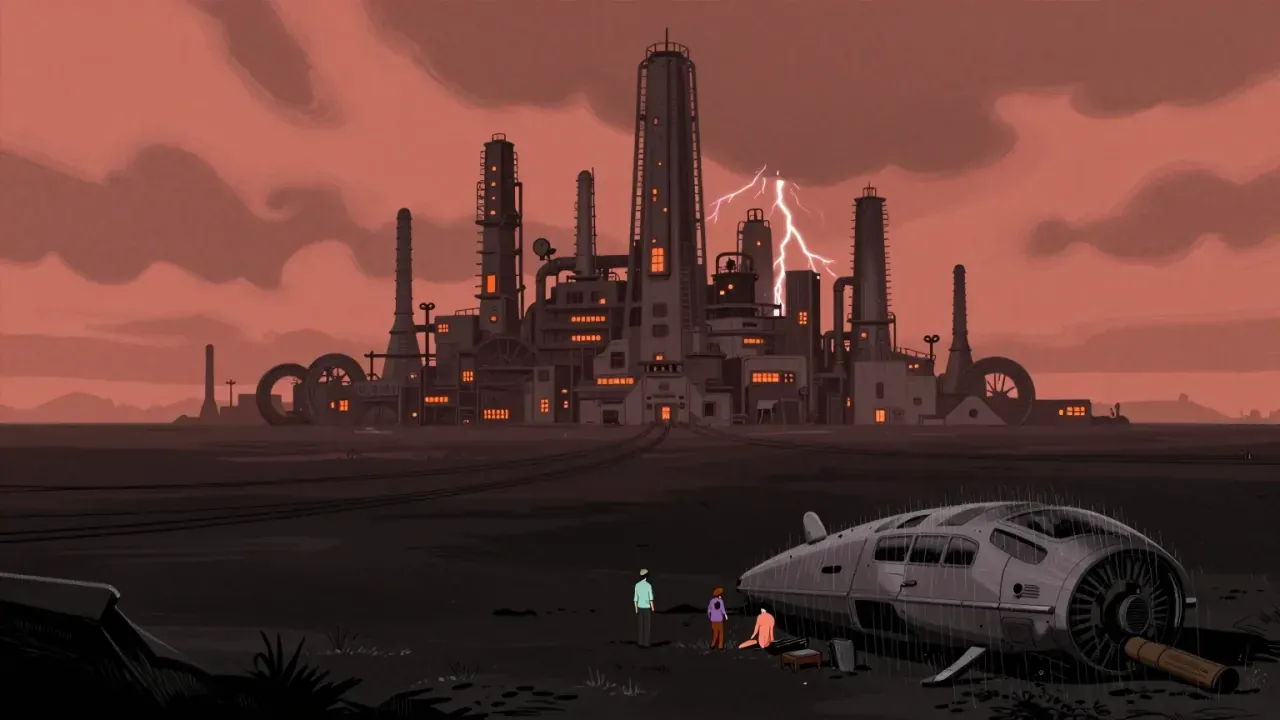
Trinity’s death arrives after she pilots the ship Logos through a machine-controlled cloud layer and briefly glimpses open sky before crashing and being fatally impaled, a moment the film treats with unusual stillness against its otherwise effects-heavy back half. On release, the film opened in 108 territories simultaneously, the widest release for a live-action feature at that point, and became the first live-action film released in regular and IMAX theatres at the same time; it earned $24.3 million on opening day and $427.3 million worldwide overall, an eighth-place finish for the year despite the declining reviews.
A trilogy’s ideas thinning under their own weight
Critics at the time consistently praised the visual effects while criticising a perceived lack of new ideas and thinner characterisation compared to the first two films, and that reaction has held up in retrospect: the Rotten Tomatoes critic score sits at 33% against the Metascore of 47, both markedly lower than the original film’s marks in the 90s. The trilogy’s philosophical scaffolding, the Architect’s determinism versus the Oracle’s belief, Smith’s viral self-replication as a rebellion against both human and machine control, gets resolved through a prolonged physical battle rather than the dialogue-driven confrontations that defined the earlier films, a shift some viewers experienced as the series cashing out its ideas for spectacle.
Who this suits
This is worth watching for anyone who has already sat through the first two films and wants the story finished, and for viewers who enjoy large-scale effects work for its own sake, since the Zion siege sequence remains an ambitious set piece regardless of the story around it. It is a poor entry point for newcomers, who would do better starting with the 1999 original, and it is likely to disappoint anyone hoping the trilogy would return to that film’s tighter premise and more restrained visual style rather than escalate further.
One hundred twenty-nine minutes of diminishing returns
At 129 minutes and a $150 million budget, The Matrix Revolutions grossed nearly three times its cost and closed out one of the most influential science fiction franchises of its era, but it did so to a critical reception clearly cooler than its predecessors received. It remains a required watch only in the sense that a trilogy asks to be finished once started; taken on its own, with the choral bombast of its climax and its comparatively thin character work, it is the weakest case among the three films for spending an evening on.