A rejected pitch becomes a time-machine comedy
Back to the Future is Robert Zemeckis’s 1985 comedy, made under Steven Spielberg’s Amblin banner and shot largely around Los Angeles and on Universal’s backlot. Teenager Marty McFly is thrown from 1985 into 1955 by a DeLorean rigged into a time machine by the scientist Doc Brown, and finds himself stuck there with no way home and no plutonium to spare. Worse, he accidentally derails the meeting of his own future parents, so the ticking clock is not only about getting back but about not erasing himself first. Zemeckis and his co-writer Bob Gale had shopped the idea for five years and been turned down more than forty times before the unrelated success of Romancing the Stone gave Zemeckis the standing to make it his way, on his own terms, with Universal financing it.
One rule, followed all the way through
The plot runs on a single mechanical idea, worked out with real discipline: every change Marty makes in 1955 has to ripple forward and show up as a consequence, from a fading photograph to his own parents’ personalities. Michael J. Fox, brought in five weeks into shooting after Eric Stoltz was dropped from the role, plays Marty as a straight man reacting to an increasingly absurd situation rather than driving the jokes himself, which leaves room for Christopher Lloyd’s Doc Brown and Thomas F. Wilson’s bully Biff to supply the noise. Lea Thompson and Crispin Glover, as Marty’s teenage parents, carry the stranger half of the film, in which a son has to make his own mother fall for his own father without letting on who he is. Dean Cundey’s cinematography keeps both decades bright and legible rather than sepia-toned, so 1955 reads as a real place rather than a memory.
The paradox played for laughs, not lectures
The film’s best trick is treating a paradox as a joke rather than a puzzle to be solved with diagrams. Marty fading out of a photograph, or feeling his own hand start to disappear mid-guitar-solo, lands harder than any lecture on causality could, because the film never stops to explain the rules before breaking them for a laugh. Alan Silvestri’s score, all brass fanfare, sells the DeLorean’s launches as genuine spectacle on what was, for a studio picture, a modest budget of nineteen million dollars. Thomas F. Wilson’s Biff is a mean, specific creation rather than a generic bully, funny because Wilson plays him as genuinely aggrieved rather than cartoonish. Reshooting five weeks of footage with a new lead actor could have produced something visibly patched together; instead the film reads as a single, confident take from its opening frame.
A tidy 1955 and a bolted-on chase plot
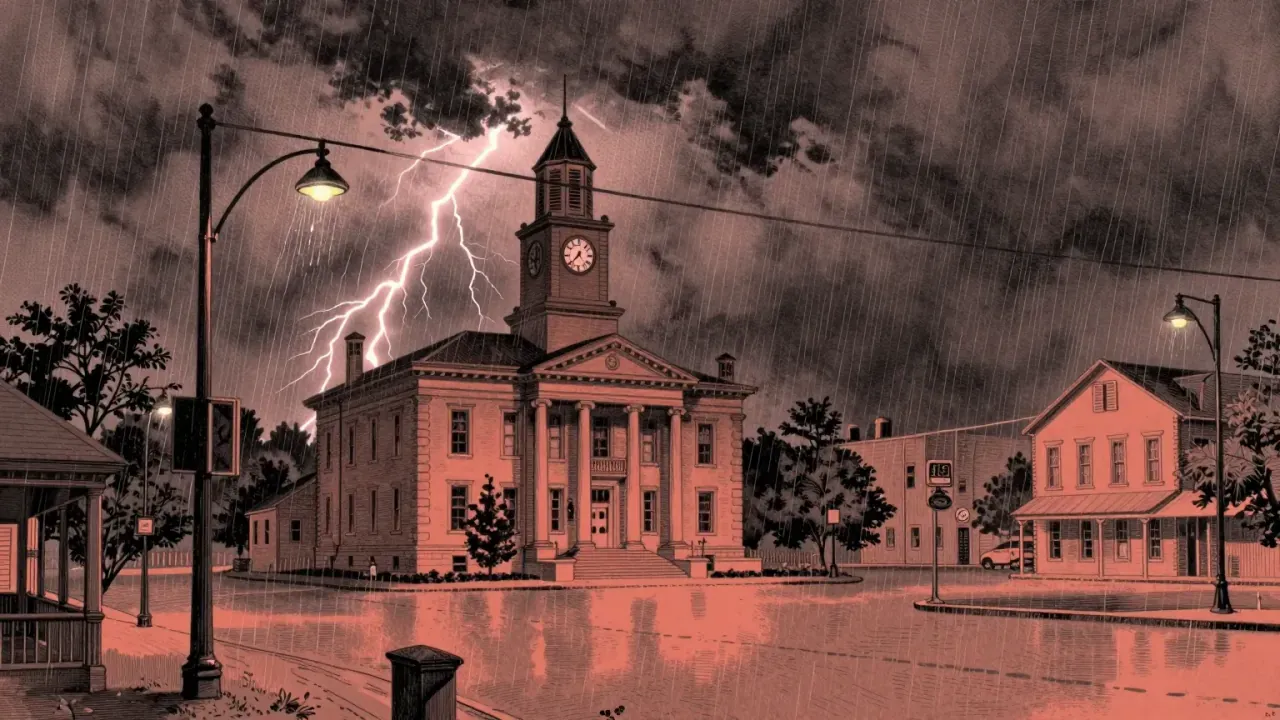
The film’s comedy depends on 1955 being a tidy, orderly America of soda shops and school dances, which is a deliberate choice but one that flattens the decade into a postcard. The Libyan terrorists chasing Doc Brown for a stolen plutonium bomb are a jarring, borrowed-headline gag that has aged worse than almost anything else in the script, arriving with no real point beyond a chase device. The rushed post-production, a consequence of moving the release date earlier after strong test screenings, shows in a handful of effects shots, particularly the lightning-strike climax, where the compositing looks noticeably thinner than the rest of the film. Marty’s discomfort at his own mother’s attraction to him is played for a long stretch of the middle section, and the film leans on it more than the joke can comfortably support.
Rewriting a father, inspecting two decades
Family sits underneath every scene: Marty is not just retrieving his parents’ romance but rewriting his father George from a bullied doormat into a man capable of standing up for himself, and the film argues, without ever saying so directly, that a single act of courage can reset a person’s whole life. Nostalgia here works in two directions rather than one, since Marty’s 1985 is already treated as slightly embarrassing and dated, and his 1955 is not romanticised so much as inspected for what it got wrong and right. The comedy of manners between decades, Marty’s clothes, slang and music baffling everyone he meets, does more thematic work than the time-travel mechanics, turning the film into a study of how quickly a culture’s assumptions calcify.
Who gets the most from it
This suits a viewer who wants a tightly engineered studio comedy rather than a demonstration of visual imagination for its own sake, and it rewards anyone curious about how a script can turn a paradox into pure momentum rather than exposition. Families with older children will find the pace and the jokes hold up scene to scene, and Wilson’s and Lloyd’s performances are broad enough to work for a first-time viewer who has never thought about the plot mechanics at all. It is a poor match for anyone allergic to a hero who mostly reacts rather than acts, since Marty spends much of the middle stretch pushed along by events rather than driving them himself. Viewers hoping for hard-edged science fiction rather than a comedy dressed in its clothes should also look elsewhere.
Forty years on, still a clean two hours
Set against a budget of nineteen million dollars, the film returned over 380 million at the box office and has held up across four decades better than almost anything else from the same summer, still turning up on rewatch lists rather than nostalgia clip shows. Critics’ aggregates in the high eighties and low nineties out of a hundred track with how well the mechanics of the script still work rather than any residual affection for 1985 itself. It earns its two hours by solving its own puzzle cleanly rather than padding toward a sequel, even though two sequels followed. Anyone deciding whether to give it an evening should know it asks for very little patience and repays it almost immediately, which is the rarer thing.