A picture book expanded into a technological experiment
The Polar Express adapts Chris Van Allsburg’s 32-page picture book about a boy who boards a magical train to the North Pole on Christmas Eve, expanding a story built around a handful of illustrations into a 96-minute feature using a fully performance-captured cast rather than traditional animation or live action. Van Allsburg had refused to sell the film rights for years, worried any adaptation would misrepresent his artwork, until Tom Hanks, who wanted to play both the train’s conductor and Santa Claus, got involved and set one condition of his own: the film could not be conventionally animated. Robert Zemeckis, who replaced original director Rob Reiner after repeated delays, decided a live-action version would be prohibitively expensive to stage and a standard cartoon would betray the book’s specific illustration style, leaving motion capture as his solution to preserve both.
A million dollars a minute for six Tom Hanks performances
Motion capture cost roughly $1 million per minute of footage, and Hanks ultimately performed six separate roles, including the hero boy later redubbed by a child actor; Zemeckis originally wanted Hanks in every part before deciding the workload was too exhausting to sustain. The technique required an entire second financier to co-fund the film, since the process and its price tag made Warner Bros. and investor Steve Bing’s involvement necessary after Universal turned the project down. Alan Silvestri’s score and the song Believe, later performed by Josh Groban at the Academy Awards and covered again with Beyoncé, anchor the film’s emotional peaks in music rather than in the performance-captured faces, which struggled at the time to convey subtle emotion convincingly.
The train’s mechanical specificity holds the fantasy together
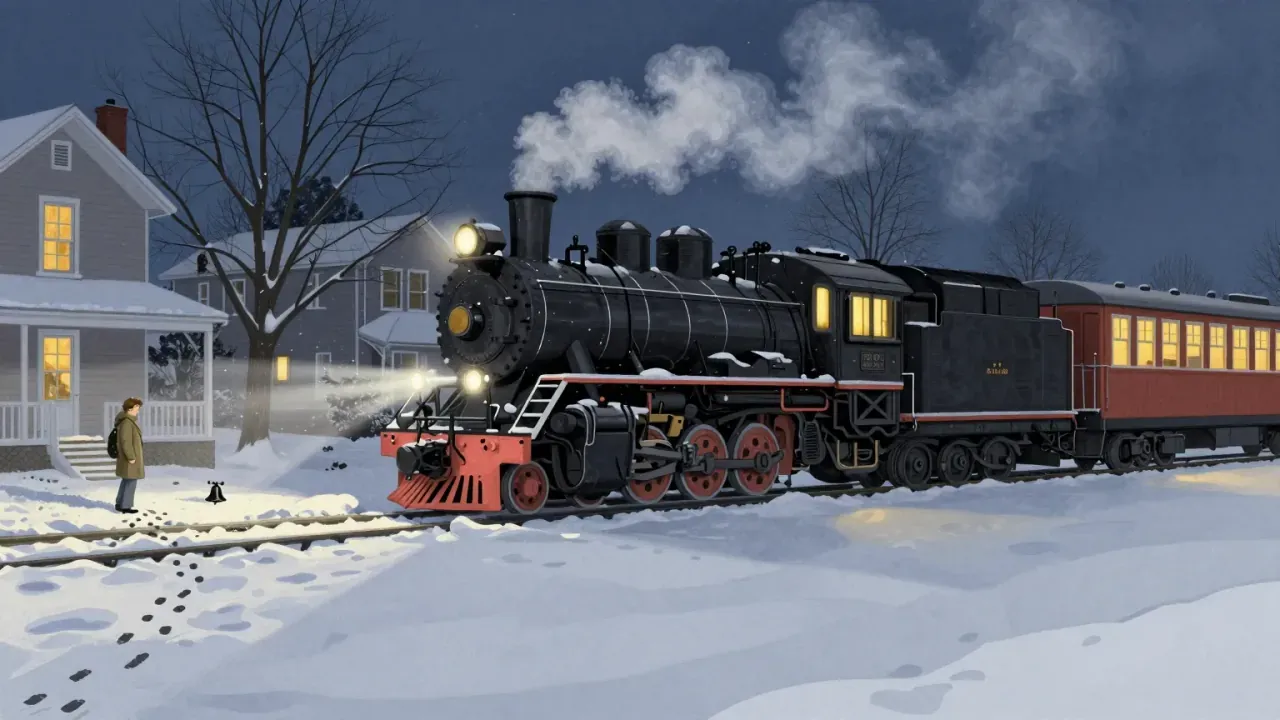
The train’s steam-engine design, based directly on the Pere Marquette 1225 with parts and sounds sourced from the actual locomotive’s operators, gives the film’s central setting a mechanical specificity that grounds the fantasy elements around it. Michael Jeter’s performance as the engineer, his final film role before his death partway through production, retains real warmth even where his dialogue had to be redubbed and patched together by another actor afterward. The sequence depicting Billy, the lonely boy sitting apart in the observation car, uses silence and physical distance more effectively than dialogue to establish why he doesn’t believe in the trip’s magic.
Where motion capture becomes the film’s own liability
The film’s signature technology is also its clearest liability: motion-captured human faces, still an emerging technique in 2004, register as unsettling to a significant portion of viewers rather than as a faithful translation of Van Allsburg’s illustrations, and that mismatch between intention and result shows up directly in the film’s mixed critical reception. At 96 minutes stretched from a picture book’s handful of pages, several sequences — an extended detour involving a runaway ticket blowing across the wilderness, a roller-coaster-style slide down an ice slope — read as padding inserted to justify feature length rather than material essential to the story.
Belief as the film’s one sustained argument
The film’s actual argument, voiced through the ticket inscribed with the word Believe and Hero Boy’s arc toward hearing Santa’s bell, is about sustaining belief specifically past the age when childhood credulity is supposed to end, and the production’s own choice to preserve Van Allsburg’s illustration style so faithfully is itself a kind of belief in the book’s authority over any adaptation’s usual license to change things. Billy’s poverty and loneliness, an addition not present in the source book, gives the film’s Christmas-magic message a material stake beyond simple faith, tying belief in Santa to a more concrete hope that someone notices you. The film’s insistence on Hanks embodying nearly every authority figure the boy encounters suggests belief itself is really one continuous act, filtered through different adult faces.
Who the experiment suits, and who it unsettles
This suits viewers curious about a specific, expensive technological experiment in film history, and families wanting a Christmas Eve film built around a real emotional question about outgrowing belief rather than around jokes. It also rewards anyone interested in how a studio’s biggest-budget animated production at the time was justified entirely by fidelity to a picture book’s aesthetic. It’s a difficult recommendation for viewers sensitive to unconvincing human facial animation, since the technology’s limitations are most visible exactly where the story asks audiences to connect emotionally with a character’s face.
Why a modest return followed the era’s biggest animated budget
At 96 minutes and with a $165 million budget, the highest ever for an animated feature at the time, The Polar Express earned back less than double its cost on first release before later re-releases pushed its total past $310 million, a modest return relative to its ambitions. Mixed reviews, reflected in scores well below the era’s best-regarded animated films, suggest the technological gamble divided audiences more than it united them. Worth an evening mainly around the holidays and mainly for the train’s mechanical design and Jeter’s performance, with the understanding that the human faces carrying the story’s emotional weight may or may not work for you.