A move to the countryside, and almost no plot
My Neighbor Totoro, released on a double bill with Grave of the Fireflies in 1988, follows two sisters, Satsuki and Mei, who move with their father to a house in the countryside while their mother recovers in hospital from a long illness. Miyazaki wrote and directed it for Studio Ghibli, and the film has almost no antagonist and barely any plot mechanism beyond the girls settling into a new home and meeting the spirits living in the trees around it. It is trying to render a specific, unhurried texture of rural Japanese childhood rather than build toward a conventional climax.
A camera that lingers
Joe Hisaishi’s score, all woodwind and simple piano melody, tracks the sisters’ moods rather than underlining incident, and cinematographer Hisao Shirai’s camera holds on empty rooms and overgrown paths long enough that the house itself becomes a character. Mei’s discovery of the soot spirits and her chance meeting with Totoro in the hollow of a camphor tree happen at a child’s pace, with no adult confirming what she has seen. Editor Takeshi Seyama lets scenes run past their narrative usefulness, into stretches of the girls simply playing, which is where most of the film’s charm sits.
An indifferent giant instead of a helpful mascot
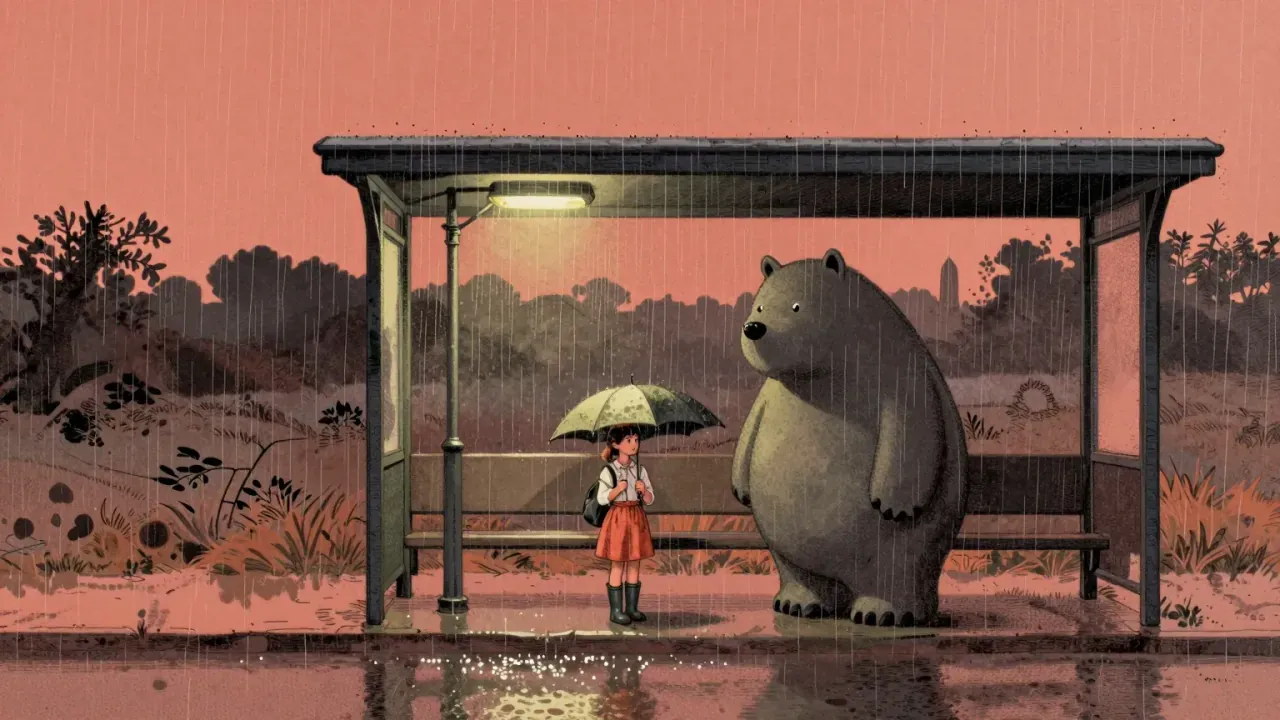
The film’s patience is its achievement: it trusts a bus shaped like a cat, an oversized forest spirit that roars rather than speaks, and two children’s unforced affection for each other to carry ninety minutes without incident-driven plotting. Mei’s tantrum and eventual disappearance late in the film land with real weight precisely because the film has spent so long establishing ordinary domestic rhythm beforehand. The design of Totoro himself, indifferent and enormous rather than cute and eager to help, keeps the fantasy strange instead of merely comforting, a spirit that tolerates the girls’ company rather than one that exists to serve their needs.
An illness kept mostly off screen
Viewers expecting a plot with rising stakes will find long stretches where nothing much happens beyond weather and chores, and the film’s refusal to explain its spirits, what they want, why only children can see them, leaves some ambiguity unresolved rather than deliberately mysterious. The mother’s illness, present throughout as quiet dread, is never dramatised directly, which keeps the film gentle but also means its central source of anxiety stays mostly implicit, felt through the girls’ behaviour around their father and their eagerness for news from the hospital, rather than ever shown outright on screen.
Spirits in ordinary places, and a family holding steady
Animism and Shinto ideas about spirits inhabiting ordinary places run through the film without being explained as doctrine: trees, rain and a broken-down bus shelter all carry the possibility of something living in them, and the film asks the audience to extend children’s credulity toward the natural world rather than adult scepticism. It is also, more quietly, about a family managing a parent’s serious illness without collapsing, finding relief and distraction in a new place rather than resolution, with the father’s steadiness giving the girls a model for how to hold worry without being consumed by it.
Who it rewards
It suits families with young children and adults nostalgic for unstructured summers, along with anyone tired of incident-heavy children’s films and wanting something built around atmosphere and patience instead. Viewers who need forward momentum, a villain, or a tidy explanation for the fantasy elements are likely to find it slight or frustrating rather than restorative. It also rewards a second viewing once the mother’s illness is understood, changing how the sisters’ small joys register the second time through, and it works equally well shared between an adult and a child, since neither will read the quiet parts the same way.
A modest opening, a towering reputation
My Neighbor Totoro grossed a comparatively modest $30.6 million worldwide against no reported dramatic budget concerns, and Studio Ghibli’s own numbers show it took years, including a surprising 2018 Chinese release three decades late, to build the audience its reputation now suggests. Sight & Sound critics ranked it the best animated film ever made in a 2012 poll, and Totoro has since become the studio’s mascot. For an unhurried evening rather than a plotted one, it remains close to essential, and the fact that it took decades and an unlikely Chinese theatrical release to reach some of its largest audiences only underlines how little it depended on urgency to endure.