The look of it
Genocide is a Japanese science fiction horror film from Shochiku, released in 1968, that attempts to fuse Cold War anxiety, post-nuclear trauma, and ecological dread into a single allegorical framework. It uses the premise of weaponised insects — bred or awakened by radiation — not as monsters but as vectors: of memory, of retribution, of biological collapse. The film does not aim for plausibility in its entomology or military logistics, but for compression — of Hiroshima’s afterimage, of Okinawan occupation tensions, of the moral vertigo of deterrence theory — into a tight, island-bound parable. Its ambition lies in scale of implication, not spectacle: it treats the H-bomb not as a plot device but as a narrative horizon, a fixed point toward which every character’s action tilts. It is less concerned with explaining how insects swarm than with asking why humans keep building weapons that make such swarming inevitable. This is not pulp with subtext; it is pulp as subtext — a genre film whose formal economy serves ideological density.
The shape of the story
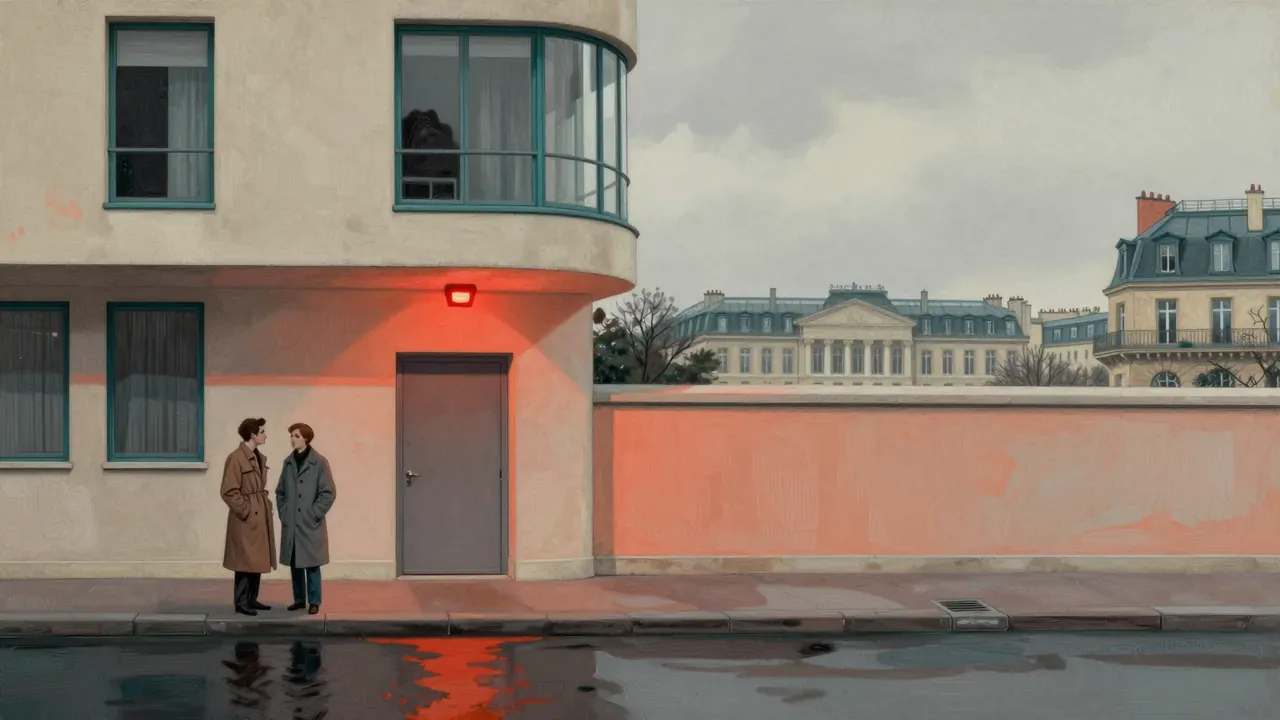
The story moves in jagged, functional blocks: crash, investigation, arrest, revelation, capture, sacrifice, detonation deferred. Performances are restrained, even muted — Joji’s stoicism, Yukari’s quiet vigilance, Nagumo’s weary authority — avoiding histrionics in favour of procedural gravity. Shizuo Hirase’s cinematography keeps compositions tight and lighting flat, favouring mid-shots over close-ups, daylight over chiaroscuro; interiors feel airless, exteriors sun-bleached and unyielding. Shunsuke Kikuchi’s score is sparse, leaning on low brass and dissonant strings only at moments of rupture — Charly’s breakdown, the egg-laying sequence — never underscoring mood but punctuating shifts in bodily autonomy. Editing avoids rhythm, favouring abrupt cuts between locations and perspectives, reinforcing fragmentation rather than continuity. There is no visual flourish for its own sake: even the insect effects — rudimentary miniatures, matte overlays, stock footage spliced in — are deployed with clinical indifference to awe.
The weight of women
What lands is the film’s cumulative sense of encroachment — not just of insects, but of history, of surveillance, of compromised agency. Annabelle’s connection to the swarm reads less as villainy than as embodied consequence: her trauma is literalised in the insects’ behaviour, their nesting in human tissue mirroring wartime violation. The American search party’s arrival feels less like rescue than occupation-in-miniature, their uniforms and radios asserting control before they’ve spoken a line. Yukari’s isolation — managing a clinic, fending off Kudo, receiving Nagumo’s letters — gains weight precisely because it is underplayed; her resilience is structural, not rhetorical. The final sequence, where Gordon orders the bomb’s detonation while Nagumo pleads over a radio, lands with grim inevitability: not because the characters lack will, but because the system they inhabit has already decided the terms of survival. The film’s bleakness is earned, not imposed — it accrues through refusal to offer catharsis, explanation, or even clear causality.
The loose ends
What does not land is the espionage subplot: the ‘Eastern bloc’ spies operate without motive, method, or presence beyond two scenes of whispered exposition and one brief interrogation. Their involvement feels grafted on, a concession to genre expectations rather than an organic extension of the film’s logic. Annabelle’s dual role — war survivor, insect conduit, spy collaborator — remains unresolved, her alignment shifting without psychological scaffolding. Charly’s descent into madness is physically convincing but narratively inert; his death adds no new information, nor does it alter the trajectory of events. The film’s pacing sags in the middle third, where exposition about watch serial numbers and parachute trajectories slows momentum without deepening thematic resonance. Crucially, the insects themselves never cohere as a unified threat: sometimes swarming en masse, sometimes acting individually, sometimes vanishing for ten minutes — their behaviour serves plot necessity, not internal consistency. This isn’t ambiguity; it’s omission.
What the insects know
The themes that matter are inheritance and erasure — of memory, of sovereignty, of the body. The Anan Archipelago stands in for Japan’s contested periphery: neither fully sovereign nor wholly occupied, its islands bear the physical and psychic residue of war without the official recognition of mainland trauma. Insects here are not metaphors for fascism or communism, but for what persists when ideology fails — biological tenacity, evolutionary patience, the sheer indifference of non-human life to human borders or bombs. The film interrogates scientific responsibility not through hubris but through silence: Nagumo’s research is sidelined, his warnings dismissed not because he is wrong, but because his knowledge has no institutional purchase. Gender functions structurally: Yukari’s labour — medical, domestic, emotional — holds the island together, while Annabelle’s body becomes the site where colonial violence, Cold War paranoia, and ecological rupture converge. There is no redemption arc, only endurance — and the question of what endures, and at what cost.
Who it is for
This film is for viewers who value thematic density over narrative coherence, who find tension in restraint rather than escalation, and who approach genre not as escapism but as diagnostic tool. It rewards attention to framing, to silence between lines, to the weight of a military-issue watch handed across a counter. It is not for those who require clear antagonists, causal logic, or resolution — the film denies all three deliberately. Anyone expecting the kinetic pacing of Goké or the creature spectacle of The X from Outer Space will find Genocide withholding, even obstinate. Those who dislike films where political context is embedded in composition rather than dialogue — where power is signalled by uniform fabric, not speech — will struggle to locate its stakes. A viewer who values craft over clarity, or who finds meaning in gaps rather than exposition, will engage deeply; one who needs the film to tell them what to think will leave frustrated.
What it costs
It is worth your evening if you accept that a film can be both flawed and necessary — if you are willing to sit with its unevenness, its ellipses, its refusal to flatter the viewer’s desire for mastery. Its eighty-four minutes do not pass easily, but they accumulate: the image of Yukari stitching a wound while distant explosions thud, the way Nagumo’s glasses fog as he examines a corpse, the hollow echo of a radio call unanswered. It is not entertaining in the conventional sense, but it is rigorously engaged with its moment — 1968, Shochiku’s last horror release, the tail end of Japan’s studio system, the height of nuclear brinkmanship. Someone who prefers tightly plotted thrillers or visually lush fantasy would reasonably reject it; someone who values films that treat genre as archaeology, not amusement, will find it indispensable. Its value lies not in perfection, but in persistence — as artefact, as warning, as anomaly.