The premise
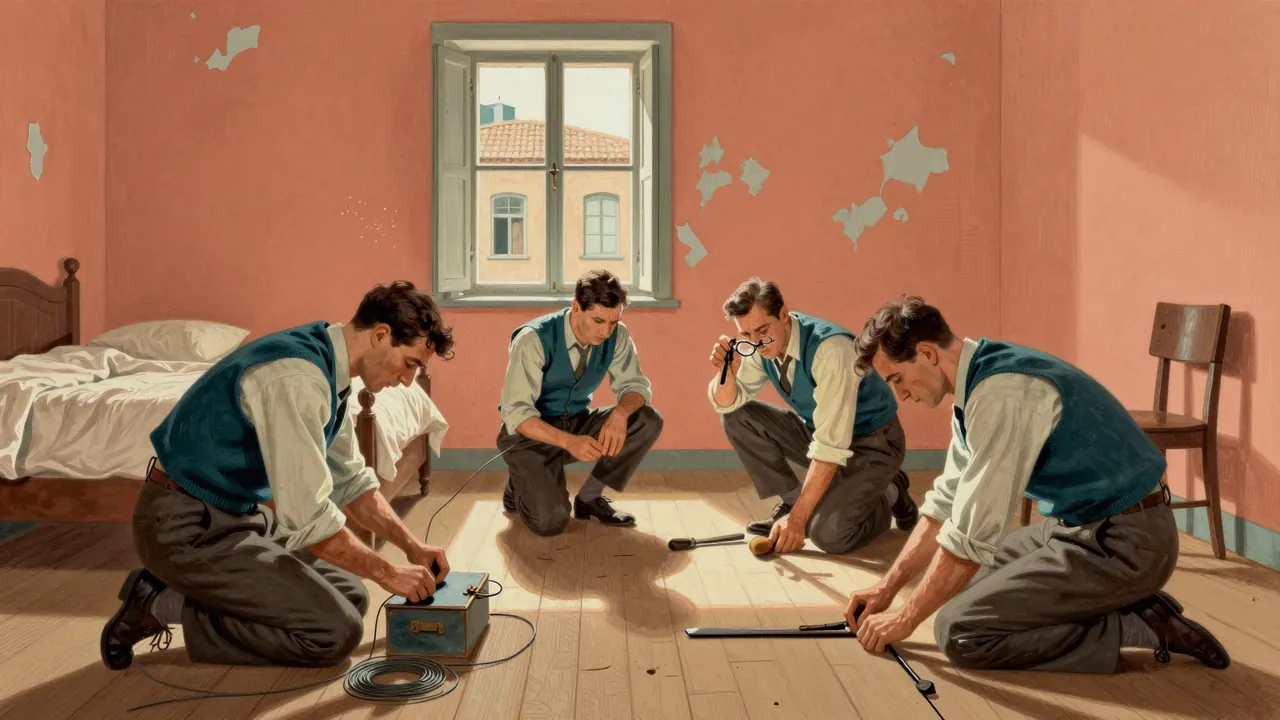
Big Deal on Madonna Street is a 1958 Italian heist film that sets out to parody both the solemnity of post-war crime thrillers and the social gravity of neorealism—not by mocking them, but by placing their formal rigour in the hands of people who lack the means, skill or discipline to pull off either. It treats burglary not as a test of nerve or intellect, but as an extension of everyday improvisation: a way for underemployed men in Rome’s marginal districts to negotiate poverty without dignity or leverage. Mario Monicelli directs it as if adapting a police report written by someone who keeps forgetting the suspects are human. The script—by Monicelli, Suso Cecchi d’Amico, Age & Scarpelli and Furio Scarpelli—builds its comedy from structural fidelity: every step of the plan follows logic, however flawed; every failure arises from material constraint, not whimsy. It does not ask the audience to laugh at incompetence so much as at the sheer, unrelenting friction between intention and circumstance. The film’s ambition is modest in scale but precise in aim: to show how systems—criminal, bureaucratic, domestic—collapse not from malice or chaos, but from the quiet weight of ordinary need. (158 words)
The structure
The story moves with the clipped, procedural rhythm of a failed audit: each stage of the heist is introduced, attempted, and undermined by a detail previously overlooked—Nicoletta quitting her job, the stove exploding, the rearranged furniture. Performances avoid caricature: Vittorio Gassman’s Cosimo is impatient and self-important but never cruel; Marcello Mastroianni’s Peppe is charmingly untrustworthy, not deceitful; Totò’s consultant appears only twice, delivering advice with the weary authority of a man who has seen too many bad plans. Gianni Di Venanzo’s cinematography refuses comic lighting—interiors are flat, grey, underexposed, shot on location in real Roman apartments and streets, giving the film the texture of a municipal survey. Piero Umiliani’s jazz score is light but never breezy; it underscores timing, not mood. Adriana Novelli’s editing sustains deadpan pacing, cutting away just before punchlines land. Dialogue was all post-dubbed, partly because several cast members were non-professionals or spoke the wrong dialect—a technical necessity that deepens the film’s sense of remove, of characters mediated, even to themselves. (159 words)
The timing
What lands is the cumulative weight of small, irreversible misjudgements: Tiberio stealing a camera he cannot operate, Dante the safe-cracker refusing to cross a parole line while handing over tools, Capannelle blowing up the stove not from clumsiness but from hunger. These are not gags but consequences—each one narrowing the margin for error until the final breach into the kitchen feels inevitable, not absurd. The film’s realism is what makes it funny: the characters speak in the rhythms of actual Roman street talk, not scripted banter; their motivations are narrow and local—dowries, baby formula, probation, a mother’s reputation. Even the title’s mistranslation—‘Madonna Street’ instead of ‘Via delle Madonne’—mirrors the film’s central joke: everyone is working from incomplete, second-hand information. The gang’s defeat is not humiliating but matter-of-fact, like a bus missing its stop. There is no moralising, no redemption arc, no last-minute reversal—just a newspaper item about pasta theft, filed and forgotten. That restraint gives the comedy durability: it does not depend on period detail or cultural reference, but on the universal experience of planning something carefully and watching it unravel for reasons you could not have predicted. (157 words)
The framing
What does not land is the framing device involving Cosimo’s imprisonment and release, which introduces narrative momentum the rest of the film deliberately avoids. His death by streetcar feels abrupt and tonally dissonant—not tragic, but narratively orphaned—cutting short a character whose bitterness might have anchored the group’s fracturing. Claudia Cardinale’s appearance, though historically notable, is functionally inert: her character exists only to be guarded, then vanish, and her dubbed Sicilian voice sits oddly against the otherwise grounded vocal textures. The subplot involving Mario’s courtship of Carmelina dissolves without consequence, leaving emotional threads untied. Some of the post-dubbing choices—particularly the mismatched regional inflections—create moments of unintentional distance rather than cohesion. And while the film’s refusal to romanticise poverty is admirable, its near-total exclusion of women beyond functional roles (maid, spinster, sister, wife in prison) begins to feel less like realism and more like a limitation of perspective, one that no amount of irony can fully offset. A viewer attuned to gendered labour or domestic power structures may find those omissions harder to overlook than the film intends. (156 words)
The ground
The themes that matter are not about crime, but about constraint: economic, spatial, linguistic, temporal. The gang works within boundaries they did not choose—the width of a wall, the duration of a weekly absence, the reach of parole conditions, the limits of a stolen lens. Their failures are not moral but infrastructural: they lack capital, training, time, and authoritative speech. The film treats poverty not as backdrop but as grammar—shaping syntax, dictating pace, determining who gets to speak and who must be dubbed. It also explores the quiet violence of respectability: Peppe’s probation, Dante’s parole, Cosimo’s fear of shaming his mother—all suggest that legality is less a code than a series of thresholds, most of which these men have already crossed, quietly, repeatedly. There is no nostalgia here, no lament for lost honour—only the steady pressure of having to make do. Even the jazz score, often read as light relief, functions as counterpoint: its syncopation mirrors the characters’ attempts to stay ahead of consequence, to improvise rhythm where none is given. The film’s enduring resonance lies in this: it shows how people rehearse agency in spaces where real control is unavailable. (154 words)
The fit
This film is for viewers who value precision over polish, dryness over dazzle, and structure over sentiment. It rewards attention to process—the way a plan accumulates dependencies, how dubbing alters presence, how location shooting fixes a story in brick and dust. It is not for those who require narrative payoff, emotional catharsis or clear moral orientation. Anyone expecting the kinetic energy of Rififi or the satirical bite of later caper films may find its tempo too deliberate, its stakes too low. A viewer who dislikes post-synchronised dialogue—or who finds the absence of female interiority a barrier to engagement—will likely disengage early. Those who respond to films where the joke is in the architecture, not the punchline, will find it rich. Its appeal is not broad but deep: it asks for patience with anticlimax, and repays it with a clarity few comedies achieve. To dismiss it as ‘quaint’ or ‘old-fashioned’ is to miss how rigorously it models the mechanics of futility. (159 words)
The finish
Yes, it is worth your evening—provided you watch it as a study in calibrated failure, not as escapism. Its 101 minutes pass without strain because nothing is overstated, nothing rushed, nothing explained. You do not need fluency in Italian cinema history to follow it, but you do need willingness to sit with unresolved tension and understated consequence. A viewer who prefers exposition, emotional signposting or visual flair may leave unsatisfied—but that is not a flaw in the film, it is a boundary of its design. The verdict would shift only if the film tried to do more: if it added sentiment, expanded its gendered scope, or softened its refusal of catharsis. As it stands, it remains exact, economical, and quietly devastating in its depiction of how little room there is for error when you begin with nothing. Its value is not in what it delivers, but in how honestly it measures the gap between intention and outcome. (158 words)