Neighbours, then not quite lovers
In the Mood for Love is set in 1962 Hong Kong and follows Chow Mo-wan, a newspaper editor played by Tony Leung, and Su Li-zhen, a secretary played by Maggie Cheung, who move into adjoining rooms on the same day and gradually work out that their respective spouses are having an affair with each other. Wong Kar-wai wrote and produced as well as directed, and the film became the second part of an informal trilogy either side of it, following Days of Being Wild and preceding 2046, sharing actors and a handful of unresolved plot threads between all three. Rather than dramatising the affair itself, the film sets out to watch two wronged people circle a relationship they keep insisting they will not let happen.
A script that kept changing shape
The project began under a different title, Summer in Beijing, conceived as a musical love story and partly shot without authorisation around Tiananmen Square before political sensitivities and Wong’s improvisational methods made a mainland shoot impractical. Wong had envisioned it as three linked stories; he kept only one, a strand then called A Story of Food about a man and woman sharing noodles and secrets, and relocated it to 1960s Hong Kong with Leung and Cheung already attached. The shoot ran fifteen months without a finished script, evolving as it went, and moved between locations standing in for a Hong Kong that had changed too much by 2000 to be filmed as itself: exteriors and hotel scenes in Bangkok, a later sequence in Singapore, and closing shots of Leung’s character at Angkor Wat.
Cheung’s cheongsams, Doyle’s replacement
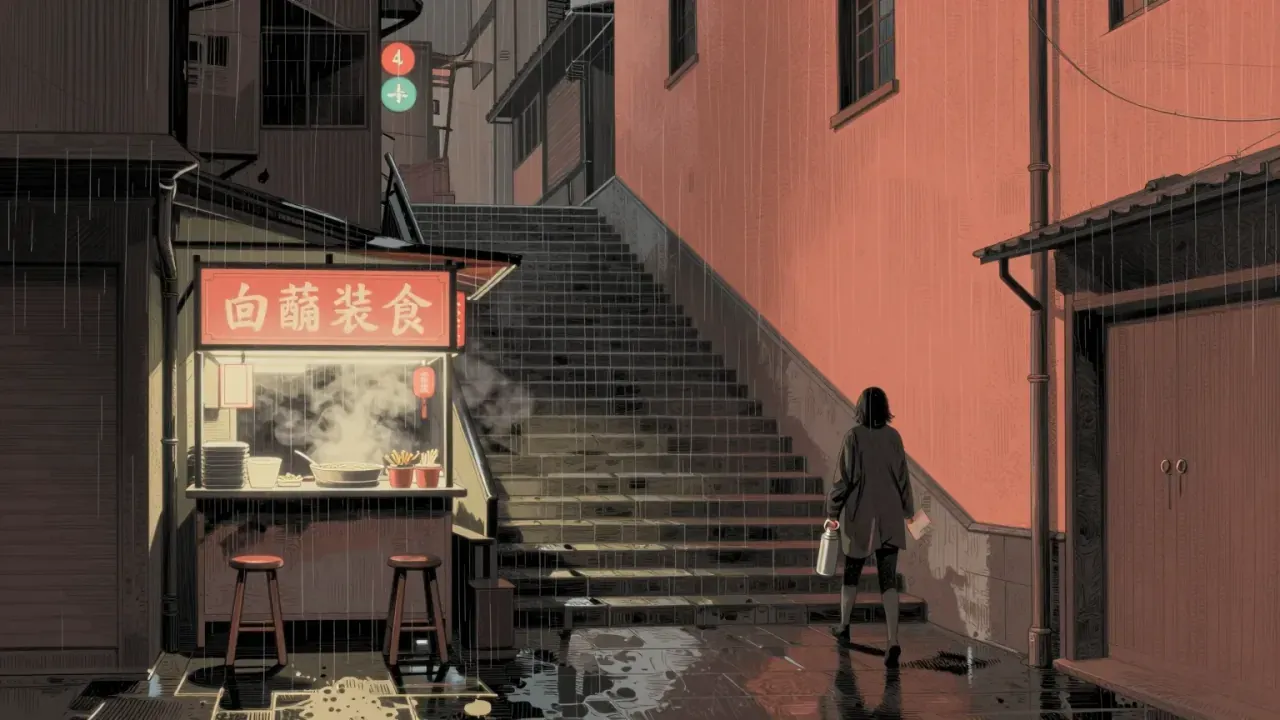
Cheung’s performance is inseparable from her wardrobe: William Chang, credited as editor but also responsible for costume and production design, put her in a different qipao for nearly every scene, and the dresses restrict her stride and posture by design rather than incident. Christopher Doyle, on his sixth collaboration with Wong, shot most of the film in tight corridors and stairwells that keep the two leads close but rarely alone together, before production ran over schedule and Mark Lee Ping Bin, known for his work with Hou Hsiao-hsien, finished the remaining photography. Shigeru Umebayashi’s waltz theme recurs over slow-motion passes of Su carrying noodles down the same stairwell, turning a single repeated errand into the film’s clearest expression of routine standing in for restraint.
Fifteen months, three cities
The film asks a viewer to accept that almost nothing happens between its two leads for most of its running time, and anyone expecting the relationship to become physical, or the story to resolve into a clear declaration either way, will find the ambiguity frustrating rather than poignant. Because the script evolved during shooting rather than being locked in advance, some connective material feels thin on close inspection, holding together more through mood and repetition than through causal plotting. The device of rehearsing confrontations with their unfaithful spouses, staged as if-then scenarios between Chow and Su, is effective the first few times but risks feeling like a structural crutch by its later repetitions, standing in for scenes the film otherwise declines to show.
What restraint is doing here
What the film is actually interested in is the gap between what two people feel and what they allow themselves to act on, given that acting on it would make them exactly what their spouses already are. Su’s qipao, ever more restrictive as the film continues, becomes a physical correlative for that self-denial, and the numbered rented rooms and shared landlady’s mahjong games place the affair-that-isn’t inside a community that would notice immediately if it became real. Longing here is treated as its own subject rather than a delay before consummation, and the film’s later detour into Cambodia, where Chow whispers a secret into a hole in a wall at Angkor Wat, extends that idea past the relationship itself into a meditation on what gets carried silently once the moment for saying it has passed.
Who this rewards
This suits viewers who are comfortable with a love story told mostly through glances, costume changes and repeated errands rather than confrontation or dialogue, and who find genuine tension in two people constantly almost saying something. It rewards attention to Doyle’s and Lee’s framing, to Chang’s editing rhythms, and to Cheung’s physical performance more than it rewards attention to plot. It is a poor match for anyone who wants the central relationship to become explicit, wants a resolved ending, or finds slow, repetitive editing tedious rather than hypnotic; the film’s pleasures are cumulative rather than immediate, and viewers looking for incident will likely find the pacing frustrating well before the final act arrives.
Ninety-eight minutes, fully earned
At 98 minutes it never overstays its restraint, and it delivered concretely for those involved: Tony Leung became the first Hong Kong actor to win the Cannes best actor award, and the film took eight prizes from eighteen nominations across other bodies, including Hong Kong Film Awards for both leads. Made on a comparatively modest run that returned 2.7 million dollars at the box office, its reputation has only grown since, reflected in the 92 percent Tomatometer and 87 Metacritic score it holds now, both well above what its quiet, incident-light premise might suggest on paper. It is worth a full, undistracted evening rather than background viewing, since its rewards depend on noticing what is withheld rather than what happens.