A Halloween king wanders into Christmas
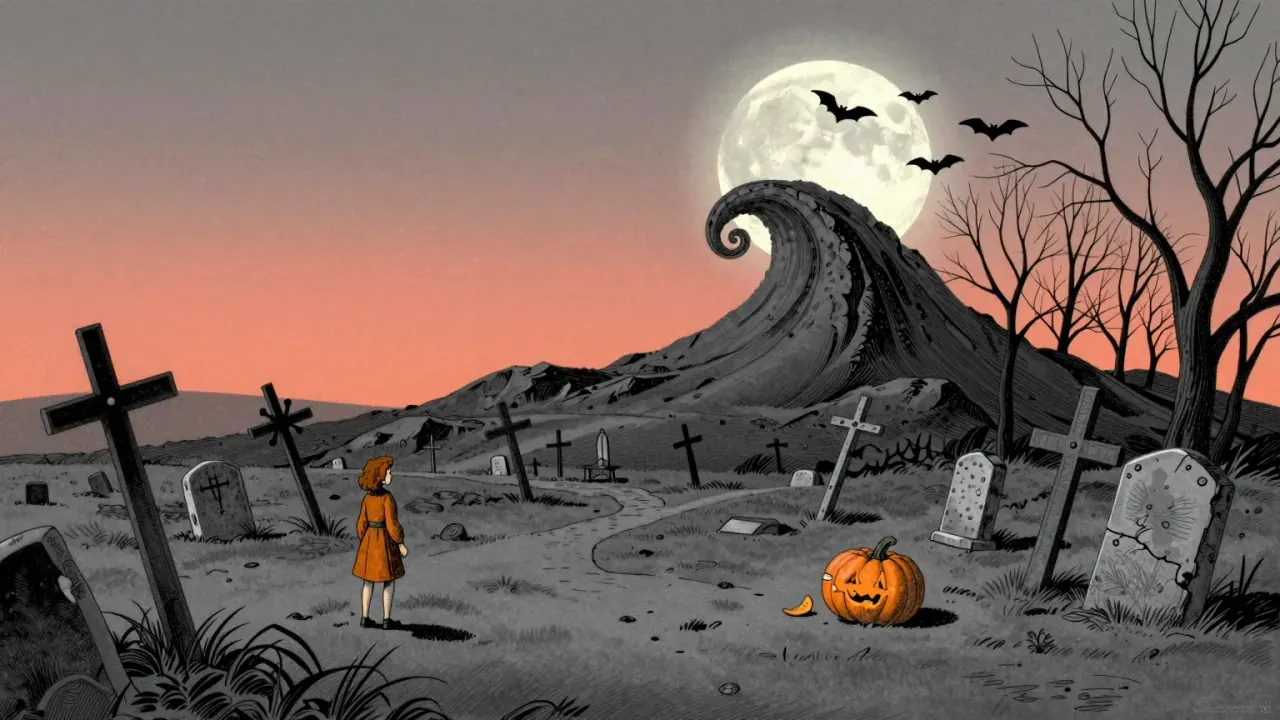
The Nightmare Before Christmas is a stop-motion musical built around a single premise: Jack Skellington, Halloween Town’s celebrated Pumpkin King, grows bored with his own specialty, wanders into neighbouring Christmas Town, and convinces himself he can run the holiday better than whoever already does. Henry Selick directed from a screenplay credited to Caroline Thompson, itself expanded from a three-page poem Tim Burton wrote in 1982 while employed as a Disney animator, a project the studio shelved for years as too strange for its usual audience. Burton returned to it only after Beetlejuice and Batman gave him enough leverage to get Disney to commit, though by then he was too tied up directing Batman Returns to take the job himself, handing directing duties to Selick instead.
A decade-old poem finally gets made
Selick ran production out of San Francisco with more than 120 crew members across twenty sound stages, ultimately shooting 109,440 frames for a seventy-three-minute film. The filmmakers built 227 puppets, giving Jack around four hundred interchangeable heads to cover his full range of expression and rigging Sally with ten distinct face types, each carrying eleven separate expressions, animated through a replacement method that swapped her whole face rather than just her mouth. Danny Elfman wrote both the score and all eleven songs and voiced Jack’s singing parts himself, calling the songwriting some of the easiest work of his career. Burton, occupied elsewhere with Batman Returns and Ed Wood, visited the San Francisco set only a handful of times over two years, leaving Selick to translate Burton’s sensibility into a finished film largely without him present.
Selick directs from San Francisco, Burton visits rarely
What lands is the sheer density of craft in the puppetry: Jack’s interchangeable heads let a single silent figure carry comic despair, manic enthusiasm and eventual regret without a line of dialogue changing, and Sally’s face-swap animation gives her a wistfulness the script itself barely writes for her. The production’s visual references, Ray Harryhausen’s creature work, Edward Gorey’s linework, German Expressionist shadow, are legible on screen rather than just claimed in interviews, and Halloween Town’s design commits to a genuinely unsettling scale that Christmas Town’s candy-cane brightness plays against effectively. Elfman’s songs carry structural weight too, moving the plot forward rather than pausing it, which is rarer in animated musicals than the genre’s reputation suggests it should be.
Two hundred and twenty-seven puppets, one for every mood
What doesn’t land as cleanly is everyone who isn’t Jack. Caroline Thompson is credited with the screenplay, but Selick has said only a handful of the finished film’s lines are actually hers, the result of constant rewriting during production; that patchwork shows in characters like Dr. Finkelstein and Oogie Boogie, who register as strong designs without matching depth of motivation. Sally, despite the animation resources spent on her face, is written mostly as an observer who loves Jack from a distance and worries about his plan without much power to alter it, which leaves the film’s only prominent female character short of real narrative agency compared with the puppet craft invested in her.
Disney hides its own name on the credits
The film’s real subject is dissatisfaction with mastery: Jack is Halloween Town’s most accomplished citizen and still finds the job hollow, which reads less as a holiday mash-up gag than as a portrait of ambition curdling into restlessness once a skill stops offering anything new to prove. Christmas Town and Halloween Town function as sealed, self-contained societies with their own logic and citizens, and Jack’s attempt to import one holiday’s methods into another exposes how little he actually understands about what he’s copying, only what it looks like from outside. His eventual return to Halloween is less a lesson learned than an acceptance that identity is built through specific, unglamorous work rather than adopted wholesale from someone else.
A story built for one character
This suits viewers who want stop-motion puppetry executed at a level of ambition rarely attempted since, fans of Burton and Selick’s shared aesthetic, and audiences happy to watch a musical commit fully to a genuinely gothic register rather than softening it for younger viewers. It’s a poor fit for very young children who find skeletal, shadow-heavy imagery upsetting rather than fun, and for anyone wanting more than one character to carry real dramatic weight, since Jack’s arc absorbs almost all of the film’s attention and leaves the supporting cast, Sally included, orbiting around him rather than acting independently. Seasonal timing matters too: the mash-up premise plays best watched near either Halloween or Christmas rather than at a random point in the year.
Worth seventy-three minutes and three decades of cult status
At seventy-three minutes, the film earned $75.1 million against a reported $18 million budget, an Academy Award nomination for Best Visual Effects that was a first for an animated feature, and, thirty years later in 2023, a place in the National Film Registry as culturally significant. Disney’s own hesitancy, releasing it under Touchstone rather than its main label out of fear the tone would scare off children, reads in hindsight as a studio underestimating exactly the audience that made the film a durable annual tradition rather than a one-season curiosity. Worth the evening for the puppetry and Elfman’s songs alone, and short enough that its single-character focus never overstays its welcome.