What it is trying to do
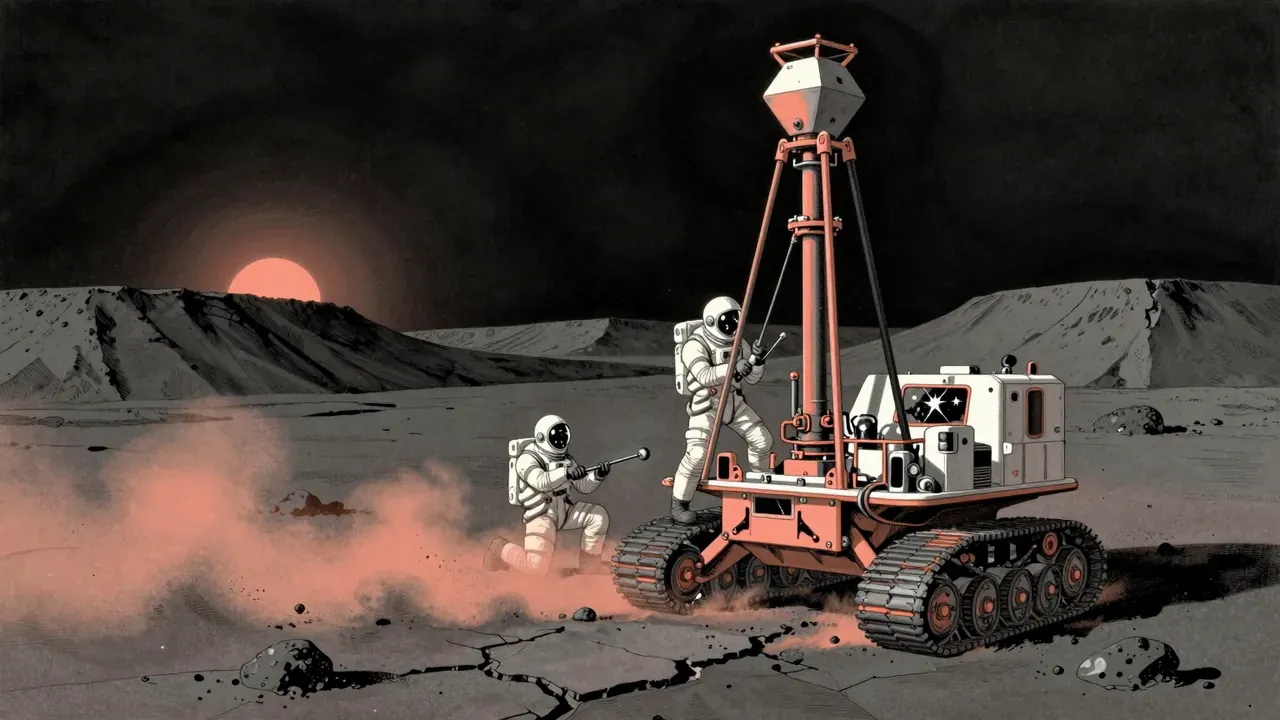
Armageddon is a 1998 American action film built around a singular, high-stakes premise: an asteroid the size of Texas hurtles toward Earth, and NASA recruits oil drillers to land on it, drill deep, and detonate a nuclear device. It aims not for scientific fidelity or psychological realism but for visceral, large-scale spectacle anchored in working-class heroism and sentimental stakes — specifically, the bond between a father and daughter, and the romance between that daughter and one of his crew. The film operates as a disaster procedural crossed with a military mission narrative, compressing training, launch, crisis, sacrifice and resolution into a tightly wound, emotionally amplified arc. Its ambition is structural and tonal: to make physics feel urgent, drilling feel heroic, and grief feel immediate — all while sustaining momentum across 151 minutes. It does not seek ambiguity or irony; its moral and emotional coordinates are fixed, legible, and repeated. It is less interested in what space is than in what it means to stand on something solid when everything else is falling apart.
How it works
The story follows a rigid cause-and-effect chain: threat identified, plan devised, team assembled, training compressed, mission launched, complications introduced, sacrifices made, climax resolved. Jonathan Hensleigh’s foundational script — later revised by Abrams, Gilroy, Salerno and others — prioritises escalation over nuance, giving each character a clear function (the gruff leader, the loyal friend, the cocky rookie, the grieving widow) rather than interiority. Performances lean into archetype: Ben Affleck projects earnest charm without subtext; Billy Bob Thornton delivers technical exposition with dry precision; Liv Tyler conveys sincerity without strain. John Schwartzman’s cinematography favours tight close-ups during dialogue and wide, kinetic tracking shots during action, often lit with high-contrast backlighting to heighten drama. Chris Lebenzon’s editing sustains rhythm through repetition — countdowns, radio check-ins, slow-motion leaps — rather than surprise. Trevor Rabin and Harry Gregson-Williams score the film with brass-heavy cues that cue emotion before it arrives. There is no misdirection, only reinforcement.
What lands
What lands most reliably is the film’s emotional grammar: the weight of a handshake, the gravity of a last look, the quiet dignity of men who know how to weld, weld under pressure, and weld in zero gravity. Scenes where characters articulate love or loyalty — Harry’s promise to Grace, Chick’s apology to his ex-wife, A.J.’s proposal — land because they are brief, unadorned, and placed at precise narrative pressure points. The visual language also works: the contrast between the grimy, grease-stained interiors of the drilling rig and the sterile, blue-lit corridors of NASA control creates a tangible class divide that the plot then bridges. The asteroid itself, though physically implausible, reads as a coherent, oppressive presence — vast, cratered, indifferent. Even the shuttle crashes and explosions follow a consistent logic of impact, debris, and consequence. The film’s pacing never stalls; every sequence serves either exposition, escalation, or catharsis, and it rarely asks the viewer to hold more than one emotional idea at once. That clarity is its greatest functional strength.
What does not
What does not land is any attempt at scientific coherence, psychological complexity, or tonal restraint. The film treats orbital mechanics, radiation exposure, and structural integrity as narrative conveniences rather than constraints — meteors strike cities with cartoonish precision, astronauts survive vacuum exposure long enough to deliver monologues, and the asteroid’s composition shifts to serve the next beat. Character motivations remain static: Harry Stamper opposes A.J. Frost solely to oppose him, with no evolution beyond reluctant acceptance. The ensemble cast, though large, receives uneven attention — Steve Buscemi and Owen Wilson register vividly in limited screen time, while Keith David and William Fichtner disappear mid-mission without narrative consequence. The film’s insistence on framing every technical problem as a test of masculinity leaves little room for doubt, dissent, or alternative expertise. Its emotional beats rely on repetition rather than development: Grace cries three times in identical close-up, each time to the same musical phrase. The result is not sincerity but ritual — effective in the moment, hollow on reflection.
The themes that matter
The themes that matter are duty as inheritance, competence as virtue, and sacrifice as continuity. Harry Stamper is defined by lineage — third-generation driller, father to Grace — and his authority rests not on rank but on accumulated skill and responsibility. The film elevates manual labour as the bedrock of civilisation: NASA cannot save the world without men who know how to read rock strata or weld titanium under pressure. This is not anti-intellectualism but a specific valuation: theory must be grounded, literally, in practice. The film also treats national identity as collective action — American engineers, Russian cosmonauts, French landmarks, Indian monuments — all absorbed into a single, apolitical emergency response. There is no critique of militarisation, corporate sponsorship (Touchstone Pictures), or state power; instead, institutions are presented as flawed but necessary vessels for human decency. Mortality is acknowledged, but only to affirm legacy: characters die so others may live, and their deaths are framed not as loss but as transfer — of knowledge, of love, of purpose. The film’s worldview is resolutely secular, pragmatic, and paternal.
Who should watch it
It is for viewers who value momentum over ambiguity, emotional clarity over psychological depth, and spectacle that serves story rather than substitutes for it. It suits those who respond to physical craft — welding, piloting, drilling — rendered with tactile specificity, and to narratives where moral choices are legible, consequences immediate, and stakes absolute. It is not for viewers who require internal consistency in physics or character, who find repetition emotionally numbing rather than reinforcing, or who expect genre films to interrogate the systems they depict. Those who dislike formulaic plotting, sentimental resolution, or the flattening of expertise into archetype will find little to engage them. A viewer who values irony, restraint, or historical context — say, the Cold War undercurrents of space co-operation — will likely feel the film’s omissions more acutely than its achievements. Change the budget’s scale or the studio’s marketing imperatives, and the film’s priorities would shift; as it stands, its virtues and flaws are inseparable.
Is it worth your evening
Yes, it is worth your evening — provided you approach it as a crafted object of its time and intent, not as a benchmark for realism or depth. Its 151 minutes pass without drag because every shot advances plot, character, or mood, and its emotional payoffs are earned within its own rules. You do not need to believe the asteroid is plausible to feel the weight of Harry’s final transmission, nor accept the science to admire how the camera holds on Ben Affleck’s face as he makes a choice. It rewards attention to craft: Schwartzman’s lighting, Lebenzon’s rhythm, Rabin’s percussive scoring. It is not a film that improves with distance or analysis, but one that functions precisely as designed — like a well-built drill bit, turning fast and true. Those who dismiss it as ‘just’ entertainment miss how much intention lies in its simplicity. Its endurance — in home-video sales, academic essays, and persistent cultural reference — suggests it fulfils something durable in the cinematic contract: to make magnitude feel personal, chaos feel choreographed, and sacrifice feel sacred.