A Studio Noir, Not a Copy
Rusty Knife is a 1958 Japanese drama film produced by Nikkatsu as part of its deliberate pivot toward noir-inflected crime narratives, modelled in part on American and French examples but rooted in postwar Japanese social tensions. It attempts to fuse the moral urgency of post-convict rehabilitation with the procedural tension of syndicate prosecution, using genre scaffolding to explore guilt that outlives punishment and justice that falters at institutional edges. The film does not disguise its debt to imported noir — the rain-slicked streets, the voiceover cadence, the tight framing — but it reorients those devices toward local conditions: the fragility of reintegration for ex-prisoners, the quiet complicity of officialdom, the way trauma calcifies into reflex. Its ambition lies not in stylistic novelty but in disciplined compression: ninety minutes devoted to one man’s suspended violence, one prosecutor’s stalled diligence, and the syndicate’s unblinking routine. It is a studio film with a thesis, not just a mood.
The Look of It
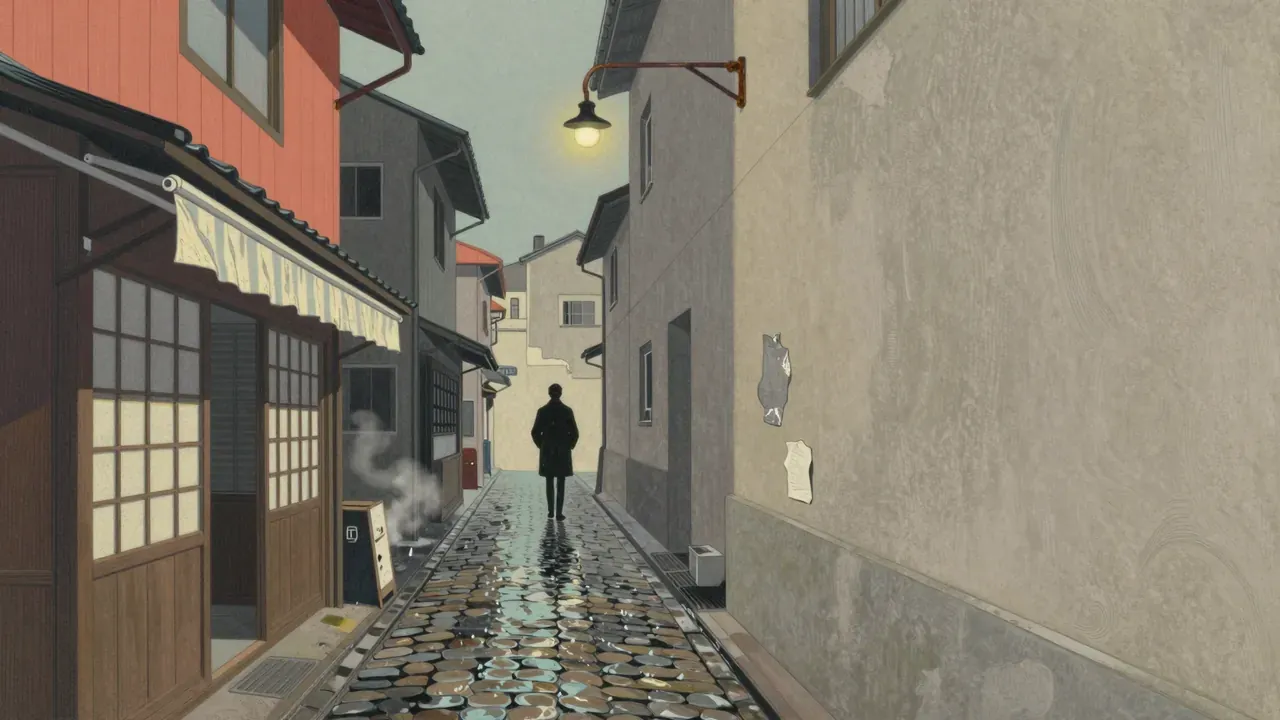
The story follows Yukihiko Tachibana’s return from prison and his slow, self-conscious resistance to vengeance, while District Attorney Karita gathers evidence against the same syndicate without ever quite closing the gap between suspicion and proof. Yūjirō Ishihara’s performance anchors the film: he moves with coiled stillness, his face registering fatigue more than fury, his pauses weighted with memory rather than menace. Joe Shishido’s Shimabara is all slippery charm and casual threat — no monologues, just glances that land like shoves. Masaru Sato’s score uses muted brass and percussive stabs, never swelling but always underscoring tension. Toshio Masuda directs with economy: interiors are shallow-focus and dimly lit, exteriors often shot from low angles that make alleyways feel like chutes. Editing is brisk but never frantic; cuts land on hands, doorways, cigarette smoke — details that accrue meaning across scenes. The script, by Shintarō Ishihara, avoids exposition, trusting silence and repetition — a repeated gesture, a line half-remembered — to carry psychological weight.
The Weight of Not Acting
What lands is the film’s refusal to resolve its central tension. Yukihiko does not kill, but neither does he walk away whole; Karita does not win, but neither does he surrender. That ambiguity is sustained through performance and pacing: Ishihara’s restraint makes every suppressed impulse legible, and Masuda holds shots just long enough for doubt to settle. The syndicate feels real because it operates without fanfare — no grand speeches, no ritualised violence, just quiet transactions and offhand intimidation. The supporting cast, particularly Mie Kitahara as Keiko and Masao Shimizu as the weary syndicate elder Mano, ground the film in lived consequence rather than plot mechanics. Even minor exchanges — a clerk refusing to file paperwork, a waiter delaying service — register as micro-resistances within a system too dense to dismantle. The film’s power lies in its accumulation of small, unheroic choices, each one narrowing the space between survival and complicity. It does not ask whether Yukihiko will snap, but whether endurance itself becomes another kind of surrender.
Where the Frame Falls Short
What does not land is the district attorney’s arc, which remains underdeveloped despite Shoji Yasui’s capable presence. Karita’s motivations stay vague — professional duty, personal grievance, or something else — and his investigative methods lack texture: we see documents signed, not how they were obtained. The legal process feels like a backdrop, not a counterpoint. Similarly, the romance between Yukihiko and Keiko lacks the specificity needed to make her role more than symbolic; their scenes together are tender but thin, offering emotional contrast without psychological depth. The film also struggles with its own genre logic: if the syndicate is as entrenched as shown, its vulnerability to Karita’s case feels unearned, and the final confrontation hinges on coincidence rather than consequence. These are not flaws of execution — the craft remains tight — but of structural balance. The film invests deeply in Yukihiko’s interiority, yet treats the world around him as either obstacle or atmosphere, never as equally contested terrain.
The Texture of Compromise
The themes that matter are the persistence of moral injury after formal punishment ends, the quiet architecture of impunity, and the difference between justice and retribution when both are out of reach. Rusty Knife treats guilt not as a state to be absolved but as a condition to be managed — like a chronic pain that dulls but never vanishes. It shows how institutions absorb dissent: Karita works within the law, yet his case stalls not from lack of evidence but from lack of political cover. The syndicate thrives not through brute force alone but through routinised erosion — of records, of testimony, of nerve. Even the title functions thematically: the knife is rusty, not broken — still dangerous, still capable of cutting, but dulled by time and disuse. This is not a film about catharsis but about calibration: how much violence is tolerable, how much silence is strategic, how much hope is prudent. It asks what integrity looks like when every available action carries compromise, and answers not with slogans but with Ishihara’s tired eyes holding the frame a beat too long.
Who It Is For, and Who It Is Not
This film is for viewers who value precision over propulsion — those who watch for how a glance shifts power, how a cut delays revelation, how silence thickens before speech. It rewards attention to gesture, to lighting ratios, to the weight of a pause. It is not for those who require clear moral binaries, narrative closure, or protagonists whose arcs bend toward redemption. Some may find its pace withholding, its ending unresolved, its politics implicit rather than argued. A viewer expecting the kinetic charge of A Colt Is My Passport or the operatic fatalism of Cruel Gun Story may leave impatient — Rusty Knife trades spectacle for scrutiny. What would change that verdict? A tighter integration of Karita’s procedural thread, or deeper investment in Keiko’s agency, might broaden its appeal without sacrificing rigour. But as it stands, its discipline is also its boundary: it assumes patience, and offers little incentive to those unwilling to grant it.
Is It Worth Your Evening?
Yes, it is worth your evening — provided you watch it as a study in restraint, not as a thriller waiting to ignite. Its ninety minutes unfold with the quiet insistence of a clock winding down, not racing forward. You will not leave exhilarated, but you may leave unsettled in a precise, useful way: reminded how little room there is between vigilance and exhaustion, between justice and inertia. Those who dislike ambiguity or demand catharsis will find it frustrating, and rightly so — this is not a film that accommodates impatience. Its value lies in its fidelity to a specific, unglamorous truth: that some wounds do not scar, they calcify; some systems do not crack, they constrict. To dismiss it as ‘slow’ mistakes tempo for intention. To call it ‘dated’ ignores how thoroughly its questions — about accountability without recourse, about dignity without recognition — remain current. It earns its time by refusing to waste a single frame.