A device that lets you watch someone else dream
Paprika is Satoshi Kon’s fourth and final finished feature, released in Japan in November 2006 and adapted from Yasutaka Tsutsui’s 1993 novel, with Kon co-writing the screenplay alongside Seishi Minakami. It imagines a device called the DC Mini that lets a therapist enter a patient’s dreams, then asks what happens once three prototypes are stolen and used to attack people while they sleep. Kon is less interested in solving that theft as a mystery than in using it as a pretext to keep sliding the film between registers, so that a scene that looks like a police interrogation can turn, without a cut you could point to and name, into somebody’s nightmare instead.
Two women sharing one mind
Dr. Atsuko Chiba, the lead researcher on the DC Mini project alongside its inventor Kosaku Tokita, investigates the theft through official channels at the research institute while secretly using the device herself, under the alias Paprika, to counsel patients including a haunted detective named Konakawa outside her clinic. Kon and Minakami keep both identities voiced by the same actress, Megumi Hayashibara, and the film never signals a switch between them with a music cue or a framing device the way a more cautious script would bother to. Editor Takeshi Seyama’s cutting compresses the gap between a line spoken in the waking world and its echo inside a dream, which is where most of the film’s disorientation actually originates, rather than from the theft plot itself.
A parade that eats the frame
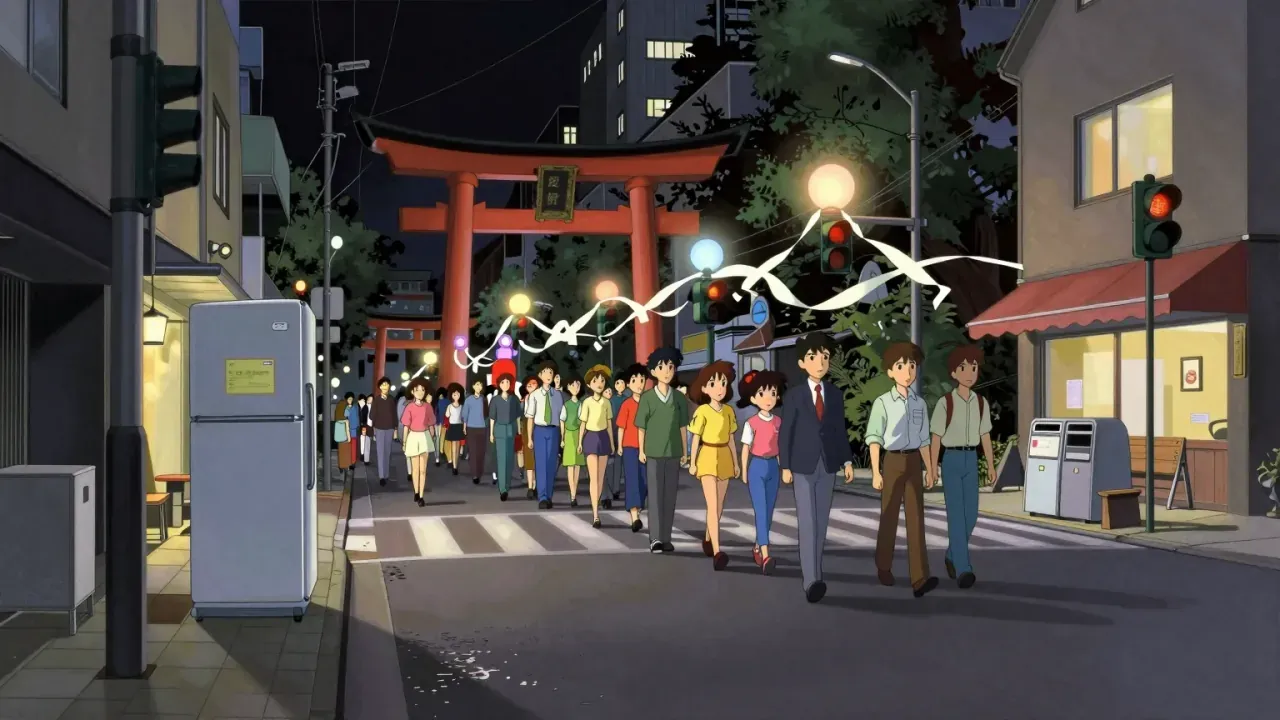
The film’s strongest sustained image is a parade: a procession of marching household appliances, frogs, dolls, telephone booths and cheering figures that starts inside one scientist’s collapsed mind and gradually breaks into the film’s supposedly real Tokyo streets, swallowing pedestrians and storefronts as it grows in scale across several minutes. It works because Kon has already trained the audience, over the previous half hour of unmarked transitions, to expect any given scene might secretly be someone’s dream, so the moment the parade actually crosses into what had been presented as daytime traffic lands as a genuine violation of the film’s rules rather than a cheap visual twist.
A villain’s motive stated once and then dropped
The villain’s stated reason for sabotaging the DC Mini, chairman Seijiro Inui’s belief that dreaming needs to be protected from human tampering and technological interference, is spoken once in a boardroom scene early on and then never returned to with any real weight or follow-through. Kon is plainly more absorbed by what the device can do to the film’s images than by what his antagonist’s politics might mean, and the story’s back half resolves the chairman’s scheme mechanically, through a physical confrontation between Paprika and his accomplice Osanai, rather than through anything that actually engages with his professed belief about dreams needing a guardian.
Boundaries that do not hold
Kon had spent his two previous features, Perfect Blue and Millennium Actress, worrying at the same seam: how a person’s sense of which version of their life counts as real can come apart under pressure from performance, media coverage or unreliable memory. Paprika removes the metaphor and makes the seam literal, since the DC Mini physically wires one person’s inner life into another’s, which is why detective Konakawa’s recurring dream about an unsolved case, and his own former colleague, functions simultaneously as therapy session, confession and plot device without the film ever needing to pick just one of those functions and commit to it.
Who this rewards
This suits viewers who already enjoy animation willing to abandon strict continuity for the sake of effect, along with anyone curious about Kon’s documented influence on later films and filmmakers who have borrowed his unmarked dream-logic transitions. It will frustrate anyone who wants the theft investigation to carry as much weight as the imagery built around it, or who regards a villain’s motive delivered in a single scene and then dropped as a structural weakness in the screenplay rather than a defensible stylistic choice on Kon’s part. Newcomers to anime who want an easy entry point may also find the constant identity-swapping harder going than the film’s short runtime suggests.
Ninety minutes, no waste
At ninety minutes, produced over roughly two and a half years on a budget of around 300 million yen, Paprika does not have room to become tedious even when its internal logic gets away from it, and Susumu Hirasawa’s score, built in part around one of the earliest film uses of Vocaloid vocals recorded through an Amiga computer, gives the parade sequence and the climax a propulsion the screenplay’s looser plotting does not always earn on its own terms. It rewards watching twice, once to be genuinely disoriented and once to see exactly how that disorientation was constructed, which is a reasonable trade for a single evening’s attention.