Leaving Disney to prove a point
The Secret of NIMH follows Mrs. Brisby, a widowed field mouse whose home is about to be destroyed by a farmer’s plough just as her son falls seriously ill, forcing her to seek help from a colony of rats who escaped a research laboratory years earlier with enhanced intelligence. Don Bluth directed the film as his first feature, having left Disney’s animation department in September 1979 along with eleven colleagues, frustrated in part by the studio’s unwillingness to greenlight the source novel and by what they saw as a broader decline in the craft standards Disney’s own feature animation once represented. Made through their new independent studio in partnership with Aurora Productions, the film had a budget of $7 million and thirty months to complete.
A story Disney turned down twice
Robert C. O’Brien’s novel Mrs. Frisby and the Rats of NIMH had reportedly been offered to Disney as early as 1972 and turned down. Bluth himself pitched it a second time to Disney director Wolfgang Reitherman, who rejected it, pointing out the studio already had a mouse in Mickey and had recently made a similar rodent-themed film in The Rescuers. It took a former Disney executive, James L. Stewart, founding Aurora Productions and acquiring the rights independently, to finally get the project moving, giving Bluth’s new studio a tighter budget and schedule than Disney features typically received.
Magic added to a story that didn’t have any
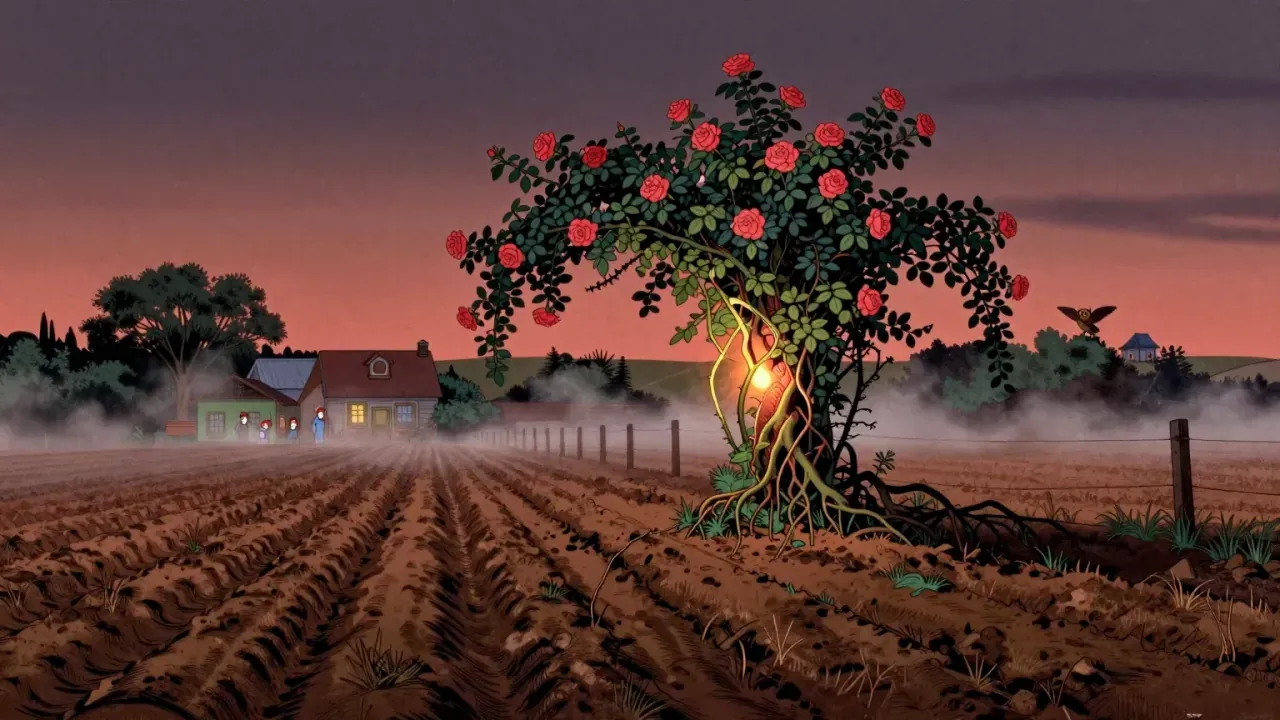
Bluth added elements with no basis in O’Brien’s novel, most notably a magic amulet given to Mrs. Brisby that represents her inner courage, and reworked the rat leader Nicodemus into an explicit wizard figure to deepen the sense of mystery around the colony’s origins. Bluth has said he believed animation specifically called for some sense of magic to achieve a fully fantastic quality, a philosophy that shaped several of these additions. The visual result leans considerably darker and more atmospheric than most animated features of the period, with the underground rat colony rendered in shadow and glowing light rather than the brighter palettes typical of family animation at the time.
A trademark dispute that forced a name change
Partway through post-production, toy company Wham-O objected to the character’s name, Mrs. Frisby, as too close to their trademarked Frisbee, forcing a change to Mrs. Brisby after voice recording had already been completed. That required re-recording some lines and, in the case of actor John Carradine, who had become unavailable, editing existing recordings to swap the sound of the letter F for a B rather than bringing him back in. It’s a small, almost accidental production detail, but it illustrates how much last-minute problem-solving went into finishing the film on Aurora’s tight schedule.
Courage built through action, not rescue
Where O’Brien’s novel has the rats rescue Mrs. Brisby’s children directly, the film changes the ending so that she saves them herself using the amulet, without the rats’ direct intervention — a deliberate choice by Bluth to keep the emotional stakes centred on her own growth rather than letting outside help resolve the story for her. That shift reframes the whole film’s idea of courage: rather than being protected by more powerful allies, Mrs. Brisby has to act on her own initiative when it matters most, which gives the resolution more weight than a straightforward rescue would have.
Who this is for
This suits older children and adults who want an animated film willing to sit in genuine darkness and tension rather than softening every threat, and anyone curious about American animation being made seriously outside the major studios in this period will find plenty to admire in the craft on display throughout. It’s a harder recommendation for very young or easily frightened viewers, since the film’s tone, visual style and stakes are considerably heavier than most family animation of its era, closer in mood to a fantasy adventure than a typical children’s cartoon of the same vintage.
Is it worth the evening
The film earned a Saturn Award for Best Animated Film and turned only a modest profit in theatres, grossing $10.1 million against its $7 million budget before finding a stronger audience through home video and international release; it currently holds 93% on Rotten Tomatoes and 76 on Metacritic. Those numbers understate how influential the film became for a generation of animators who saw it as proof that hand-drawn animation could carry real darkness and craft ambition outside a major studio’s resources. Worth the evening, particularly for anyone who assumes animation from this period was uniformly lighter than what this film actually attempts.