A briefcase, a killer, and a sheriff behind both
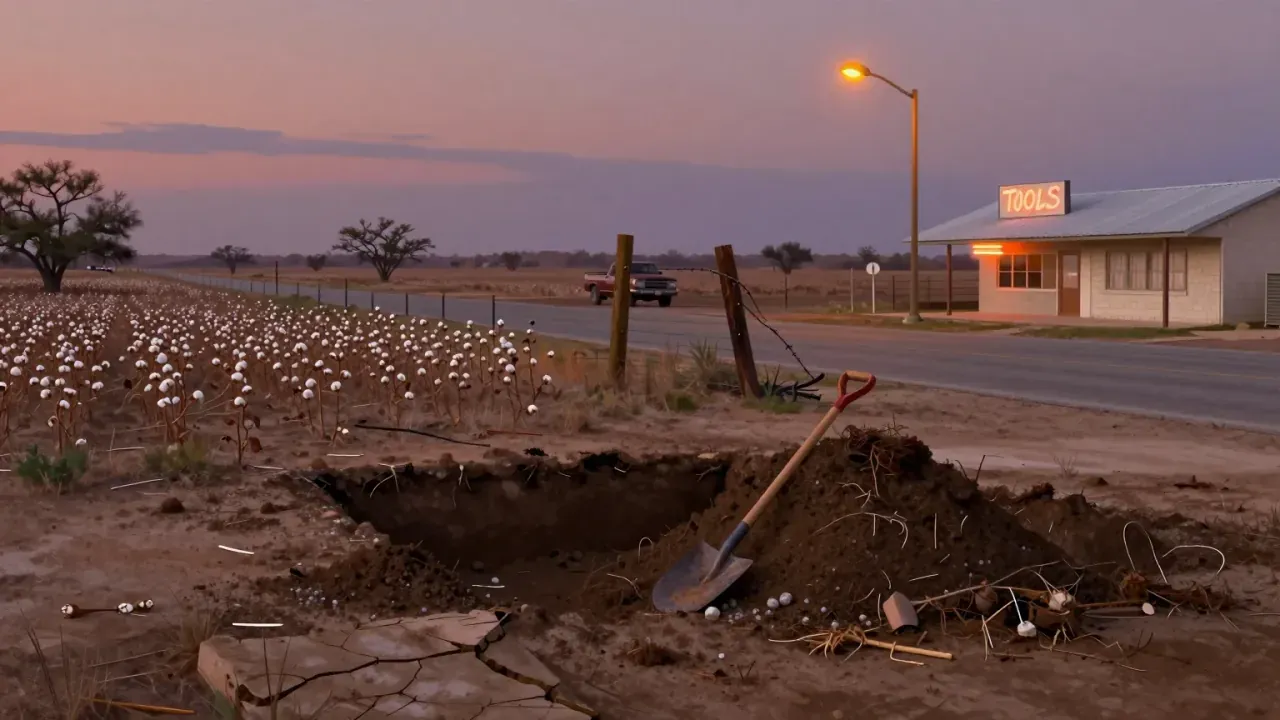
No Country for Old Men follows three people across the same stretch of 1980 West Texas desert: Llewelyn Moss, a welder and Vietnam veteran who stumbles on two million dollars left behind after a drug deal turns into a massacre; Anton Chigurh, the hitman sent to recover it; and Ed Tom Bell, the county sheriff investigating a body count neither he nor his methods are equipped to keep up with. Joel and Ethan Coen adapt Cormac McCarthy’s 2005 novel, their second McCarthy adaptation after considering an earlier project, and keep close to its structure and dialogue. Rather than build toward a conventional confrontation between hunter and hunted, the film is constructed to keep Moss and Chigurh, and eventually Bell, running parallel tracks that rarely intersect directly.
Faithful to McCarthy, sparing with words
The Coens have said their process involved one of them typing while the other held the novel open, and the adaptation shows: large stretches of dialogue come almost verbatim from McCarthy, and the script trims mainly for compression rather than invention. Roger Deakins’s cinematography, which won the film’s Academy Award, uses wide desert shots and long silences to do work that dialogue would otherwise carry, letting the audience read danger in empty motel corridors and open highway before anything happens in them. Javier Bardem, who won Best Supporting Actor, plays Chigurh with a flat, unhurried line delivery and a signature weapon, a captive bolt pistol, that turns ordinary doors and locks into instruments of horror. Josh Brolin, initially uneasy about how little dialogue Moss is given, compensates with physical performance instead.
The scene the genre trained you to expect never comes
The clearest departure from thriller convention is structural: the film builds every expectation that Moss and Chigurh will meet in a final confrontation and then declines to give it to you, killing Moss off-screen between scenes rather than in a staged showdown. That choice, faithful to the novel, reframes the entire film retroactively as being about the impossibility of outrunning Chigurh rather than a contest that might go either way. Carter Burwell’s score is used so sparingly that its absence becomes part of the tension; entire sequences, including a hotel-room standoff scored only by footsteps and a beeping tracking device, run without music at all. The effect is a thriller that keeps redirecting its own suspense away from the scenes genre habit trains you to expect.
Bell’s narration, thinned but present
In McCarthy’s novel, Bell’s first-person narration opens every chapter and carries much of the book’s meditation on how the world has changed around him; the film keeps his opening monologue but distributes the rest of that interiority thinly across scenes, which means Tommy Lee Jones’s performance has to carry weight the source material handed to prose. Some of the novel’s material about Bell’s lost daughter Deborah disappears entirely. Kelly Macdonald’s Carla Jean, given more agency in her final scene with Chigurh than her counterpart in the book, still exits the story largely off-screen, and the film’s very last stretch, Bell’s retirement and a dream about his father, will read to some as a deflating comedown after the violence preceding it, even though it is the novel’s actual ending.
Fate versus choice on a stretch of desert road
The film’s engine is a question about whether anything happening here is a matter of justice, chance, or neither. Chigurh’s coin flips, offered to strangers as a decision about whether they live, dramatise a worldview in which morality has been replaced by a colder, indifferent mechanism, and the film never lets Bell, or the audience, land a counter-argument that actually holds. Bell’s exhaustion and eventual retirement read as an admission that the world he’s paid to police no longer runs on rules he recognises. The title, drawn from Yeats, points at generational displacement more than crime specifically: this is a film about a man who no longer belongs to the country he’s supposed to be protecting.
Who should watch this one
This suits viewers who want a thriller willing to withhold its genre’s usual payoffs, and anyone drawn to sustained dread over incident. Fans of Deakins’s landscape work and of understated, non-theatrical villainy in Bardem’s mould will find both here in full. It rewards attentiveness to structure and silence rather than plot mechanics, and it’s a strong entry point for anyone curious how faithfully the Coens can translate a specific prose style to screen. It’s a poor match for anyone who needs a climactic confrontation to feel a film has paid off its tension, or who finds off-screen violence, including a major character’s death, a cheat rather than a choice.
An evening that ends without the ending you wanted
At 122 minutes, the film moves briskly for something this contemplative, and its refusal to give Moss and Chigurh their expected final scene remains a genuinely bold structural choice more than fifteen years on. Bardem’s performance and Deakins’s photography alone justify the evening, and the film rewards a second viewing once you know where the tension is actually headed. It won’t satisfy anyone looking for closure, since Bell’s final monologue offers reflection rather than resolution, but as a demonstration of a thriller that trusts silence and structure over spectacle, it holds up as one of the strongest such experiments of its decade.