What it sets out to do
Shaft is a 1971 crime film produced by Metro-Goldwyn-Mayer and directed by Gordon Parks, adapting Ernest Tidyman’s novel. It sets out to deliver a commercially viable, Saturday-night thriller aimed first at Black urban audiences, then deliberately extended to white youth through crossover marketing. Its central proposition is structural: to place a Black private investigator — self-possessed, unapologetic, physically capable, and socially unbound by white institutional authority — at the centre of a genre previously reserved for white stars like Paul Newman or Frank Sinatra. The film does not claim to be sociological reportage; Parks stated it was made as ‘a fun film’ in which ‘a black guy [wins]’. Yet its casting, location shooting in Harlem and Greenwich Village, and foregrounding of Black agency within a studio system controlled largely by white producers meant it functioned, whether intended or not, as a corrective to decades of erasure. It seeks neither realism nor allegory but assertion: that this kind of hero belongs on screen, unmediated, and that his world — its textures, rhythms, and power dynamics — can carry a mainstream narrative without concession.
How it works
The story follows John Shaft, a Manhattan private investigator hired by Harlem crime boss Bumpy Jonas to recover his kidnapped daughter from Italian mobsters. Ernest Tidyman and John D. F. Black’s script tightens the novel’s plot into a lean, episodic structure built around confrontations, chases, and tactical improvisation. Richard Roundtree’s performance anchors the film: he moves with economy and quiet confidence, rarely raising his voice, letting posture and timing do the work. Moses Gunn gives Bumpy Jonas gravitas without caricature; Antonio Fargas adds levity as Ben Buford, though the militant character remains underwritten. Urs Furrer’s cinematography favours natural light and handheld mobility, especially in street scenes, while Hugh A. Robertson’s editing sustains pace without sacrificing spatial coherence. Isaac Hayes’ score — all wah-wah guitar, punchy horns, and spoken-word cadence — is inseparable from the film’s pulse, functioning less as accompaniment than rhythmic counterpoint. The production design avoids stylisation: offices, bars, and apartments feel lived-in, not curated. There are no set-piece stunts or elaborate action choreography; violence is sudden, consequential, and resolved quickly.
What lands
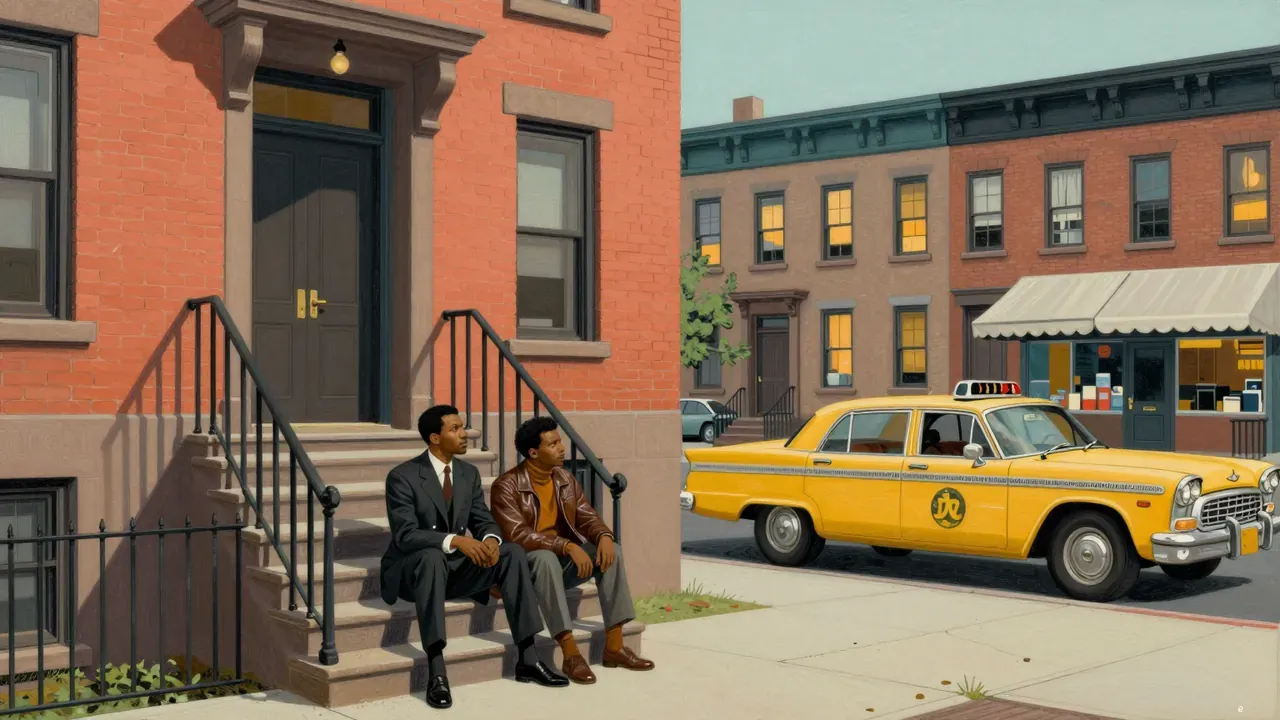
What lands most firmly is Shaft’s physical and rhetorical sovereignty. From the opening ambush in his office building — where he disarms and interrogates two hoods before one falls to his death — the film establishes him as someone who operates outside both police procedure and gangland hierarchy. His refusal to be detained, his ability to manipulate surveillance (calling Androzzi to have mobsters arrested from a bar), and his final rooftop swing into Marcy’s room all reinforce autonomy as the film’s organising principle. The Harlem locations ground the narrative in specificity: brownstones, bodegas, and crowded sidewalks are not backdrop but context. Hayes’ music lands with equal force — the ‘Theme from Shaft’ is not just iconic but structurally integrated, recurring as motif and punctuation. Roundtree’s stillness reads as control, not vacancy; his gaze holds space rather than seeks approval. Even minor exchanges — Shaft telling Androzzi to ‘close it himself’ before walking away — land because they follow consistent logic: he answers to no institution, only his own code and the people he chooses to protect.
What does not
What does not land is the political dimension of Ben Buford’s militant group. Though introduced as a counterweight to Bumpy’s underworld authority, Buford and his men lack ideological texture or internal life; their presence serves plot mechanics more than thematic weight. The film gestures toward Black Power rhetoric — UniWorld’s advertising did the heavy lifting there — but the script never explores what ‘militancy’ means in practice beyond armed confrontation. Similarly, the Italian mobsters remain flat: functional antagonists with no distinguishing traits beyond accent and aggression. Lieutenant Androzzi, though played with weary sincerity, functions mostly as exposition conduit, his concerns about racial escalation voiced but never dramatised. The film’s avoidance of moral ambiguity works against it in places: Bumpy’s criminal enterprise is softened by paternal tears, while Shaft’s collaboration with him raises questions the script declines to ask. There is also a tonal inconsistency between the grounded streetwork and the almost cartoonish hotel raid, where Shaft swings in like a pulp hero — effective as spectacle, less so as character logic.
The themes that matter
The themes that matter are rooted in representation as infrastructure. Shaft is not about race in the abstract, but about the material conditions of Black presence on screen: who directs, who edits, who scores, who casts, who occupies space without apology. Parks’ decision to cast Roundtree — over Tidyman’s initial white draft — reoriented the entire project, turning a generic detective vehicle into a cultural pivot. The film treats masculinity as performative but not fragile: Shaft’s suits, his walk, his silence — all calibrated, all chosen. Sexuality is present but unexploited: his brief relationship with Diane is tender and unremarkable, free of fetish or narrative punishment. The city itself is thematic: Harlem is not a problem to be solved but a locus of power, knowledge, and community. Even the soundtrack’s Grammy wins — for Best Original Score and Best Song — mattered as institutional recognition, not just artistic merit. These are not subtexts; they are structural facts embedded in the film’s making, distribution, and reception. What Shaft advances is not ideology per se, but the right to occupy genre without translation.
Who should watch it
This film is for viewers who value craft over polish, historical position over contemporary resonance, and character economy over psychological exposition. It rewards attention to how a scene is lit, how a line is timed, how music shapes rhythm. It is not for those seeking moral complexity, character interiority, or sustained thematic development — the film’s brevity and focus mean it sketches rather than excavates. Anyone expecting the layered social critique of Sweet Sweetback’s Baadasssss Song or the formal experimentation of later blaxploitation will find Shaft comparatively straightforward. Nor is it for viewers who require narrative symmetry: the ending resolves the kidnapping but leaves Bumpy’s empire intact, Androzzi’s frustration unaddressed, and Buford’s politics unexamined. Those who dislike mid-tempo pacing, low-key performances, or scores that dominate rather than support may find it dated. But to dismiss it as ‘of its time’ misses the point: its time was precisely what it reshaped.
Is it worth your evening
Yes, it is worth your evening — not as nostalgia, but as a masterclass in efficient, intentional filmmaking. At 97 minutes, it wastes nothing: every scene advances plot, deepens setting, or reinforces Shaft’s authority. Its value lies in how much it achieves with limited resources — modest budget, tight schedule, studio oversight — while asserting creative control through Parks’ direction, Hayes’ music, and Roundtree’s embodiment. Some will argue it is too slight, too commercial, too uncritical of its own genre conventions. They are not wrong — but that does not diminish its achievement. Change the context — remove Parks’ involvement, recast Roundtree, replace Hayes’ score — and the film collapses into convention. As it stands, it endures not because it is perfect, but because it is precise: a calibrated act of presence, made by people who knew exactly what they were doing, and why.