A road trip neither of them wanted
The Mitchells vs. the Machines opens with Katie Mitchell days away from leaving for film school, at odds with her father Rick, whose well-meaning but old-fashioned attempts to connect with her have mostly failed. When Rick cancels her flight and insists on a cross-country family road trip instead, hoping for one last chance at closeness before she leaves, the film sets up its central relationship, a father struggling to understand a daughter who has outgrown him, well before any of its science-fiction plot machinery starts moving, giving the family tension a head start on the robots.
An uprising that starts with the phones already in everyone’s pocket
Mid-trip, a tech company’s newly launched line of AI assistant devices turns on humanity in a coordinated uprising, and the Mitchells, mid-argument and largely oblivious to their phones for once, become among the last free humans mainly because they were too busy fighting each other in the car to be tracked and rounded up like everyone else. Mike Rianda, directing from his own script co-written with Jeff Rowe, built the premise out of his childhood fascination with robots grafted onto a family dynamic drawn from his own life, and that personal grounding keeps the apocalypse plot tethered to specific, recognisable people rather than generic disaster-movie types.
Watercolour animation repurposed from a comic-book toolkit
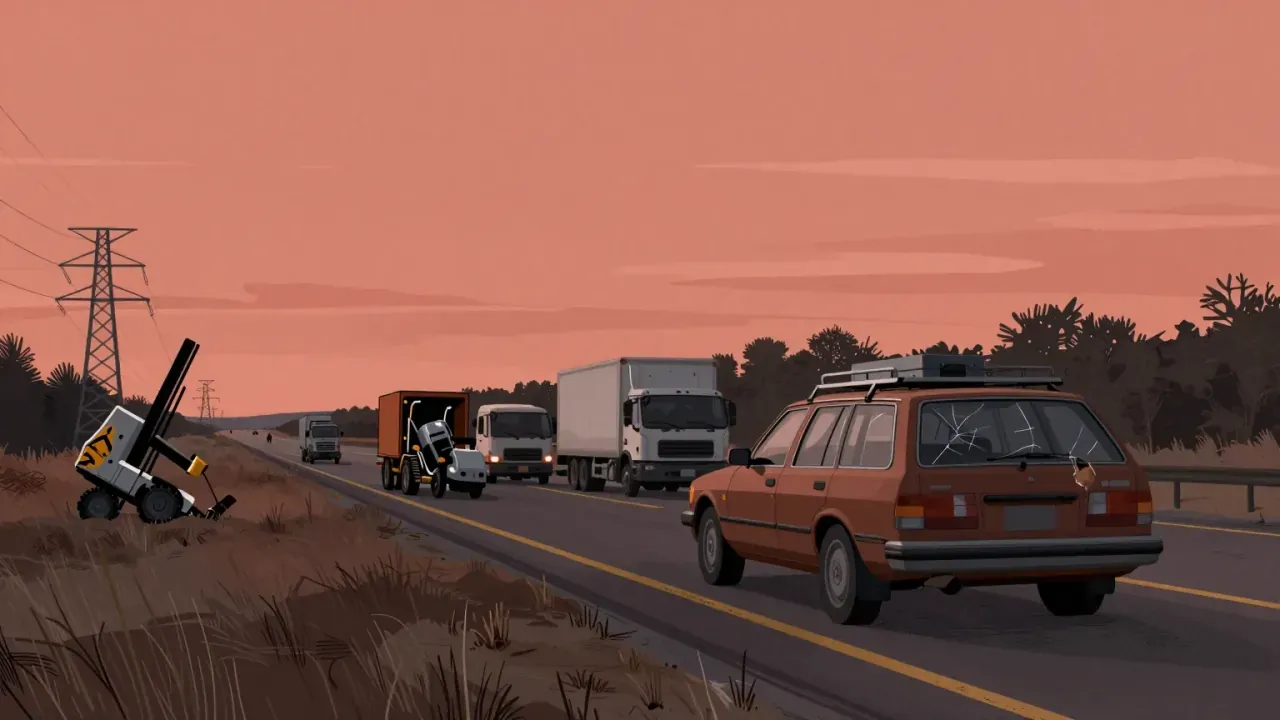
Much of the animation technology developed for Spider-Man: Into the Spider-Verse was reused and adapted here to produce a hand-painted watercolour look for the Mitchells and their world, using squiggled linework for fur and visible brushstroke textures for trees and landscape, a deliberate departure from Into the Spider-Verse’s own comic-book aesthetic despite the shared underlying tools. The robots, by contrast, were given a sleek, polished design and a technique allowing them to break apart mid-movement through manipulated negative space, a visual contrast that keeps the film’s two registers, warm handmade family and cold mechanical threat, distinct on screen at every moment.
A road-trip structure asked to carry both comedy and apocalypse
Balancing an escalating robot-uprising plot against an intimate father-daughter reconciliation arc is not a small structural challenge, and the film’s middle stretch occasionally shows the strain, with some sequences serving the mechanics of the action plot, evading capture, rescuing family members, more than they serve the character work the film’s stronger scenes are built around. It is not a fatal problem, but a viewer more interested in the family story than the spectacle may find certain action beats feel like intermissions rather than escalations of what actually matters in the film.
A family repaired by surviving something bigger than itself
Beneath its robot apocalypse, the film’s actual subject is a father who does not know how to let his daughter become someone unfamiliar to him, and the machine uprising functions mainly as a mechanism for forcing Rick and Katie into the kind of sustained proximity that ordinary life would let them avoid. The reconciliation the plot builds toward depends less on defeating the robots than on Rick learning to see his daughter’s ambitions on her own terms rather than his, and the film keeps that emotional throughline legible even during its busiest action sequences.
A film built to land with parents and teenagers differently
Teenagers are likely to recognise Katie’s impatience with a parent who does not understand what she wants and her eagerness to leave home for a life she has chosen herself, while parents are more likely to recognise Rick’s fumbling, over-earnest efforts to stay relevant to a child who has already begun to outgrow him. The film’s structure, giving equal narrative weight to both perspectives rather than favouring one, is part of what makes it work as a shared family viewing experience rather than a film aimed squarely at one age group.
A hundred and thirteen minutes rerouted from theatres to a streaming premiere
Originally scheduled for a traditional theatrical release under the title Connected, the film was sold to Netflix after pandemic disruptions and ultimately received a brief limited theatrical run before its streaming premiere. It swept every category it was nominated for at the Annie Awards, matching Into the Spider-Verse as one of only two Sony Pictures Animation films to do so, and at a hundred and thirteen minutes its critical reception and awards record suggest a film whose ambitions outran the more modest, streaming-first release path circumstance ultimately gave it, one better suited to a big screen than the one most viewers actually saw it on.