A society with a rulebook Miles never agreed to
Spider-Man: Across the Spider-Verse continues Miles Morales’s story after Into the Spider-Verse, sending him alongside Gwen Stacy into contact with the Spider-Society, a task force of alternate Spider-People led by Miguel O’Hara who believe certain personal tragedies are load-bearing events that must occur in every universe to prevent reality from collapsing. Before settling on that premise, directors Joaquim Dos Santos, Kemp Powers and Justin K. Thompson and screenwriters Phil Lord, Christopher Miller and David Callaham decided the story needed to be, at its core, about the tension between being a son and being a Spider-Man, and built the plot around Miles’s refusal to accept a fate the Society insists is non-negotiable.
Six universes, six art styles, one crew of a thousand
The film assembled roughly a thousand crew members, at the time the largest crew ever used on an animated feature, to give six separate universes Miles visits their own distinct animation style rather than a single unified look. Daniel Pemberton’s score shifts registers to match, while the production designed roughly 240 characters across the film’s various dimensions, a scale that let the filmmakers stage entire sequences, such as a chase through Mumbattan or the crumbling architecture of a universe under active collapse, as showcases for animation techniques unrelated to whatever style the previous scene used.
Where the scale actually serves the story
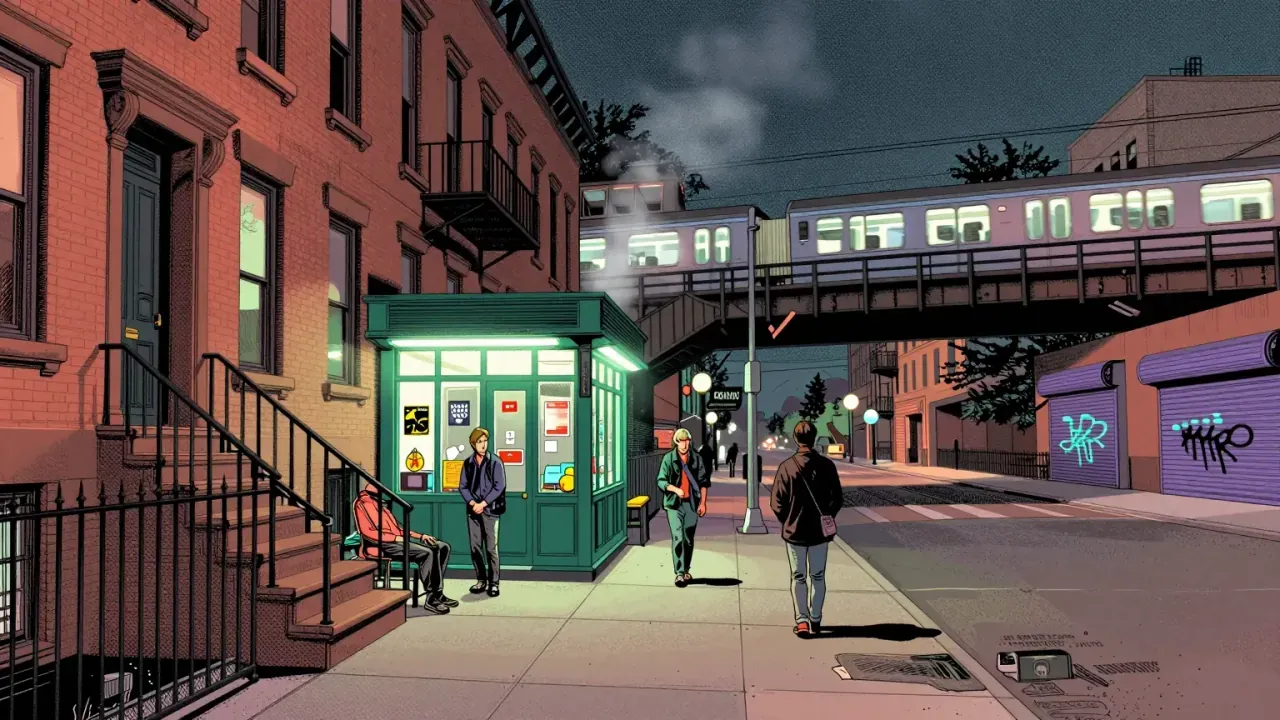
That visual range does real narrative work rather than existing purely as spectacle: Miles’s own Brooklyn, rendered with the same graffiti-and-halftone texture as the first film, reads as scrappy and improvised next to the Spider-Society’s gleaming, over-engineered headquarters, so the clash between Miles and Miguel plays out visually before either character says a word about it. Hailee Steinfeld’s Gwen Stacy gets a comparable treatment, her own universe painted in shifting watercolour that tracks her emotional state scene to scene. At two hours and twenty minutes, the film uses its length to let each universe register as a genuinely different place rather than a quick backdrop change.
A cliffhanger built into the structure
The film was written and shot back to back with its sequel, Beyond the Spider-Verse, and it shows: the story ends mid-confrontation rather than at a natural resolution point, a structural gamble that some viewers will read as bold serialised storytelling and others will experience simply as an incomplete film. With 240 characters populating six universes, several Spider-People introduced with visual flourish get little more than a cameo’s worth of screen time, and the pacing occasionally strains under the sheer number of concepts, cameos and universes competing for space inside one film.
Fate, family, and who gets to choose
Underneath the spectacle, the film is making an argument about authorship over your own life: the Spider-Society treats certain deaths as statistically necessary to preserve the multiverse’s stability, and Miles’s refusal to accept that his father’s death is owed to some larger structural need becomes the film’s real conflict, more than any single supervillain fight. That question of fate versus choice runs through Gwen’s parallel estrangement from her own father, giving the film’s family theme a second, quieter throughline alongside Miles’s more public rebellion. The multiverse conceit, in other words, is used to dramatise a fairly ordinary adolescent question — how much of your life is actually yours to decide — at continent-spanning scale.
Who this is for
This is built for viewers who already have some investment in Miles Morales’s story from the first film, and for animation audiences who want to see genuinely different visual languages coexisting inside one movie rather than a single consistent house style. It rewards patience with an unresolved ending, since the story is explicitly the first half of a larger arc. It is a weaker fit for anyone who wants a complete story by the credits, or for viewers already tired of multiverse plotting as a device across recent big-budget releases.
Worth the two hours twenty
Yes. Grossing over $690 million worldwide and becoming the highest-grossing film Sony Pictures Animation has released, the film backed up its ambition commercially as well as critically, winning Best Animated Feature at the Annie, Critics’ Choice and other major industry awards. Its scale, unprecedented for an animated film at the time of release, was put to use making a specific argument about individual agency rather than simply multiplying spectacle for its own sake. The unresolved ending is a real cost, but two hours and twenty minutes spent inside six distinct, fully realised visual worlds is time well spent regardless.