A bite, a death, and an untrained inheritance
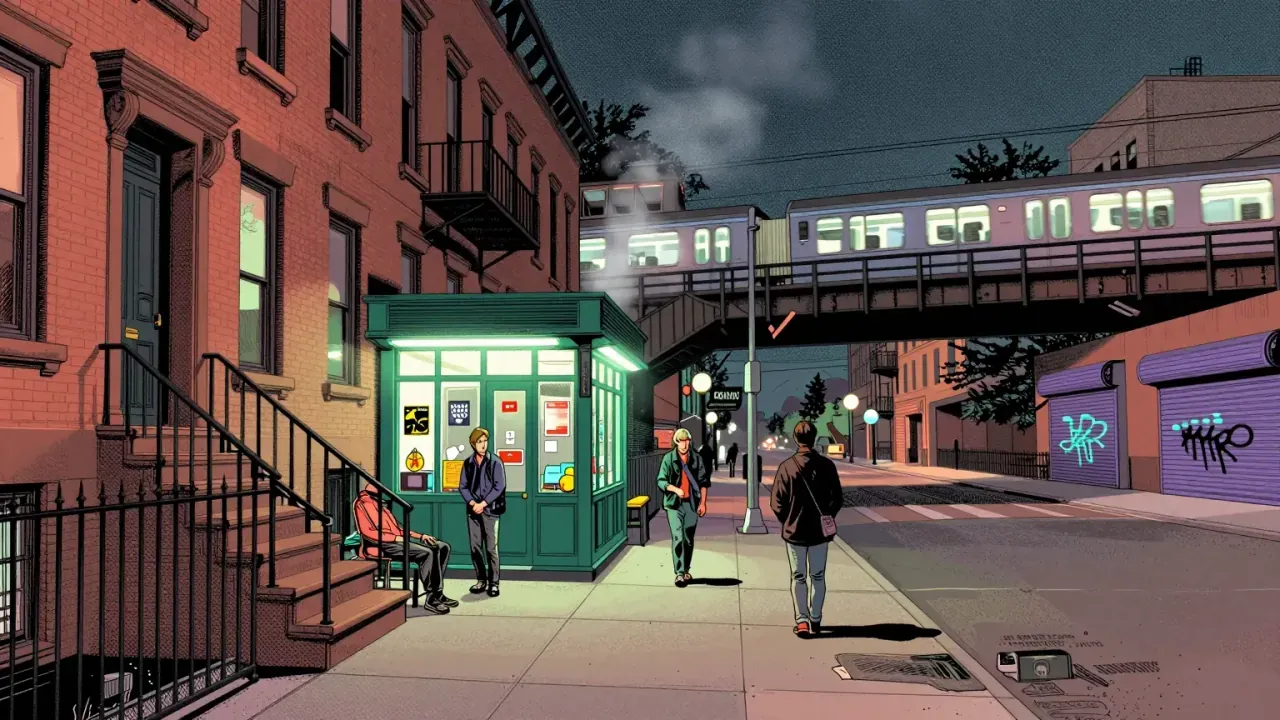
Into the Spider-Verse gives Miles Morales, a Brooklyn teenager attending a new school he did not choose, the same radioactive spider bite that made Peter Parker Spider-Man, but strips away the thing that made Peter’s origin manageable: a mentor. Peter is killed by Kingpin partway through the film’s first act, leaving Miles with powers he does not understand and no one to teach him how to use them. Phil Lord and Christopher Miller pushed specifically to adapt Miles’s comic-book storyline as the foundation, describing it as an origin story about a young person figuring out who they want to be, rather than another retelling of the same white college-age Peter Parker story six prior films had already told.
Five more Spider-People fall through a hole in reality
Kingpin’s supercollider, built to tear open access to parallel universes in pursuit of his own family, accidentally pulls five alternate Spider-People into Miles’s world, including an older, overweight, divorced alternate Peter Parker who becomes Miles’s reluctant mentor precisely because he is not the confident hero Miles expected. The ensemble also includes Gwen Stacy’s Spider-Woman, a noir-styled Spider-Man Noir, the cartoonish Peter Porker, and the anime-inflected Peni Parker, and the film’s plot mechanics, getting everyone home before the collider destroys Brooklyn, give each of them a functional reason to be there rather than treating the crossover as a mere gimmick.
Animation built to look printed rather than rendered
Sony Pictures Animation assembled its largest crew ever for the production specifically to execute a visual technique combining full three-dimensional computer animation with hand-drawn comic elements, halftone dot patterns, printed linework, and deliberately inconsistent frame rates between characters, built to make the film resemble an inked and printed comic page rather than the smooth, uniform look typical of CG animation. This was a directed technical choice rather than a stylistic flourish layered on afterward, drawing explicitly on the work of Miles Morales co-creator Sara Pichelli, and it required animators to essentially reinvent parts of the standard CG pipeline to achieve.
A script that earns its ensemble instead of just casting it
The first full cut of storyboards and animatics ran over two hours, unusually long for an animated feature, largely from directors Lord and Miller’s approach of loading in every idea they could at the outset before cutting down. A year before release, the writers substantially rewrote the third act specifically to keep six separate Spider-People and their competing arcs from crowding out Miles’s own story, which needed to remain the film’s actual centre rather than one thread among equals. That discipline, cutting material that had already been boarded and animated, is why the ensemble reads as purposeful rather than merely crowded on screen.
The joke that is also the structure
Each alternate Spider-Person carries a distinct visual and tonal register, film noir shading for Spider-Man Noir, black-and-white cartoon physics for Peter Porker, anime staging for Peni Parker, and the film uses the collision of these styles for comedy that never loses track of the underlying plot mechanics. It is a structural joke as much as a visual one: six different genres of superhero story occupying the same frame, each commenting on the conventions of the others, and the film trusts the audience to follow tonal shifts that a more cautious production would have smoothed out.
A film that works for newcomers and for people who know six Spider-Man films already
No familiarity with earlier Spider-Man films is required to follow the plot, and the film works as a self-contained origin story for viewers who have never seen a Spider-Man movie before, superhero fans and non-fans alike. But it also carries a running commentary on six prior live-action films, the well-worn beats it is deliberately avoiding, that lands with extra weight for anyone who has sat through those films and recognises exactly which conventions are being skipped or subverted, making it a rare superhero film that rewards both newcomers and the genre-fatigued in noticeably different ways at once.
A hundred and sixteen minutes that changed what an animated blockbuster could look like
At a hundred and sixteen minutes, Into the Spider-Verse grossed nearly four hundred million dollars against a ninety-million-dollar budget and won the Academy Award for Best Animated Feature, and its visual technique has visibly influenced animation production since, well beyond its own sequels. It is worth the evening for the craft on its own terms, independent of any interest in the character or the superhero genre generally, since what the film accomplishes technically and structurally holds up regardless of how tired a viewer might otherwise be of Spider-Man as a subject.