The premise
The Matrix is a science-fiction thriller set in a near-future where human perception is indistinguishable from machine-generated simulation. It attempts to fuse philosophical inquiry — on reality, control, and self-determination — with visceral, choreographed action. Its central device is the ‘red pill’ choice: to accept a grim but true world over a comfortable illusion. The film does not treat this as metaphor alone; it builds its plot, visuals, and character arcs around the literalisation of that dilemma. It seeks to make abstraction tactile: the weight of gravity, the recoil of gunfire, the strain of muscle under wire suspension all serve the idea that liberation begins with bodily awareness. It is not a film about ideas dressed in action, but one in which action is the argument — where Neo’s learning to bend the rules of physics mirrors the audience’s recalibration of what cinema can show and how it can mean. The Wachowskis treat genre not as container but as grammar: every chase, bullet-dodge, and training sequence advances the thesis that perception is malleable, and therefore political.
The movement
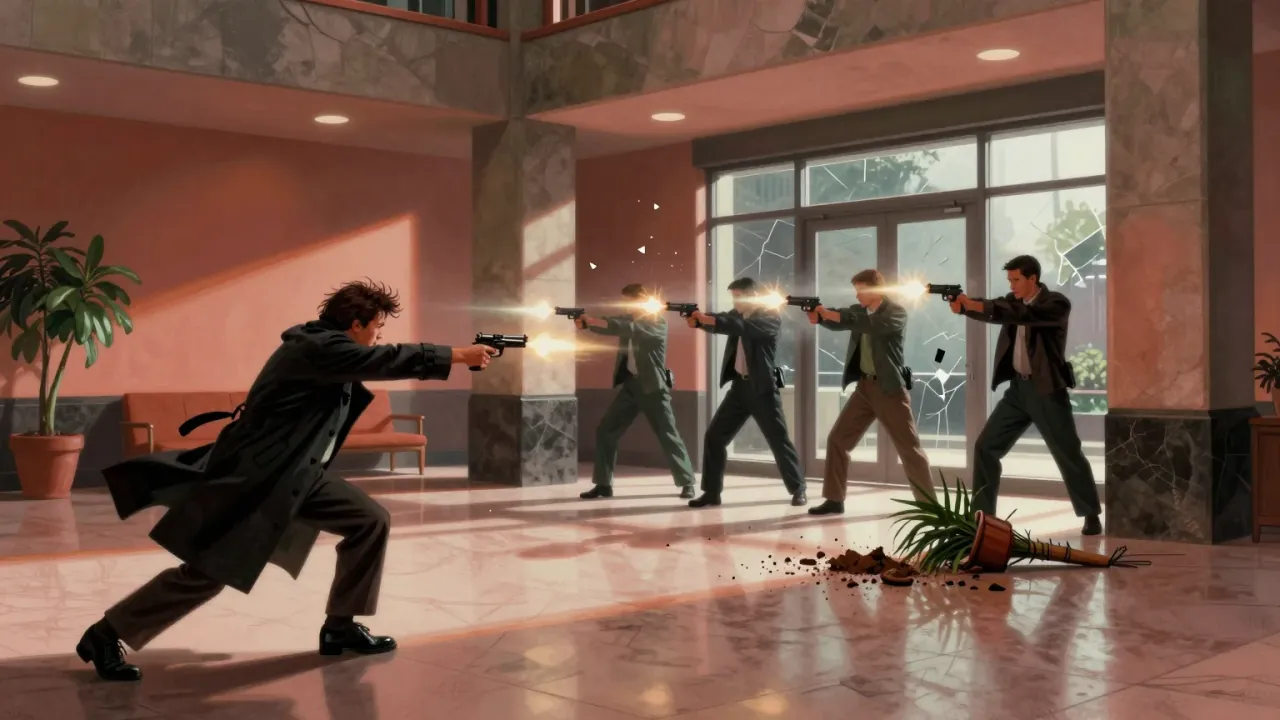
The story follows Neo’s transition from disaffected software coder to awakened insurgent, guided by Morpheus and challenged by Trinity and the Agents. Laurence Fishburne gives Morpheus gravitas without sermonising; Carrie-Anne Moss makes Trinity both precise and emotionally anchored; Keanu Reeves grounds Neo’s arc in quiet disbelief before resolve. Bill Pope’s cinematography uses high-contrast, green-tinted interiors and desaturated cityscapes to distinguish layers of reality, while Zach Staenberg’s editing stitches fight sequences into rhythmic, percussive units — notably the lobby shootout, where cuts land like punches. Don Davis’s score blends orchestral tension with industrial textures, avoiding leitmotif in favour of atmosphere. Yuen Woo-ping’s choreography treats bodies as instruments of cognition: every kick, parry, and mid-air twist is legible as thought made kinetic. The ‘bullet time’ effect is not spectacle for its own sake — it is camera movement calibrated to Neo’s dawning agency, the frame holding still while perception accelerates.
The look of it
What lands is the coherence between concept and execution: the film’s visual language never contradicts its philosophy. The green tint, the slow-motion dodges, the mirrored surfaces, even the monochrome Zion scenes — all reinforce the core distinction between simulation and source. The action sequences land because they are built on consistent physical logic: characters train, tire, bruise, and adapt. Trinity’s opening rooftop escape feels earned because Moss performs it herself, and the camera stays close enough to register effort. The interrogation scene works not for its exposition but for its spatial claustrophobia and Fishburne’s measured delivery — he doesn’t explain the Matrix so much as inhabit its weight. The Oracle’s kitchen scene lands because it replaces prophecy with observation, making mysticism feel like applied psychology. Even minor details — the repeated motif of mirrors, the use of telephone booths as portals, the way Agents move with uncanny synchrony — accumulate meaning without exposition. This is a film where design choices are arguments, not decorations.
The voice
What does not land is the dialogue in exposition-heavy passages, particularly when characters articulate philosophical premises aloud. Lines about ‘the desert of the real’ or ‘the power of choice’ sit awkwardly in mouths that otherwise speak with restraint. Some supporting performances — notably Hugo Weaving’s Agent Smith — lean too hard into theatrical menace, risking camp where ambiguity would serve better. The film’s reliance on binary oppositions (real/simulated, free/enslaved, awake/asleep) leaves little room for moral gradation or lived contradiction; characters rarely doubt their own certainty, and dissent within the resistance is absent. The pacing sags in the second act’s exposition dumps — the construct, the training montage, the Oracle’s apartment — where momentum yields to lecture. The world-building remains deliberately thin beyond its central conceit: we learn almost nothing of how the machines sustain themselves, or why humans were farmed for heat rather than energy more efficiently. These are not oversights, but limits of scope — the film chooses focus over breadth, and sometimes that focus feels narrow.
The idea
The themes that matter are perception as infrastructure, freedom as embodied practice, and rebellion as epistemic rupture. The film treats reality not as a given but as a maintained system — one enforced by habit, interface design, and sensory feedback loops. Its critique of late-capitalist alienation is implicit: Neo’s cubicle job, his insomnia, his search for meaning online all prefigure his awakening. The red pill is not just truth but responsibility — once you see the architecture of control, you cannot unsee it. The film also treats knowledge as kinetic: Neo does not understand kung fu through study but through neural upload and repetition, suggesting that cognition is inseparable from somatic memory. Religious allusion — messianic framing, resurrection imagery, sacrificial structure — serves this theme, not theology: it is about the shape of transformation, not doctrine. What endures is the film’s insistence that liberation begins not with ideology but with attention — noticing the glitches, questioning the interface, testing the edges of the frame.
The audience
It is for viewers who respond to formal rigour — those who watch films to feel how image, sound, and movement cohere into meaning — and for anyone who has ever questioned the stability of their own perceptual ground. It rewards patience with exposition and tolerance for stylised dialogue. It is not for viewers who require psychological realism in character motivation, or who find philosophical scaffolding distracting when it interrupts narrative flow. Those who dislike action as syntax — who prefer fights to resolve character rather than express cognition — may find the choreography abstract. Viewers expecting satire or irony will be disappointed: the film takes its stakes seriously. Anyone put off by green colour grading, wire work, or early-CGI textures may find the aesthetic dated. But its formal ambition remains intact: remove the bullet time or the dojo scene and the film collapses inward. Its value lies in that integration — not in isolation, but in how each element answers the others.
The timing
Yes, it is worth your evening — not as nostalgia, but as a working model of how genre cinema can hold complex ideas without diluting them. Its 136 minutes pass with cumulative force because every scene serves the central question: what do you do when you realise your senses are curated? That question has only sharpened since 1999, as interfaces multiply and attention becomes contested infrastructure. The film’s urgency is not historical but structural: it shows how systems of control become invisible not through secrecy but through saturation. Someone who finds its pacing archaic or its metaphysics reductive might prefer David Cronenberg’s eXistenZ or Alex Garland’s Ex Machina — films that treat simulation with more ambiguity and less certainty. But for those willing to meet it on its terms — as a fable built from craft, not commentary — The Matrix remains singular: a thriller whose thrills are cognitive, whose action is argumentative, and whose ending is not resolution but readiness.