The silence of it
City Lights is a silent romantic comedy-drama released in 1931, made after the arrival of sound cinema but deliberately refusing spoken dialogue. Chaplin conceived it as a self-contained world where gesture, timing, and musical underscoring carry narrative and emotional weight. It aims to reconcile the Tramp’s social invisibility with profound moral visibility — to make kindness legible without words, and tenderness legible without exposition. The film tests whether a character defined by marginality can anchor a story built on reciprocity: between sight and blindness, wealth and destitution, memory and recognition. Its ambition is not technical novelty but structural fidelity — to sustain emotional logic across 87 minutes using only intertitles, physical performance, and a composed score. It does not argue for silence as nostalgia; it treats silence as a medium with its own grammar, one Chaplin had spent two decades refining. The film’s opening — a city unveiling a statue, the Tramp asleep atop it — establishes this immediately: dignity and absurdity are inseparable, and neither requires speech to land.
The look of it
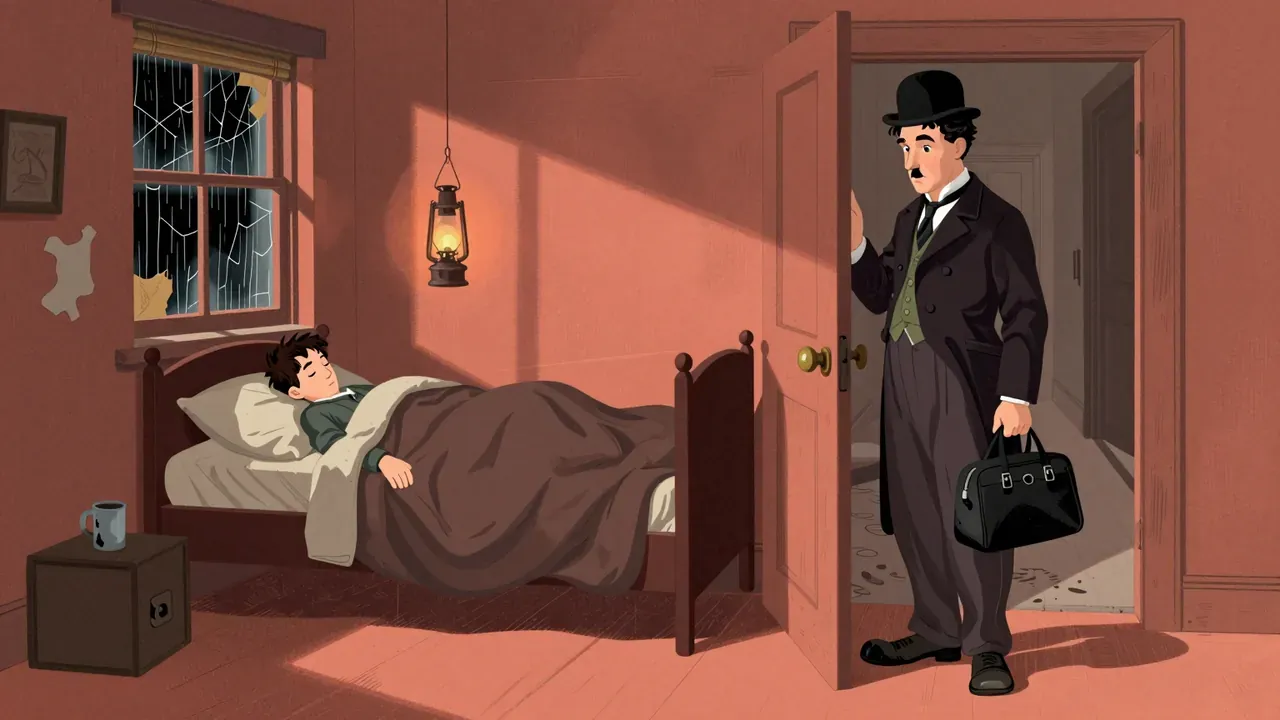
The story follows the Tramp’s attempts to help a blind flower seller while navigating the volatile generosity of a drunken millionaire. Chaplin’s performance avoids caricature: his movements are precise but never mechanical, his reactions delayed just long enough to register vulnerability before resolve. Virginia Cherrill’s flower girl conveys blindness not through mannerism but stillness — her eyes unfocused, her hands mapping space, her voice (heard only in a single off-screen line, though the sheet confirms no audible dialogue) absent entirely. Roland Totheroh and Gordon Pollock’s cinematography keeps compositions clean and shallow, favouring medium shots that hold both actor and environment in balanced tension. Chaplin edits with rhythmic patience — pauses linger, gestures repeat, reactions unfold over three or four frames. The score, composed by Chaplin in six weeks with Arthur Johnston, uses ‘La Violetera’ as a recurring motif, its wistful melody anchoring scenes of yearning without sentimentality. Sound effects — a car horn, a splash, a coin dropping — are sparse but precisely placed, functioning like punctuation rather than illustration.
The landing of it
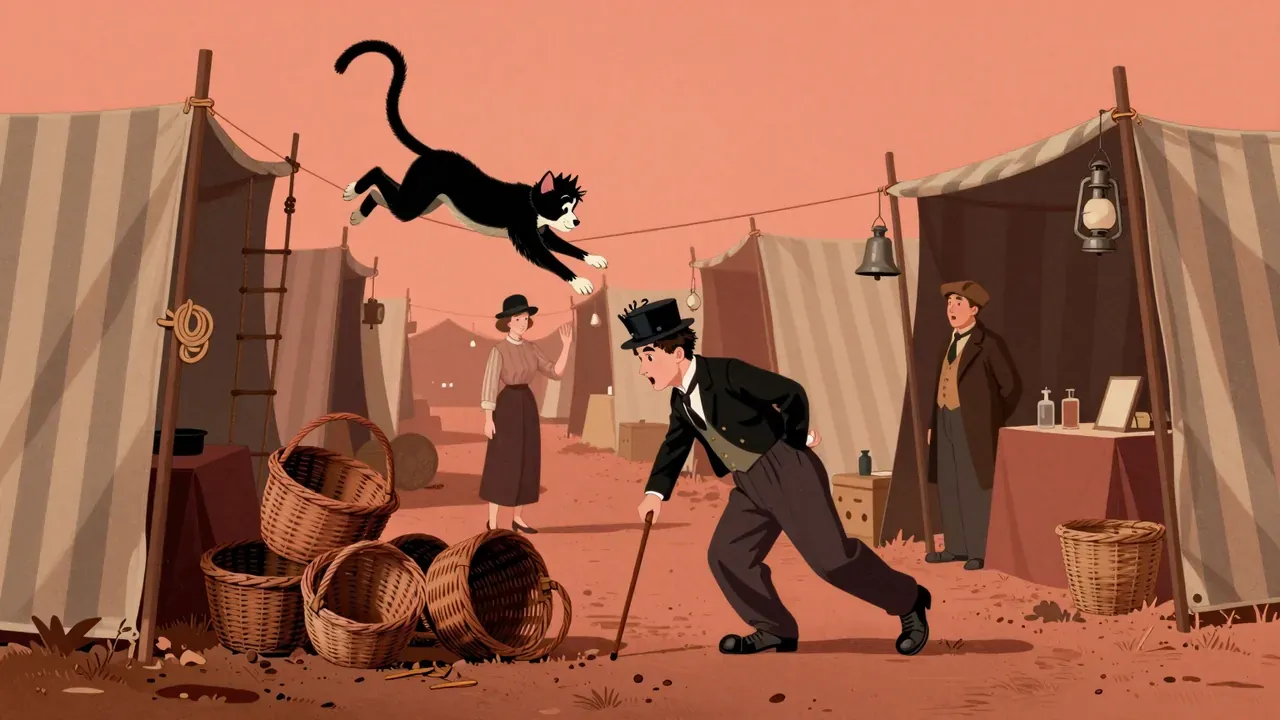
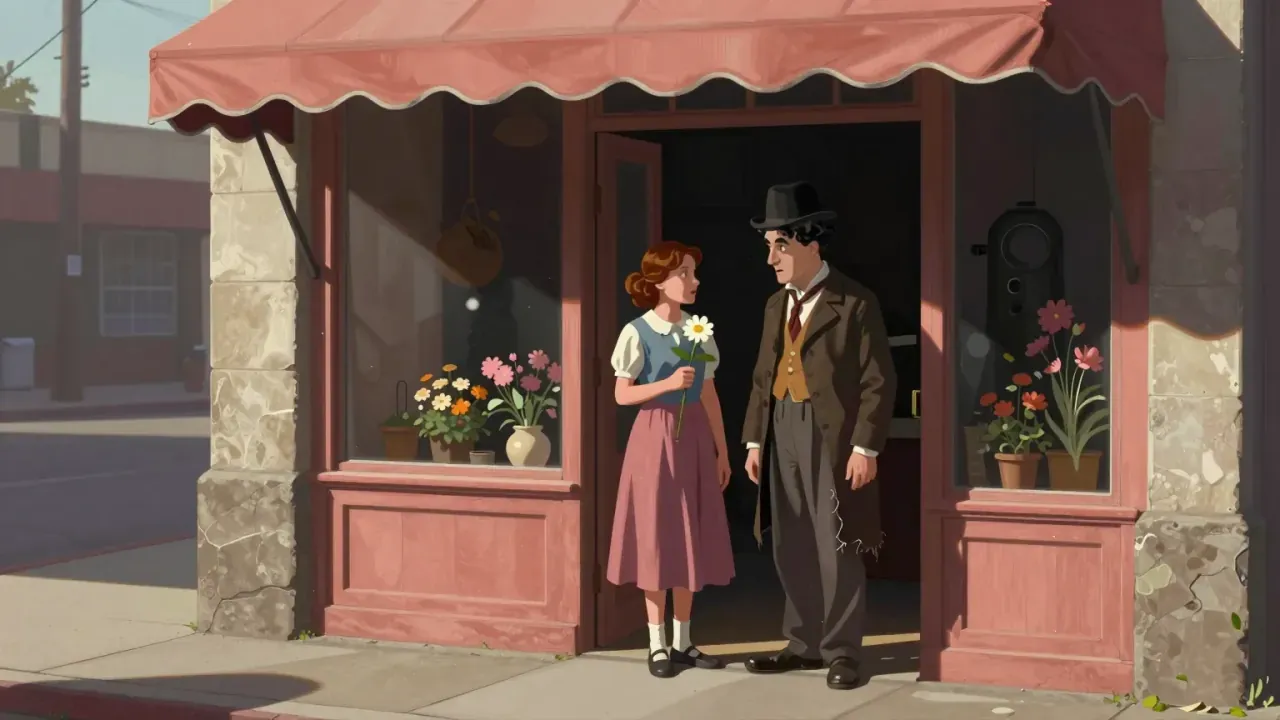
What lands most decisively is the final sequence: the flower girl, now sighted, meets the Tramp for the first time. Her hesitation, her slow realisation, her quiet, unshowy recognition — all conveyed without a single line of dialogue — remains unmatched in its compression of narrative, psychology and moral consequence. The scene works because every prior beat has calibrated our understanding of how she sees him: not as he is, but as she has imagined him — noble, generous, intact. When she finally sees his worn coat, his shuffling gait, his nervous smile, the film does not ask us to pity him; it asks us to witness the moment her love becomes sighted, and therefore irrevocable. The millionaire subplot also lands, not as farce but as a study in conditional empathy — his drunken affection is genuine, his sobriety indifferent, and Chaplin refuses to soften either state. The boxing sequence, though broadly comic, gains weight from its choreographed exhaustion: the Tramp fights not to win but to survive, and his victory feels earned only because his defeat feels inevitable.
The strain in it
What does not land — or lands unevenly — is the early scaffolding of the plot. The statue unveiling, while visually striking, functions more as iconography than narrative engine; its symbolism is clear but its dramatic necessity thin. Several transitions rely on coincidence that feels less like fate and more like script convenience — the Tramp stumbling into the millionaire’s car, then later into the flower girl’s path, then again into the same alley — and these repetitions begin to strain plausibility even within the film’s own logic. The millionaire’s amnesia is sustained too long without psychological grounding, making his shifts between warmth and hostility feel arbitrary rather than cyclical. Some gags — particularly those involving the Tramp’s ill-fated attempts at employment — rely on rhythms established elsewhere, and their reiteration lacks the variation needed to sustain interest. The film’s refusal of dialogue means it cannot clarify motivation through subtext or irony; when intent remains opaque, the silence begins to read as omission rather than restraint.
The weight of it
The themes that matter are not poverty or charity but recognition — who is seen, how, and at what cost. The flower girl’s blindness is literal, but the film treats sight as a social act: the millionaire sees the Tramp only when intoxicated; the public sees him only as a nuisance or a joke; the flower girl sees him only after surgery, yet her earlier affection was no less real. Class is rendered not through exposition but through spatial grammar — the Tramp moves through doorways others pass through unchallenged, sits where others stand, accepts handouts that others dispense. There is also a quiet meditation on artistic labour: the Tramp’s efforts to earn money — boxing, street sweeping, selling newspapers — are all forms of performance, each requiring him to embody a role he does not inhabit. Chaplin, writing, directing, producing, editing and scoring, mirrors this: the film itself is an act of sustained, solitary authorship, insisting on coherence in a medium increasingly shaped by committee and technology.
The audience for it
This film is for viewers who trust image and rhythm over exposition, who value precision of gesture over speed of plot, and who accept that emotional resolution need not be verbal. It rewards attention to repetition, to pause, to the weight of a held glance. It is not for those who require narrative propulsion, psychological explanation, or tonal consistency — the shifts between slapstick, pathos and melancholy are deliberate, but they demand tolerance for ambiguity. Anyone expecting satire will find its politics too embedded to name; anyone seeking historical realism will find its city too composite to locate. Those put off by silent-era pacing or intertitle reliance may find the 87 minutes elongated, not immersive. A viewer who values clarity of cause and effect, or who reads silence as absence rather than density, will likely disengage before the final scene — which is precisely where the film’s argument crystallises.
The time in it
Yes, it is worth your evening — not as period curiosity but as a working model of cinematic economy. Its 87 minutes do not feel dated because its methods remain unreplicated: no contemporary film sustains such sustained emotional continuity without linguistic crutches. That said, its value depends on willingness to submit to its tempo and syntax. Someone who watches primarily for plot mechanics or vocal performance will find little here to hold them; the film assumes you already know what kindness looks like, and asks only that you watch it being enacted. It is not for fans of rapid-fire editing or layered soundscapes — those elements were excluded by design. If you have seen modern films where silence is used as suspense or irony, City Lights offers silence as substance: the air between gestures, the weight before a decision, the time it takes for a face to change. That time is not filler. It is the point.