Shapeshifting tanuki fight a highway of concrete
Pom Poko follows a colony of tanuki, Japanese raccoon dogs able to shapeshift, as a suburban development project called New Tama tears through the forested hills outside Tokyo where they live. Isao Takahata wrote and directed the film as his third for Studio Ghibli, structuring it less as a single rescue mission than as a slow-motion loss spanning the late 1960s through the early 1990s, tracking how the tanuki’s options narrow year by year as their habitat keeps shrinking. The film draws on real Japanese folklore about bake-danuki, shapeshifting creatures considered mischievous and food-obsessed rather than genuinely threatening, and credits folklorists and illustrators including Shigeru Mizuki, who also appears in the film as its onscreen commentator.
A folklore resistance spanning three decades
The tanuki’s transformation abilities aren’t presented as automatic; the colony has to relearn illusion skills it had largely forgotten, and much of the film’s early stretch is spent organizing a species better suited to squabbling over shrinking resources than coordinated resistance. Studio Ghibli used early computer-generated imagery during production, still a novelty for the studio at this stage of its history, alongside its usual hand-drawn character work. Takahata stages the tanuki’s sabotage campaigns, including deliberately dangerous stunts that injure and kill construction workers, without treating the material as straightforwardly comic, and the film’s tone shifts accordingly as the campaign’s human cost becomes harder to wave off as harmless mischief.
A ghost parade upstaged by a theme park’s press release
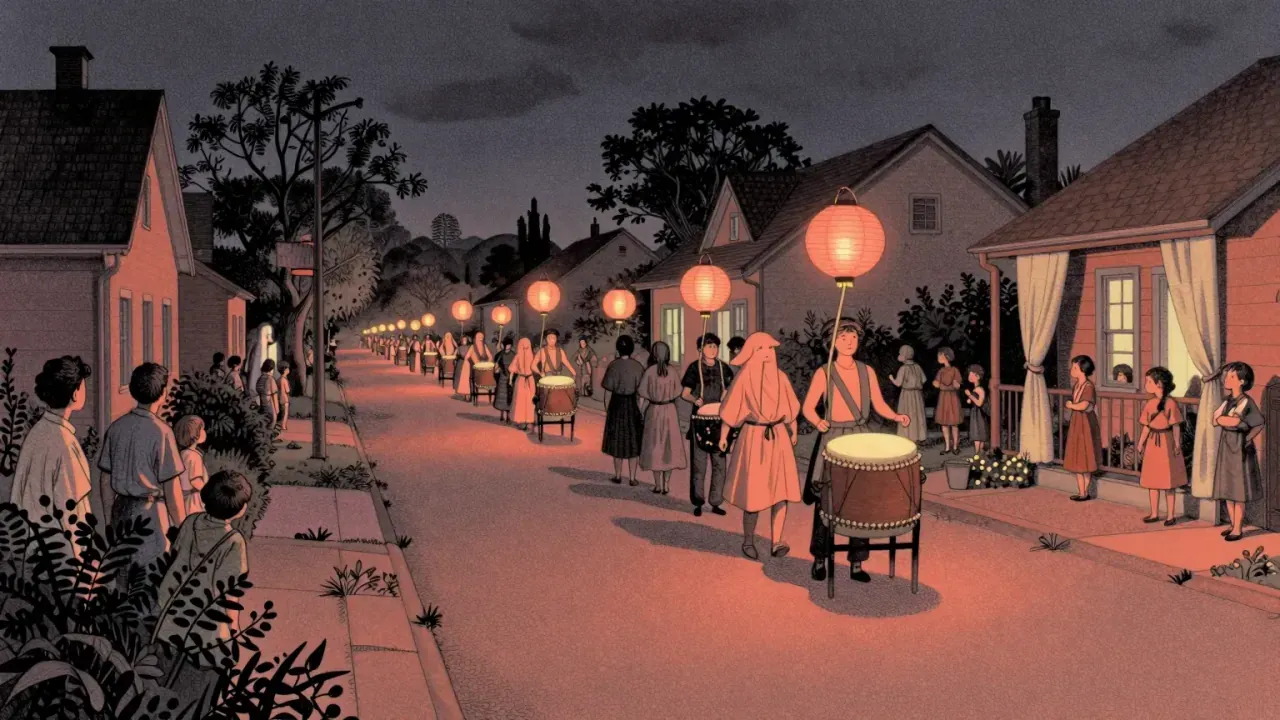
The film’s most striking sequence, a massive illusory ghost parade meant to convince the human population that the area is haunted, lands as a genuine collective achievement, costing one elder his life in the effort, only for a nearby theme park owner to claim credit for it as a publicity stunt once it succeeds. That single reversal does more to establish the tanuki’s powerlessness than any of the film’s direct confrontations with bulldozers, because it shows their most sophisticated weapon, controlling how humans perceive the world, being absorbed and repurposed by the very economy they’re fighting. Shang Shang Typhoon’s score keeps the tone buoyant even as the stakes darken, which makes the later losses land harder rather than softer.
A resistance that splinters instead of winning
Where the film runs into trouble is scale: the colony splinters into several factions once the ghost-parade gambit fails, and Takahata gives each faction, the eco-terrorist group under Gonta, the media-outreach group, the religious cult that sails to its death, roughly equal screen time, which spreads the emotional focus thin across a large ensemble rather than letting any single relationship carry the back half. Viewers looking for one clear protagonist to track through the resistance’s collapse will find the film keeps shifting its attention instead, a structural choice that suits its documentary-like ambition but costs it some of the momentum a tighter focus might have built for the audience.
Loss with no clean victory to end on
The film’s actual subject is what happens to a community once its collective strategy fails and there’s no version of victory left, only degrees of loss: some tanuki blend into human society and disappear as themselves, some die in increasingly desperate stunts, and the survivors end up scavenging traffic-adjacent parkland too small to support them. Takahata refuses to end on the reassurance that awareness alone fixes anything; the human public’s belated sympathy secures a few small parks, not a reversal of the development, and the closing address to the audience, delivered directly by one of the tanuki, asks for consideration rather than declaring any kind of triumph.
Who this is for
This suits viewers drawn to Ghibli’s more issue-driven, less fantastical register, particularly anyone interested in Japanese folklore or in animated films willing to let a resistance movement actually fail rather than manufacturing a last-minute win. It rewards patience with a large ensemble cast and a story that runs nearly two hours without a conventional villain to focus anger on. It’s a harder sell for younger children, since the comic tanuki-belly-drumming energy of the film’s marketing undersells how bleak the back half becomes, and for anyone wanting Ghibli’s more straightforwardly adventurous register found in films like Kiki’s Delivery Service.
A hit at home, a harder watch for some critics
Pom Poko was the top-grossing Japanese film domestically in 1994, taking in ¥4.47 billion, and won Best Animation Film at the Mainichi Film Awards along with the Grand Prix at Annecy in 1995, even though it was passed over as Japan’s actual Academy Award nominee that year. Its 86% Rotten Tomatoes score against a middling 6-out-of-10 average rating from critics suggests a film more admired for what it attempts than uniformly loved scene to scene, which tracks with a story that trades easy charm for a genuinely difficult ending. Worth the evening for a species-scale environmental story that Ghibli rarely tells this directly, though it asks more patience of its audience than the studio’s more famous titles.