A solo beginning
Jabberwocky is Terry Gilliam’s first solo feature, a medieval fantasy comedy that sets out to parody chivalric myth not through irony or satire but through systemic absurdity — a world where bureaucracy creaks louder than swords, commerce calcifies into farce, and heroism arrives by tripping over a corpse. It adapts neither Carroll’s poem nor any coherent source text, but uses the title as a licence to build a grubby, cobwebbed Dark Ages in which institutions are hollowed out and human effort is perpetually misdirected. Gilliam and co-writer Charles Alverson treat feudal hierarchy not as backdrop but as malfunctioning machinery: the king’s decrees are lost in heraldic pedantry, the church blesses with a flick of the finger, guilds exclude talent while begging flourishes. The film does not mock medievalism so much as expose how little has changed in the administration of power, profit, and piety — all rendered in mud, mildew, and mismatched wigs. Its ambition is structural: to make the logic of late capitalism legible through the cracked lens of a collapsing kingdom. (158 words)
The life of Dennis Cooper
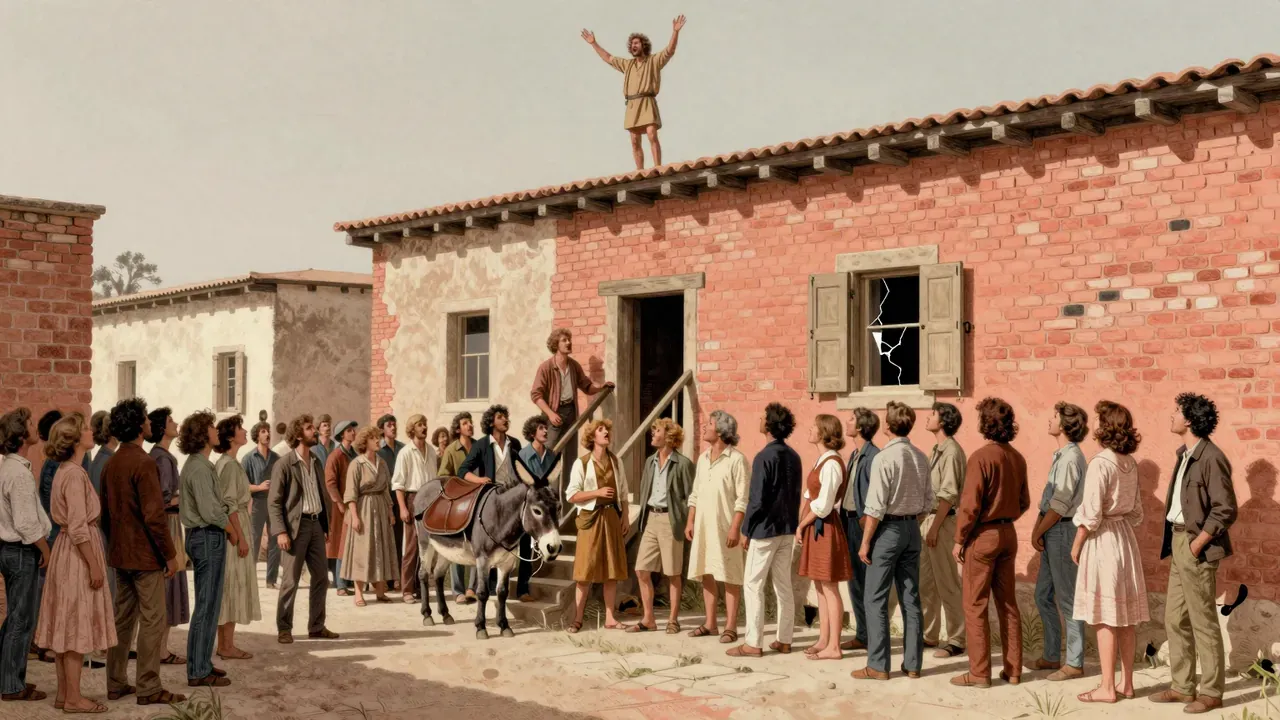
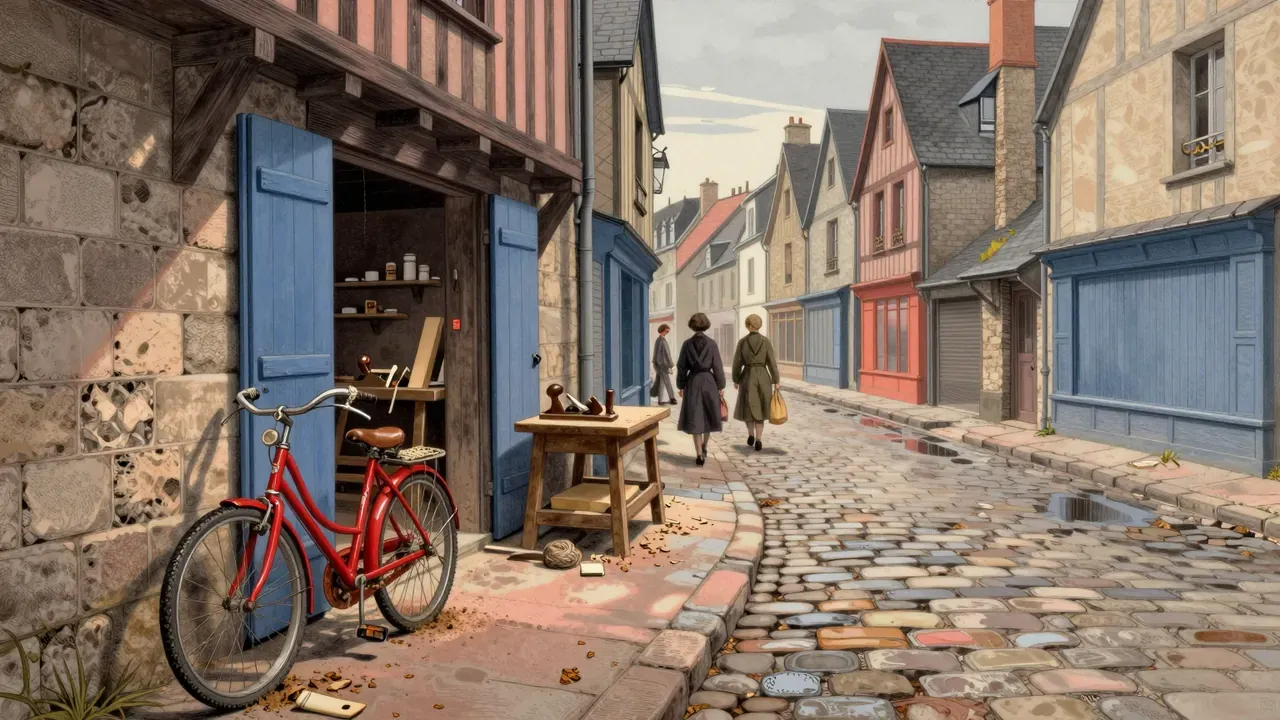
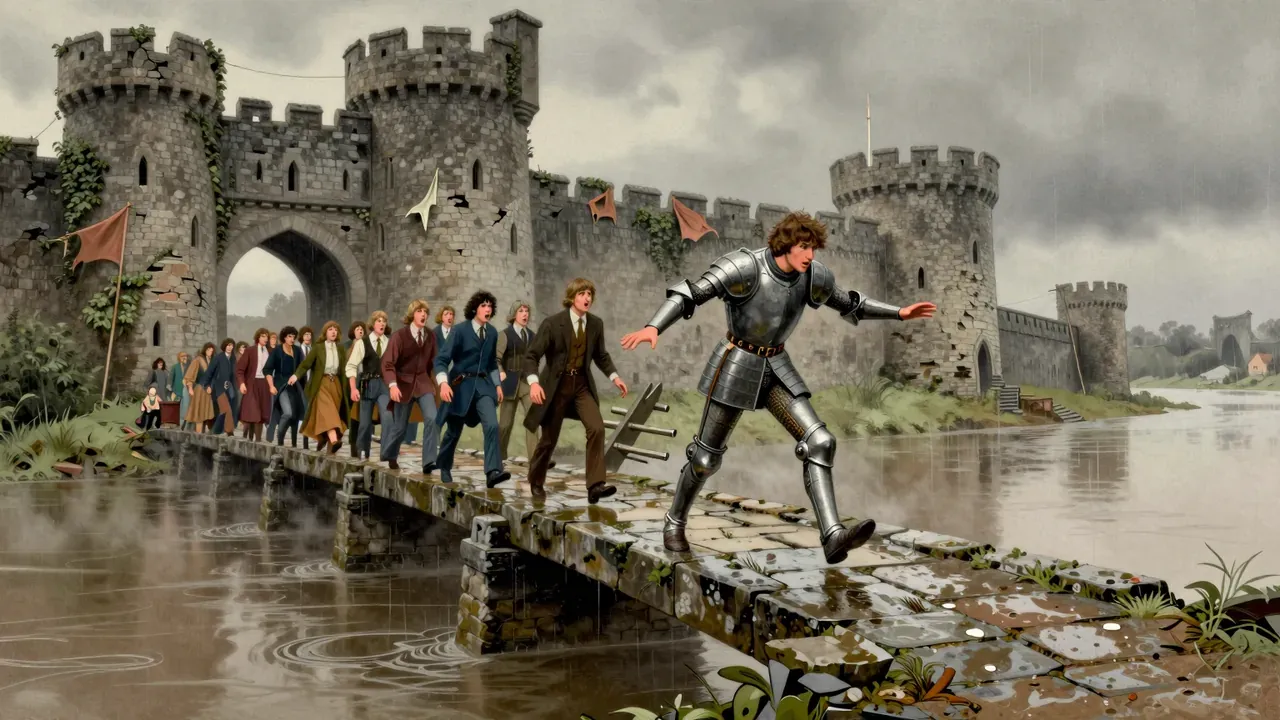
The story follows Dennis Cooper, a cooper’s apprentice whose father disinherits him on his deathbed, sending him from village to city in search of work and love. Michael Palin plays Dennis with a quiet, flustered sincerity that anchors the chaos — he never winks at the audience, even when holding a rotten potato like a relic. Supporting turns by Harry H. Corbett as the wheezing King Bruno, John Le Mesurier as the weary chamberlain Passelewe, and Warren Mitchell as a venal merchant all land with precise, underplayed timing. Gordon Willis did not shoot this film; it was shot by Terry Gilliam’s regular collaborator, Terry Bedford, who keeps the palette damp and dim — candlelight flickers across crumbling plaster, and outdoor scenes at Chepstow and Pembroke Castles feel wind-scoured and real. The Jabberwock itself is a deliberate anti-spectacle: a man in reverse-jointed costume, visible wires and all, its movements slowed and its scale implied by low angles and actor reactions rather than digital trickery. Editing by Julian Doyle avoids punchline rhythm, favouring disorientation over gags — a joust becomes a bureaucratic lottery, a dragon fight ends with a stumble and an impalement. (159 words)
How it holds together
What lands is the texture of institutional decay: the way dust settles on royal decrees before they’re read, the shrug with which the Bishop dismisses holy rites, the grim satisfaction of merchants watching refugees queue for overpriced turnips. These details accumulate without explanation, building a world where absurdity isn’t comic relief but ambient condition. The film’s physical comedy works because it’s rooted in consequence — Dennis doesn’t slip on a banana peel but on wet straw in a barn full of terrified peasants; the ‘hide and seek’ joust feels plausible within a system that has long since abandoned logic for precedent. Palin’s performance lands hardest in silence: his bewildered stare as the Princess takes the potato, his hesitant nod when offered half a kingdom, his quiet disappointment when Griselda’s interest blooms only after he’s crowned. The monster’s ‘death fall’, accidental in filming and retained in edit, lands precisely because it refuses grandeur — it’s clumsy, unheroic, and utterly consistent with the film’s thesis that meaning is assigned after the fact. Even the score — Mussorgsky’s Pictures at an Exhibition, arranged and conducted by Howard Blake — avoids leitmotif, using brass fanfares ironically, letting woodwinds wander off-key during coronations. (157 words)
The look of it
What does not land is narrative cohesion beyond the central arc. Subplots drift: Wat Dabney’s self-mutilation as failed beggar is conceptually sharp but visually underdeveloped, vanishing mid-film without resonance. The Princess’s tower sequence — meant to skewer romantic idealism — stalls in repetition, her dialogue looping wishful thinking without variation or escalation. Some Python alumni appear without function: Terry Jones as a herald whose entire purpose is to drown out the king, then get beheaded — a joke that lands once, then lingers too long. The Black Knight, played by David Prowse, is introduced with portent but dispatched without weight; his dual role as Red Herring’s rival and Dennis’s near-killer blurs rather than clarifies motive. The film’s resistance to exposition becomes a liability in its second half: viewers unfamiliar with Gilliam’s visual grammar may mistake underlit corridors and mumbled dialogue for technical failure rather than design. The ending — Dennis swept away to honeymoon with a princess he barely knows — is thematically sound but emotionally thin; it asserts accidental happiness without showing its cost or contradiction. There is no sense of loss, only substitution — and that leaves the final image feeling less like resolution than resignation. (156 words)
What the world runs on
The themes that matter are commerce as inertia, bureaucracy as theatre, and heroism as accident. The film treats markets not as engines of progress but as ossified gatekeeping systems: Dennis’s efficiency ideas are ignored not because they’re wrong, but because they threaten guild monopolies; the Bishop’s piety rises with fear, not faith; the king’s tournament is less about choosing a champion than re-enacting ancestral ritual to avoid decision-making. This is not allegory but anatomy — a dissection of how institutions preserve themselves by manufacturing crisis and then profiting from its management. The ‘creaking bureaucracy’ extends to language: proclamations are misheard, titles mispronounced, blessings abbreviated. Even the Jabberwock functions thematically — a creature whose name is nonsense, whose form is borrowed and broken, whose death is unearned. Its presence justifies rent-seeking, militarisation, and religious revival all at once. Gilliam does not contrast this with some noble past; the opening village is already compromised — Dennis’s father curses craftsmanship while dying in a workshop full of half-finished barrels. There is no golden age to return to, only systems that persist by refusing to adapt — and the film’s dark humour lies in how recognisable that feels in 1977, or 2024. (154 words)
Who it asks for
This film is for viewers who find comedy in entropy — those who appreciate slow-burn worldbuilding over punchlines, and who tolerate narrative looseness for the sake of sustained tone. It suits fans of Monty Python’s Holy Grail who want more texture and less sketch logic, and those drawn to Gilliam’s later work — Brazil, Time Bandits — who recognise his early preoccupations with institutional collapse. It is not for viewers who require clear cause-and-effect, emotional payoffs, or visual polish; the muddy cinematography, muffled dialogue, and deliberate pacing will frustrate anyone seeking brisk entertainment. Those expecting a faithful Carroll adaptation or straightforward fantasy adventure will leave confused. A viewer who values tight plotting over atmosphere, or who dislikes ambiguity in character motivation, would likely reject it outright — though such a viewer might concede its craft if shown the Shepperton set photos or the Jabberwock’s reverse-joint schematics. What would change the verdict? A tighter second act, or a stronger through-line for Wat Dabney — but that would also dilute the film’s commitment to irresolution as principle. (152 words)
Why it stays
Yes, it is worth your evening — provided you watch it as a piece of sustained tonal architecture rather than a story with stakes. Its 100 minutes unfold like a decaying fresco: details accrue, textures deepen, and the absurdity gains weight through repetition and refusal to explain itself. You do not need to ‘get’ every joke to feel the film’s cumulative effect — the greyness of the castle, the exhaustion in Corbett’s voice, the way Dennis’s potato becomes both talisman and punchline. It rewards patience, not decoding. A viewer who watches it twice — first for plot, second for pattern — will notice how often characters speak past each other, how often light fails to reach a room’s ceiling, how often a decision is deferred until it no longer matters. That is the point. Those who demand narrative propulsion or catharsis will find it inert; but those open to comedy as diagnosis, not distraction, will find it quietly devastating — and funnier on reflection than in the moment. Its value lies not in what happens, but in how relentlessly, plausibly, and dully the world keeps turning. (151 words)