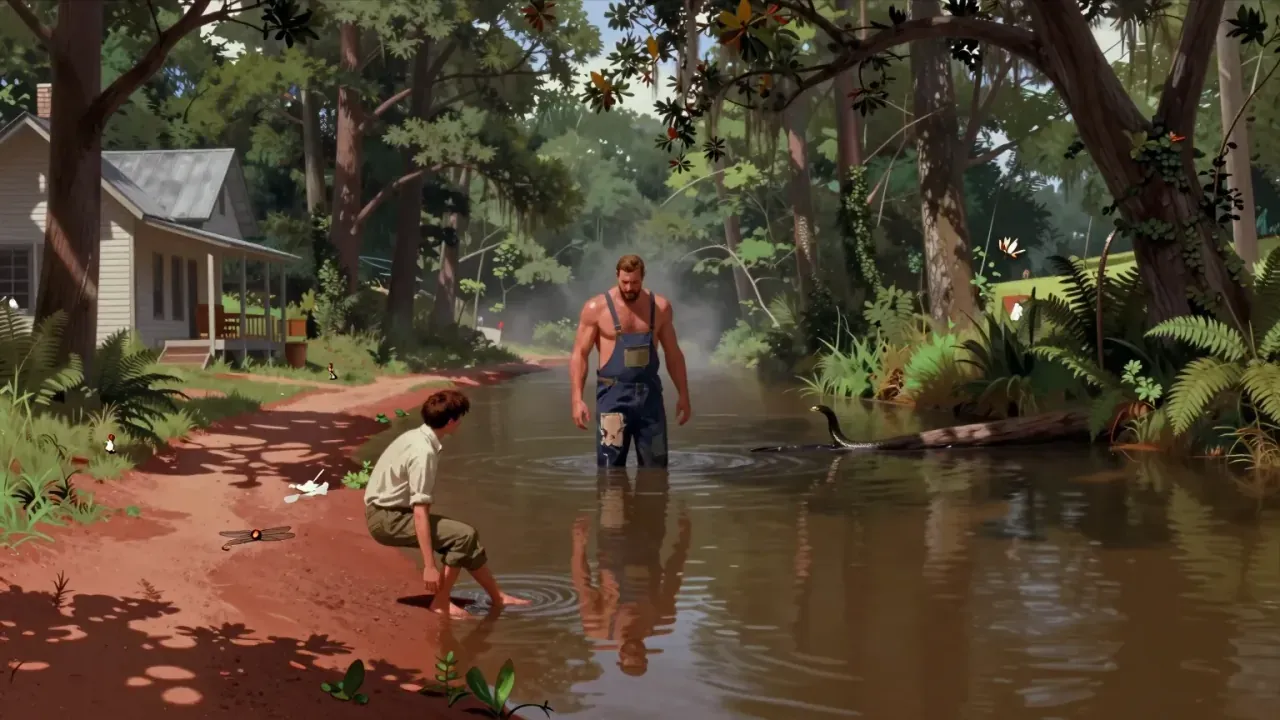
What the film is
Big Fish is a fantasy drama about the gap between a father’s stories and his son’s need for truth, built around Daniel Wallace’s 1998 novel. It tries to hold two things at once: the emotional weight of a dying man’s reconciliation with his adult son, and the visual exuberance of tall tales told as lived reality — a giant, a witch, a town that stops time, a circus run by a poet. Tim Burton directs not as a stylistic imposition but as a mediator: he treats myth not as escapism but as memory’s grammar, where exaggeration serves feeling rather than spectacle. The film avoids allegory in favour of embodied metaphor — Edward Bloom’s life isn’t like a fairy tale; it is, within the film’s logic, one. Its ambition is structural as much as thematic: to make narrative itself the site of grief and love, where the act of telling becomes both barrier and bridge. It does not ask whether the stories are true, but whether they matter — and whether fidelity to fact is the only kind of honesty a son owes his father.
How it works
The story moves between three timelines — young Edward’s adventures, middle-aged Edward’s strained marriage and fatherhood, and the present-day hospital room where Billy Crudup’s Will tries to extract a final, unvarnished version of his father’s life from Albert Finney’s fading voice. Ewan McGregor carries the younger Edward with physical ease and a lightly ironic charm, while Finney grounds the older man in weary warmth and quiet regret. Philippe Rousselot’s cinematography favours soft focus, saturated colour, and shallow depth — especially in the Southern Gothic interiors — and avoids digital slickness, using forced perspective and practical sets instead of CGI. Danny Elfman’s score swells with orchestral sweep but never drowns the dialogue or the silences between lines. Chris Lebenzon edits with rhythmic patience, letting scenes breathe even when they pivot on absurdity. The casting of Jessica Lange and Alison Lohman as Sandra across time works because their performances share a tone of grounded tenderness, not just resemblance.
What lands
What lands is the film’s central emotional transaction: the slow thawing of Will’s resentment into something like awe, not for the facts of his father’s life, but for the shape he gave them. The Spectre sequence — a town suspended outside chronology, where everyone stays the same age — lands with quiet force because it’s filmed without irony, its logic accepted as literal. Helena Bonham Carter’s Witch, though brief, registers as more than a grotesque: her early warning to Edward feels like folklore made flesh, not set dressing. The circus scenes, shot on location in Wetumpka and Montgomery, carry a tactile authenticity — sawdust, sweat, canvas — that offsets the more stylised vignettes. Even the banjo player from Deliverance, appearing unannounced on a porch, adds a layer of real-world resonance that no script could manufacture. These moments succeed because they’re anchored in place, performance, and craft rather than concept alone — the world feels inhabited, not illustrated.
What does not
What does not land is the film’s tonal drift between sincerity and whimsy, particularly in the second act. Some tall tales — the giant Karl, the werewolf poet — feel less like expressions of character and more like checklist entries in a Burton greatest-hits reel. The Paris interlude, shot in May 2003 and inserted late, sits awkwardly: its visual contrast with the Alabama sequences undercuts the film’s otherwise consistent Southern Gothic palette, and its narrative function remains vague. The dual casting of Edward and Sandra, while conceptually sound, occasionally flattens emotional progression — we see change in costume and lighting, but rarely in behaviour or speech pattern across decades. And though the hospital scenes open the film, they recede too far, leaving the final reconciliation feeling earned emotionally but structurally rushed. The film’s refusal to clarify what is ‘real’ risks becoming a deflection, not a device — especially when the stakes are mortality, not myth.
The themes that matter
The themes that matter are inheritance, not of property or name, but of narrative — how stories pass from parent to child, accrue meaning, and mutate under pressure of time and loss. Ageing appears not as decline but as compression: Finney’s Edward shrinks physically while his stories expand, until the two versions occupy the same frame. Storytelling here is neither lie nor truth, but a third thing — a form of care, a way of holding attention, a method of making sense when sense fails. The American South is not backdrop but participant: its humidity, its history of oral tradition, its layered social codes all inform how Edward speaks and how Will listens. Grief is rendered not as silence but as argument — over facts, over emphasis, over who gets to define a life after it ends. And reconciliation is shown not as agreement, but as surrender to ambiguity: Will stops demanding proof and starts accepting the shape his father gave his own life, even if it bends physics and chronology.
Who should watch it
This film is for viewers who value mood over mechanics, who find emotional resonance in stylisation rather than realism, and who accept that some truths require metaphor to be spoken. It suits those familiar with Burton’s earlier work — Beetlejuice, Edward Scissorhands — not as fans of quirk, but as readers of his recurring preoccupation with outsiders building worlds to survive inside them. It is less suited to viewers who require narrative consistency, who distrust sentiment unless it is undercut with irony, or who find Southern Gothic aesthetics indistinguishable from cliché. Those who expect adaptation fidelity may balk at the screenplay’s departures from Wallace’s episodic structure — John August reworked it into a tripartite frame, which simplifies the novel’s recursive loops. A viewer who values tight plotting over lyrical drift will likely feel the film meanders where it should tighten.
Is it worth your evening
Yes, it is worth your evening — but only if you arrive willing to meet it on its own terms: as a fable, not a biography; as a lament, not a lesson. Its 120 minutes unfold without urgency, trusting that atmosphere and repetition will do the work exposition might otherwise do. You will not leave with answers, but with a lingering sense of how stories cushion the shock of endings. Those who dislike films where tone outweighs plot, or who find Elfman’s score cloying in its sweep, will feel the runtime drag. Others — particularly those who have buried a parent, or told a story too many times to remember where memory ends and invention begins — may find its rhythms uncannily precise. It is not a film that argues; it is one that exhales, slowly, and waits for you to breathe with it.