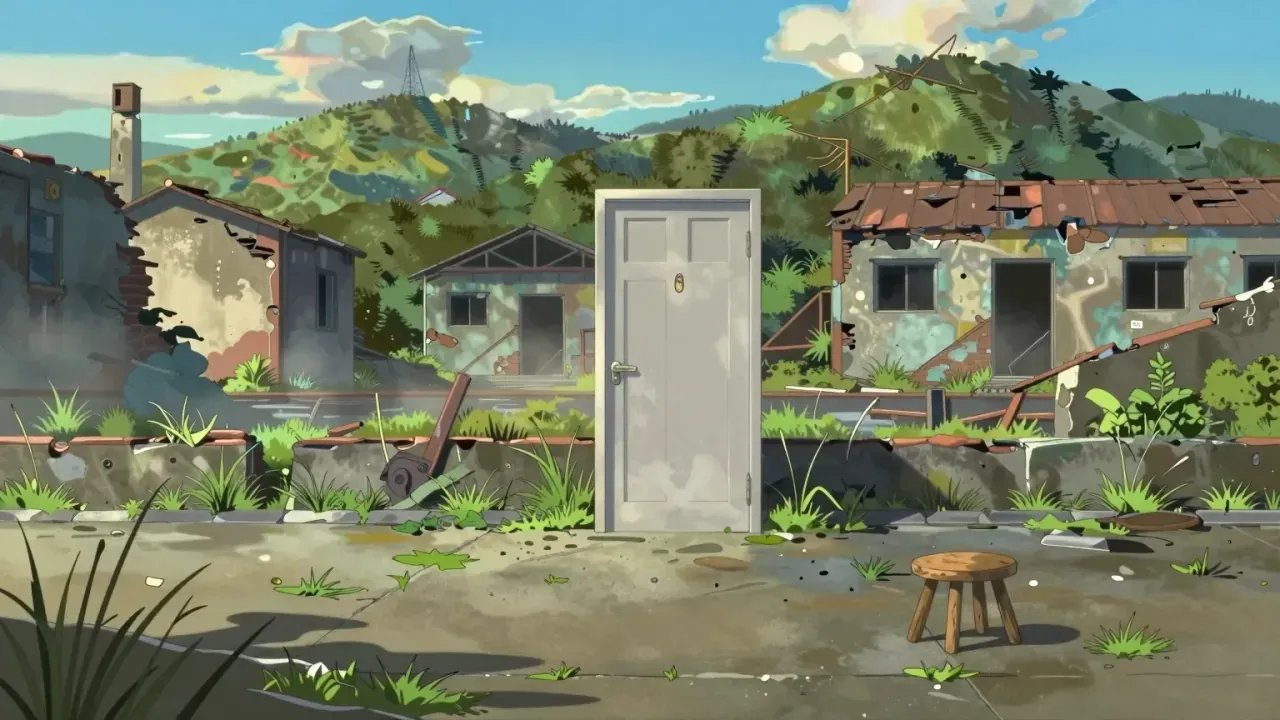
A door-closing ritual with real stakes
Suzume follows the title character, a seventeen-year-old high schooler, after she meets Souta Munakata, a young man travelling Japan to close doors left open in abandoned buildings, doors that otherwise let a colossal, earthquake-triggering worm escape into the world. Writer-director Makoto Shinkai conceived the premise while touring Japan for talks about his earlier films and noticing how many depopulated, deserted places the country now has, framing the film as a story about mourning locations rather than only people. It closes what has been described as Shinkai’s disaster trilogy, following Your Name and Weathering with You, and unlike those two films, draws its central catastrophe directly from a real one: the 2011 Tohoku earthquake and tsunami.
A chair for a co-lead
Partway through the journey, Souta is transformed into a three-legged wooden chair, a device Shinkai chose specifically to avoid repeating the straightforward romantic pairing of his earlier films and to keep the story from becoming, in his own words, too much of a boy-meets-girl structure. Nanoka Hara, selected from an audition of over 1,700 candidates, voices Suzume, while Hokuto Matsumura voices Souta in both his human and chair forms. Radwimps returns for a third collaboration with Shinkai, joined by composer Kazuma Jinnouchi, with parts of the score recorded at Abbey Road Studios in London, giving the film’s frequent musical set-pieces a consistency with its two predecessors even as the story departs from their romantic template.
Where the premise gets specific
The film is at its strongest when the door-closing ritual is tied to a specific, recognisable kind of place — an abandoned hot spring resort, a shuttered school — rather than to generic fantasy architecture, since the ritual becomes a small, formal act of grief for towns the rest of the country has already stopped thinking about. Shinkai’s choice to make the antagonist force a consequence of neglect rather than an external villain gives the road-movie structure a throughline beyond simple episodic adventure. Its most direct engagement with the 2011 disaster, arriving well into the story, lands harder for having been earned by the smaller, quieter losses shown earlier in the journey.
A structure that keeps repeating itself
The door-and-worm mechanic repeats at nearly every stop on Suzume and Souta’s journey, and while that repetition builds a consistent emotional rhythm, it also means the middle section of the film can feel structurally familiar even as the specific locations change. Souta’s chair form, while thematically deliberate, asks a lot of the audience visually and emotionally for a large stretch of the runtime, and viewers who find the device more distracting than poignant will have that reaction reinforced repeatedly rather than resolved quickly. At two hours, the film’s episodic structure occasionally slows its momentum between the bigger set-piece stops.
The 2011 earthquake, addressed directly this time
Shinkai has said he wanted to address the impact of the 2011 earthquake and tsunami directly rather than continuing to depict it through metaphor, aiming the film in part at teenagers too young to remember the disaster themselves, so that his own memory of it could be passed on rather than left to fade. That intent runs alongside the film’s quieter theme of depopulation, using the practice of formally closing down abandoned buildings as a way of dramatising a demographic reality Japan is living through in the present rather than only in disaster-film metaphor. The relationship between Suzume and her aunt, who raised her, gives the film’s found-family theme a second register beyond the central journey.
Who this suits
This suits viewers who already know Shinkai’s earlier disaster films and want to see how the trilogy resolves its recurring themes, and anyone interested in a fantasy premise built specifically around Japan’s rural depopulation rather than generic apocalypse. It is a less forgiving entry point for newcomers, since much of its emotional charge depends on accepting the chair conceit and recognising the weight the 2011 earthquake carries in Japan specifically. Viewers wanting a conventional romance plot may find Souta’s extended transformation frustrates rather than complicates that expectation. International audiences unfamiliar with the specific weight the Tohoku disaster carries in Japan may also need to do a little outside reading to feel the full force of the film’s later scenes.
Worth the two hours
Yes. Grossing over $300 million worldwide and becoming one of the best-reviewed anime releases of its year, Suzume closes Shinkai’s disaster trilogy by taking on real historical grief more directly than either of its predecessors, without sacrificing the visual craft and musical scale that made Your Name and Weathering with You into international successes. Its willingness to structure an entire road movie around the specific, unglamorous act of formally closing abandoned buildings gives it a subject few other films in the genre have attempted. Two hours spent on that specific, well-researched premise earns the evening.