A boy, a shamisen, and a stolen eye
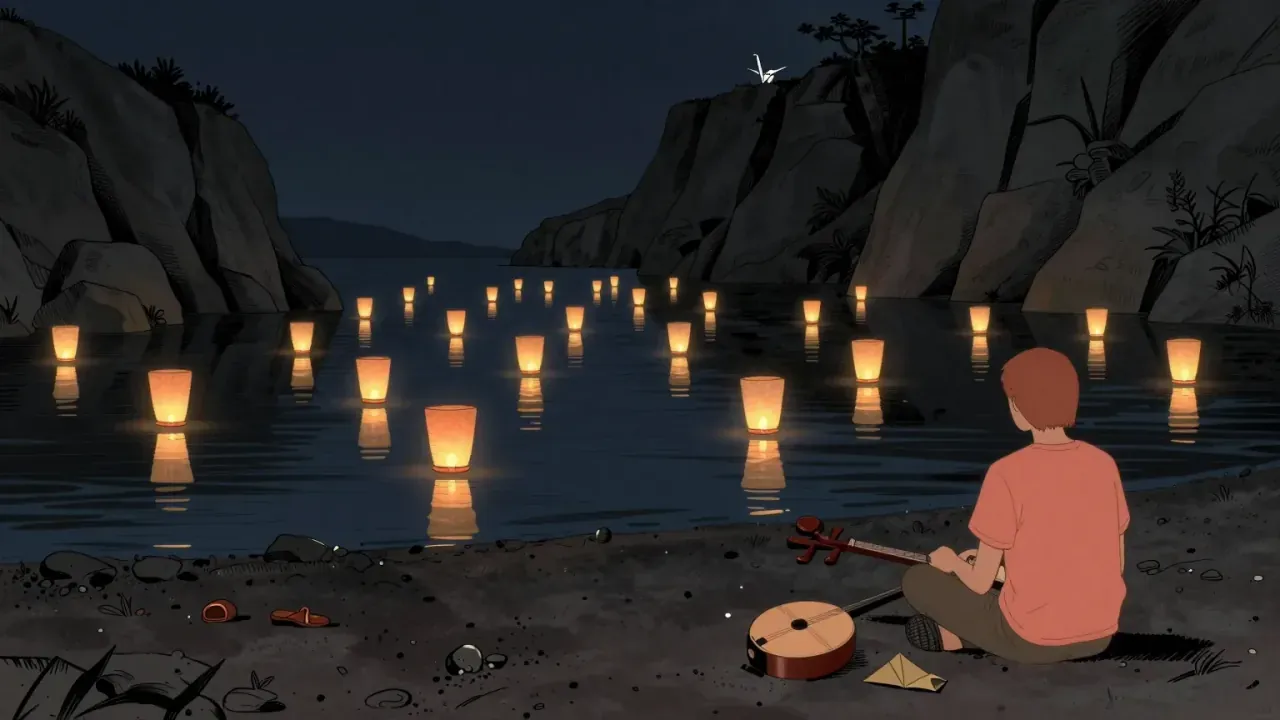
Kubo and the Two Strings sets a coming-of-age story inside a fictionalised feudal Japan, following a one-eyed boy who supports his ill mother by using a magic shamisen to animate origami figures for coins in the village square. Travis Knight, in his directorial debut after years as Laika’s president and lead animator, wanted to make a stop-motion samurai epic pitched to him by production designer Shannon Tindle, and the film’s ambition from the outset was to look, in Knight’s words, like a moving woodblock print. Kubo’s ordinary routine ends when his grandfather’s twin aunts, ghostly and identical, track him down at night hunting the eye they stole from him as an infant.
A quest built from a monkey, a beetle, and a search for armour
The plot that follows sends Kubo fleeing with two companions: a charm belonging to his mother that turns into a stern monkey, and a cursed samurai transformed into a giant beetle voiced by Matthew McConaughey. Their journey is structured around finding three pieces of magical armour needed to face the Moon King, Kubo’s grandfather, who is ultimately behind the pursuit. The quest-item structure is familiar, but the film uses it mainly as scaffolding for a series of visually distinct set pieces, a giant skeleton in a cave, an eye made of stone, an ocean crossing on an origami boat, rather than treating the armour hunt itself as the point.
A record-sized puppet doing quiet work
The film’s technical high point is a sixteen-foot, four-hundred-pound skeleton puppet, which Laika describes as the largest stop-motion puppet ever built, animated with the help of a repurposed industrial robot bought secondhand and reworked for the production. What is notable is how sparingly it is used: one set-piece sequence, not a recurring spectacle. Most of the craft instead goes into quieter work, the flex of Kubo’s paper creations, the texture of the monkey’s fur, small adjustments of expression across hundreds of puppet faces, following an art direction built on ukiyo-e woodblock printing and the graphic work of Kiyoshi Saito, which Knight named directly as a touchstone.
A whitewashed cast in a Japanese-set story
The film draws explicitly on Japanese visual art and on the films of Akira Kurosawa, and is set specifically in Japan, yet its leading voice cast is largely white: Art Parkinson, Charlize Theron, Matthew McConaughey, Rooney Mara and Ralph Fiennes take the principal roles, with George Takei and Cary-Hiroyuki Tagawa, the only cast members of Japanese descent, confined to minor parts. Critics raised this as whitewashing on release, and it sits uneasily against a production that otherwise researched its source culture closely in its visual design. The gap between the care taken with imagery and the casting choices made around it is not resolved by the film itself.
Memory as the thing actually at stake
Beneath the monster hunt, the story is about what is left of a family once its members die or vanish, and whether the stories a survivor tells can stand in for the people themselves. Kubo’s storytelling ability, the same origami skill that opens the film as a busker’s trick, becomes the way he ultimately confronts his grandfather, not through combat but through insisting that people who are gone are not erased if they are still spoken of. It is a heavier idea than most animated adventures build a climax around, and the film commits to it rather than diluting it for an easier ending.
Not quite the film the marketing suggested
The film’s melancholy, several genuinely frightening images, including the aunts’ masked faces and the skeleton encounter, and an ending that does not fully undo its losses make it a poor match for very young or easily frightened viewers, despite marketing that leaned toward a family-adventure pitch. It suits older children comfortable with sadness inside an adventure, and adults who want stop-motion animation attempting more than a rescue plot. Viewers uncomfortable with the casting choices made around a story this specifically Japanese in setting and reference should weigh that going in, since the film does not address the tension itself.
A box-office loss that outlived its opening weekend
Kubo and the Two Strings grossed under eighty million dollars worldwide against a sixty-million-dollar budget, a disappointment that reportedly affected Laika’s subsequent output, though critical reception at release was strong and has largely held since, including a BAFTA win for Best Animated Film. At a hundred and one minutes it does not pad the quest structure past what it needs, and it is better suited to a deliberate evening than to background viewing, given how much of what it does well is visual and quiet rather than eventful. It rewards attention more than most animated features asking for the same runtime.