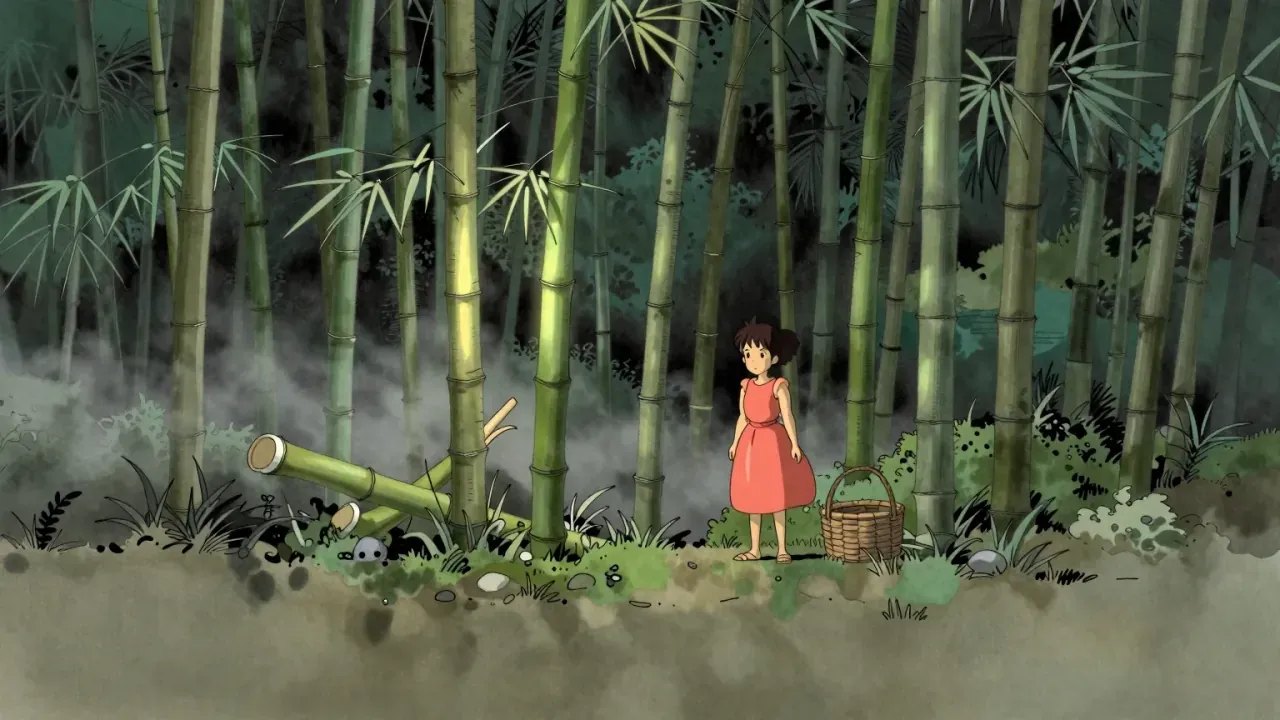
A child found in a glowing bamboo shoot
The Tale of the Princess Kaguya, released in Japan in November 2013 and directed by Isao Takahata in what became his final film before his death in 2018, adapts the tenth-century Japanese literary tale The Tale of the Bamboo Cutter. A poor bamboo cutter discovers a tiny girl inside a glowing bamboo stalk and, believing her a divine gift, raises her together with his wife; when he later finds gold and fine cloth growing in the same grove, he decides she must be royalty and become a proper noblewoman, and the film’s real, sustained conflict begins from that decision onward.
Lines that refuse to hold still
Takahata and character designer Osamu Tanabe developed an animation style that deliberately kept in what most productions would carefully clean up before release: stray pencil lines, colour bleeding visibly past its own edges, and backgrounds rendered in loose, unfinished-looking watercolour by veteran background artist Kazuo Oga. The intent, in Takahata’s own stated account, was to let viewers recall and recognise the texture of ordinary life rather than be distracted by an artificially polished, realistic surface, and the effect gives Kaguya’s story an unfinished, handmade urgency that a conventionally cleaner animation style simply would not achieve.
A nickname traded for a title she never asked for
The film’s real turning point comes not at any single dramatic confrontation but in the quiet, sustained cruelty of Kaguya’s relocation to the capital, where she is formally renamed Princess Kaguya, assigned a strict governess specifically to tame her country manners, and effectively cut off from the childhood friends who once simply called her Little Bamboo. Takahata spends real, unhurried time on this section of the film, letting her mounting discomfort with court ritual and etiquette accumulate gradually rather than compressing it into a quick montage the way a more conventional adaptation might.
Five noblemen and one emperor, all failing the same test
Five noblemen attempt to court Kaguya by claiming they will bring her the specific mythical treasures she names as a deliberately impossible condition of marriage, and each attempt collapses in its own distinct way: one presents a counterfeit, another simply abandons the quest partway through, one dies in the attempt, and even the Emperor’s own forceful advance ultimately fails once Kaguya refuses him outright and without hesitation. The sequence gives the film room to indict a whole range of entitled male behaviour rather than concentrating all of it into one single, convenient villain.
A life she did not choose, ending on a deadline she cannot delay
Underneath its folklore trappings, the film is concerned with how little genuine control a woman may have over her own life even when everyone immediately around her insists they are acting entirely in her own best interest, a concern critics have specifically and repeatedly linked to the film’s broader feminist reading. Kaguya’s late revelation that she is in fact a Moon exile, due to be forcibly reclaimed against her own will, only makes literal what the earlier mansion sequences had already established figuratively: that her life has always belonged more to other people’s plans for it than to her.
Who should watch it
This suits adults who appreciate animation willing to look deliberately unfinished on purpose, and viewers interested in stories about personal autonomy told through folklore rather than a contemporary setting. It is a genuinely demanding watch for younger audiences or anyone specifically wanting a faster pace throughout, since the film consistently takes its time with individual scenes that many other productions would simply compress or cut altogether. Fans of Takahata’s earlier My Neighbors the Yamadas will recognise a similar patience in how ordinary domestic moments are allowed to breathe here without being rushed toward the next plot point.
A long film that never wastes its length
At 137 minutes, the most expensive Japanese film made up to that point and financed in part because the dying television executive Seiichiro Ujiie personally wanted to see one more film from Takahata before he died, the production’s evident patience is matched fully by its critical reception: a 100 percent score from critics on Rotten Tomatoes and an Academy Award nomination for Best Animated Feature. The considerable length is thoroughly earned throughout, and it rewards close, sustained attention rather than testing a viewer’s patience unnecessarily along the way, closing out Takahata’s career on his own exacting terms.