What the film is and what it is trying to do
Story of a Prostitute is a 1965 Japanese war drama that attempts to dismantle the mythic solemnity of imperial military life by rendering its moral collapse in plain, unsentimental terms. Seijun Suzuki does not frame the Sino-Japanese War as a stage for heroism or national tragedy but as a bureaucratic farce populated by men whose authority rests on cruelty and whose discipline is indistinguishable from sadism. The film adapts Taijiro Tamura’s source material not as romance or allegory but as forensic observation: Harumi’s movement from city brothel to Manchurian comfort house is not a fall from grace but a lateral shift into a more exposed register of exploitation. Suzuki’s stated aim — to depict conditions ‘probably aren’t that different’ from reality — anchors the film in lived experience rather than moral instruction. He treats the military code not as a set of ideals to be upheld or betrayed, but as a brittle administrative fiction that fractures under pressure, revealing the grotesque disorder beneath. This is not anti-war rhetoric; it is anti-pretence.
How it works: story, performance, craft
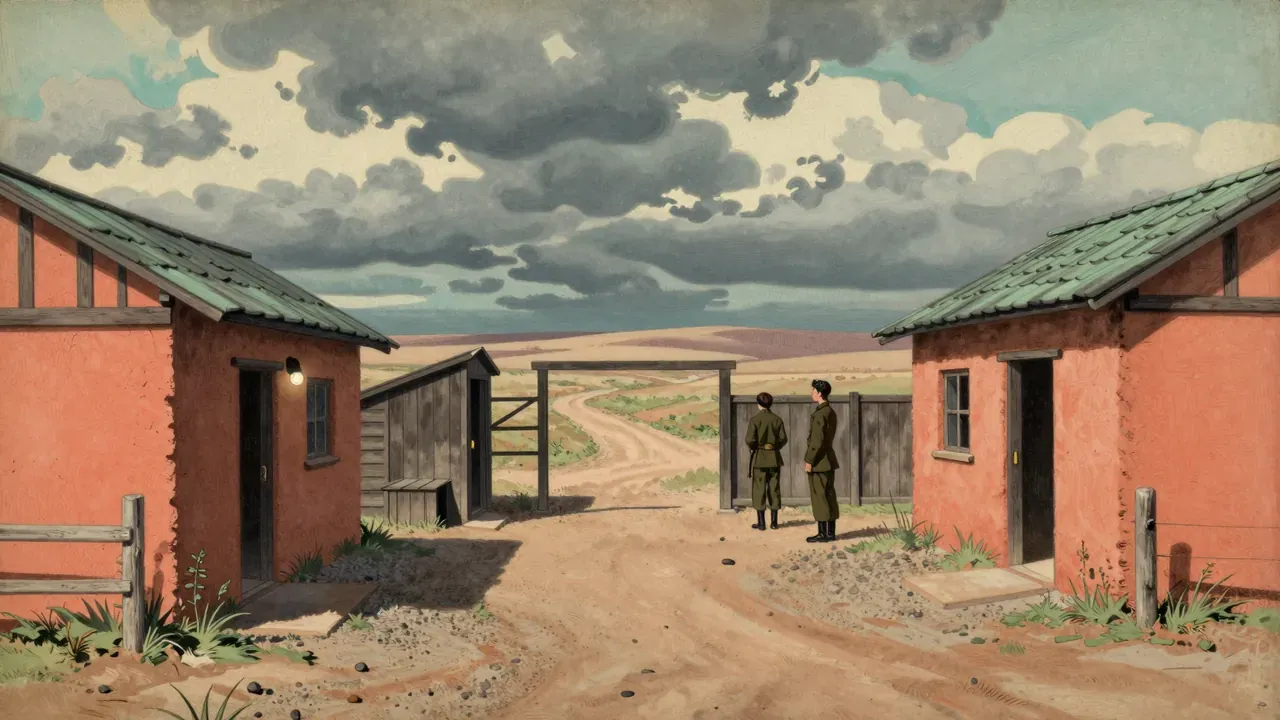
The story follows Harumi’s quiet descent into complicity and resistance within a closed, hierarchical world where desire and duty are violently incompatible. Yumiko Nogawa plays Harumi with minimal inflection — her face registers fatigue before feeling, resignation before rage. Tamio Kawachi’s Mikami is less a romantic lead than a nervous system under strain: his shifts between indifference, guilt and fatalism are conveyed through posture and hesitation, not dialogue. Isao Tamagawa’s Lt. Narita is chillingly banal — no mustache-twirling, just routine entitlement. Suzuki’s direction avoids grandeur: compositions are tight, often asymmetrical; interiors are lit with flat, unflattering light; camera movements are sparse and functional. The editing favours duration over rhythm — long takes hold on awkward silences, lingering on hands, uniforms, empty corridors. There is no score beyond diegetic sound: distant gunfire, muffled orders, the rustle of fabric. The production design leans on studio sets, but their artificiality is not disguised — walls are too close, skies too painted — reinforcing the claustrophobia of institutional fiction.
What lands
What lands is the cumulative weight of small, unvarnished choices: Harumi’s decision to run toward Mikami in the trench, not away; her silence when pleading with Narita; the way she grips his uniform collar moments before they die. These gestures carry more emotional force than any monologue because they emerge from behaviour, not exposition. The film’s realism is not photographic but behavioural — it trusts the audience to infer motive from gesture, hierarchy from spacing, power from who speaks first and who looks down. Suzuki’s refusal to aestheticise suffering — no slow motion, no swelling strings, no heroic framing — makes the final explosion feel inevitable, not cathartic. The brothel scenes avoid voyeurism: sex is transactional, weary, sometimes mechanical. Even the guerrilla attack is underplayed — no sweeping shots, no heroic last stands, just sudden noise and scrambling figures. This restraint gives the film its moral gravity: it refuses to flatter the viewer with clarity or redemption. What remains is the texture of endurance, and the quiet horror of systems that demand sacrifice without meaning.
What does not
What does not land is the film’s structural reliance on narrative ellipsis. Key transitions — Harumi’s arrival at the outpost, Mikami’s injury, the guerrillas’ motives — are implied rather than shown, leaving gaps that feel less like economy and more like omission. The political context of the Sino-Japanese War is absent: no maps, no radio broadcasts, no discussion of occupation policy — only its effects on individuals. This risks reducing the film to a psychological chamber piece, when its ambition is broader. Some performances falter under the weight of understatement: Shoichi Ozawa’s Sgt. Akiyama reads as inert rather than inscrutable; Jūkei Fujioka’s Kimura lacks the subtle menace needed to ground the chain of command. The film’s absurdist tone — Suzuki’s ‘extremely comical and absurd’ reading of military life — is present in glances and pauses, but never fully integrated into the dramatic logic. It flickers at the edges, never coheres. Without clearer tonal signposting, the juxtaposition of brutality and bathos can read as inconsistency rather than critique.
The themes that matter
The themes that matter are not love or sacrifice, but the architecture of consent under coercion, and the mutability of code. Harumi operates within two parallel systems — the brothel’s informal economy and the army’s formal hierarchy — both of which enforce obedience through isolation and surveillance. Her ‘prostitute’s code’ is not moral but practical: survival depends on reading men’s moods, anticipating shifts in power, knowing when to comply and when to vanish. Mikami’s officer’s code is equally hollow — he recites duty while violating every tenet of honour, then dies to restore a reputation no one else cares about. Suzuki treats these codes not as philosophies but as scaffolding: useful until they collapse, then discarded. The film also examines how institutions manufacture meaning through repetition — salutes, reports, punishments — even when the underlying purpose has evaporated. What persists is not ideology but habit, and the violence required to sustain it. This is not a film about individuals failing a system; it is about a system that only functions by producing failure.
Who should watch it, and who should not
This film is for viewers who value precision over persuasion, who find moral complexity in silence and discomfort in symmetry. It rewards attention to composition, timing and subtext — not those seeking narrative propulsion or emotional resolution. It is not for viewers who require clear protagonists, explanatory exposition or catharsis. Those who expect war films to clarify historical stakes or dramatise ideological conflict will find it withholding. Critics who valued Suzuki’s later, more flamboyant work — like Tokyo Drifter — may judge this too restrained; others who prefer Kurosawa’s moral clarity or Oshima’s polemical urgency may find it too oblique. A viewer who values historical fidelity might object to the studio-bound Manchuria; one who prioritises feminist agency might question Harumi’s passive arc. But none of these objections invalidate the film’s central achievement: its unwavering focus on how power wears down the body before it breaks the will.
Is it worth your evening
Yes, it is worth your evening — provided you watch it as a study in constraint, not as entertainment. Its ninety-six minutes accumulate like sediment: small decisions harden into fate; repeated gestures become ritual; silence grows heavier than speech. It demands patience, but repays it with a rare kind of honesty — about how institutions operate, how people endure, and how love functions not as salvation but as temporary shelter. Those who dislike it tend to do so on grounds of pacing or ambiguity, not incompetence: the craft is exact, the intent coherent. A viewer who finds it tedious likely expects narrative momentum or emotional payoff; change the expectation — treat it as a document, not a drama — and its rigour becomes apparent. It is not a film to enjoy, but one to reckon with. And reckoning, in this case, takes time, stillness and full attention.