The look of it
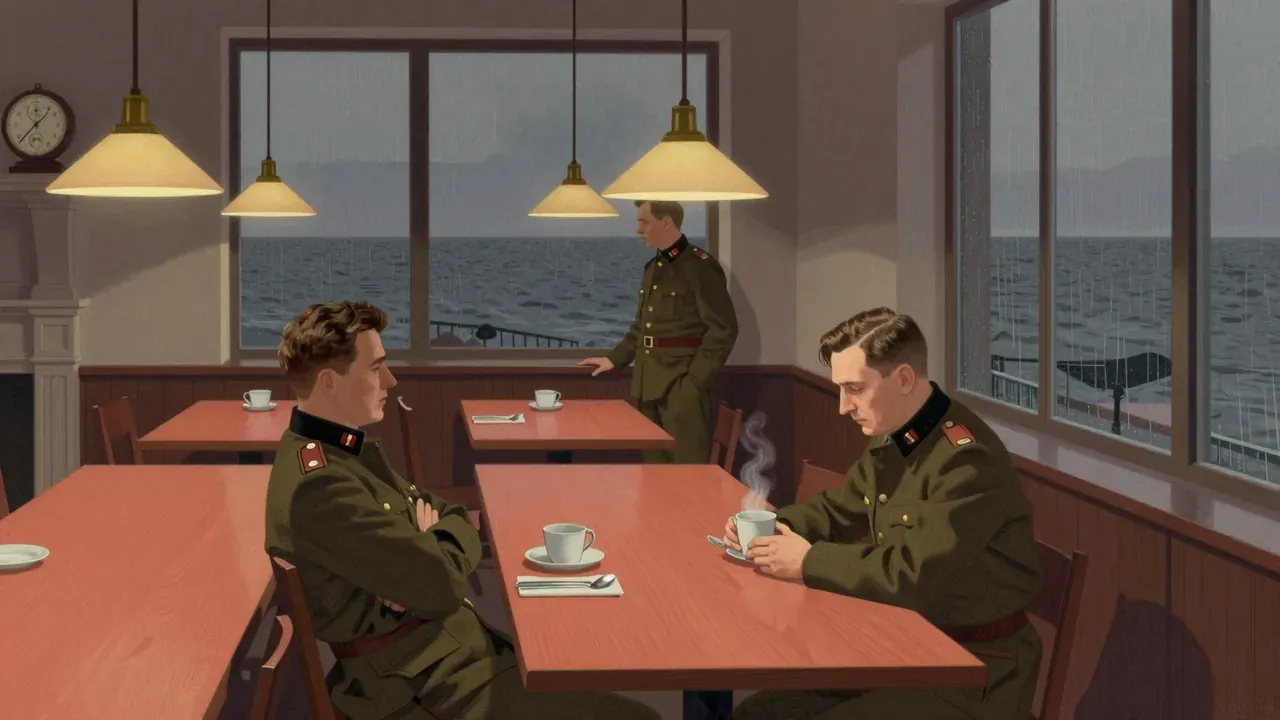
A Night to Remember is a British historical disaster film, released in 1958, that reconstructs the sinking of the RMS Titanic on 15 April 1912. It adapts Walter Lord’s 1955 book of the same name, aiming not for myth or melodrama but for procedural fidelity: to show how the ship foundered, how people behaved, and how systems failed or held under extremity. Its method is documentary-like — it avoids invented romance, minimises speculation, and distributes attention across crew, passengers, classes and decks without elevating one narrative thread above another until the final minutes. The film does not seek to indict individuals but to register collective assumptions — about safety, hierarchy, technology and national character — that proved fatally brittle. It was made with blueprints, survivor testimony and technical advisors including Fourth Officer Joseph Boxhall, and its ambition is structural realism: to make the sequence of events legible, inevitable and sobering. It treats the Titanic not as a symbol first, but as a vessel — and then lets the symbolism emerge from the weight of what happened aboard it. (148 words)
The rhythm of it
The film works through accumulation rather than climax: scenes build by cross-cutting between lifeboat launches, engine rooms, wireless cabins, first-class lounges and steerage corridors. Kenneth More anchors the action as Second Officer Lightoller, though his role synthesises duties performed by several real officers — a compression necessary for coherence, not heroism. Geoffrey Unsworth’s cinematography uses deep focus and restrained lighting to keep interiors dim but legible, avoiding theatrical shadows while preserving texture in wood panelling and brass fittings. Sidney Hayers’ editing maintains steady pacing, rarely lingering but never rushing; transitions are functional, often using sound bridges — the groan of stressed steel, the muffled chime of a clock — to sustain continuity across space. William Alwyn’s score is spare and tonal, underscoring tension without emoting. Performances are muted and precise: no actor overstates grief or panic, and even moments of moral failure — like the hesitation over loading lifeboats — are rendered as quiet choices, not caricatured cowardice. The craft serves the chronology, not the star. (157 words)
The weight of it
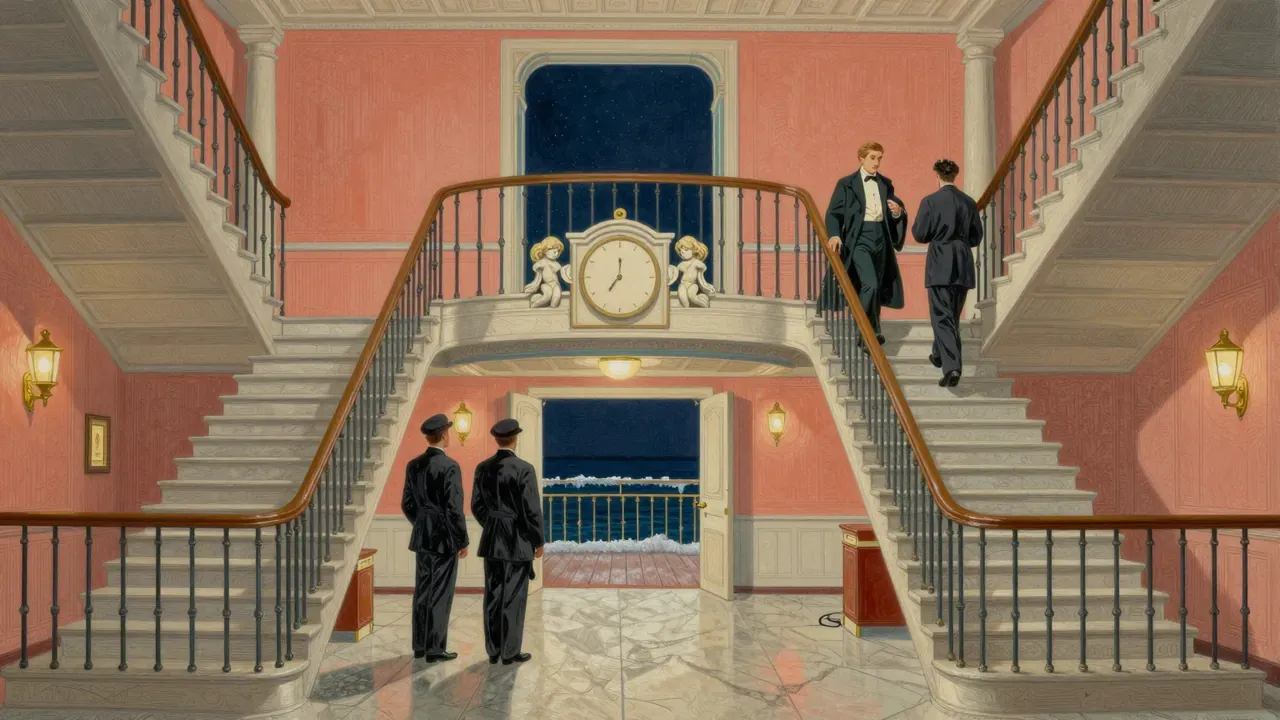
What lands is the cumulative weight of routine unravelling. The film makes the scale of the disaster legible not through spectacle but through repetition: lifeboat after lifeboat lowered half-empty, wireless operators sending the same signal again, stewards repeating instructions as if order might persist. The cold is palpable — in the icy water at Ruislip Lido, in the stillness of the North Atlantic night, in the clipped diction of officers reporting facts they cannot yet believe. The authenticity of detail — the placement of portholes, the layout of the grand staircase, the timing of the breakup — carries authority because it has been verified, not imagined. Even small gestures land: a steward handing a passenger a deck chair as if it were a coat check ticket; a band playing ragtime past midnight, then switching to hymns without comment. These are not flourishes but evidence — of habit, of training, of a world so accustomed to control that its collapse feels less like chaos than a slow, irreversible correction. The film earns its gravity not by raising its voice, but by refusing to raise it at all. (152 words)
The slip in it
What does not land is the attempt to impose a unifying psychological arc on Lightoller. His closing monologue — about disbelief and the end of certainty — is a late addition, absent from Lord’s book and the NBC teleplay, and it sits uneasily beside the film’s otherwise reticent tone. The decision to cast him as the sole focal point flattens the polyphony of the source material, where no single perspective dominates. Some historical compressions also grate: the near-absence of American passengers beyond a few named figures, the conflation of crew responsibilities, and the omission of key controversies — such as the Californian’s inaction — reduce complexity without clarifying cause. The production’s modest budget shows in places: rear-projection shots lack depth, and some exterior water work feels staged rather than submerged. But these are limitations of means, not intent — and the film never pretends to be anything other than a studio reconstruction. Where it falters is not in scale, but in occasional over-direction: telling us what the event meant, rather than trusting the audience to infer it from what they have just seen. (156 words)
The shape of it
The themes that matter are those embedded in procedure: the fragility of consensus, the inertia of routine, and the quiet violence of class as infrastructure. The film shows how social hierarchy dictated access to lifeboats not through shouted orders but through unlocked doors, unspoken expectations, and the absence of guidance in third class. It treats confidence not as hubris but as habit — the belief that the ship would not sink was not arrogance, but the default setting of an era built on industrial certainty. The disaster becomes a hinge: not between ‘then’ and ‘now’, but between two kinds of ignorance — one that assumes safety, and one that knows it is provisional. There is no redemption arc, no catharsis, only aftermath: the silence after the last whistle, the empty deck chairs, the lifeboat rowing away from a black horizon. The film’s moral centre is not virtue or vice, but accountability — not of individuals, but of systems that distribute risk unevenly and call it order. That this emerges without sermonising is its chief intellectual achievement. (149 words)
The demand of it
This film is for viewers who value precision over propulsion, who find tension in withheld information and dread in correct timing. It suits those accustomed to mid-century British cinema — its pace, its restraint, its trust in the audience to follow implication rather than exposition. It is not for viewers who require emotional signposting, narrative escalation or a protagonist whose inner life drives the plot. Those expecting the operatic sweep of the 1997 Titanic will find this austere, even withholding. Nor is it for those who treat history as backdrop: the film assumes familiarity with the basic chronology and resists explaining nautical terms or White Star Line protocols. Anyone seeking moral simplification — clear villains, unambiguous heroes — will leave unsatisfied. The film refuses to assign blame to Ismay or praise Lightoller beyond his documented actions. Its integrity lies in that refusal. A viewer who values historical texture over dramatic convenience will find it absorbing; one who measures a film by how much it makes them feel, rather than how much it makes them know, may find it distant. (150 words)
The measure of it
Yes, it is worth your evening — not as entertainment, but as calibration. It occupies ninety minutes with the weight of a primary source, offering a benchmark against which later Titanic films, and disaster narratives more broadly, can be measured. Its value lies in its discipline: every choice serves the chronology, not the market. It rewards attention, not passive viewing — you must track shifts in time, location and responsibility, and the film gives no shortcuts. Those who watch it on a screen smaller than a laptop may miss the nuance of Unsworth’s lighting or Hayers’ rhythmic cuts, and the mono soundtrack loses some of Alwyn’s spatial layering. But even then, its structure remains legible. Historians, educators and students of adaptation will find it indispensable. Casual viewers may need context — a glance at Lord’s preface, or a quick read of Boxhall’s testimony — to fully register its rigour. Without that, it risks seeming dry. With it, it feels urgent. (152 words)