The shape of suspense
The Lodger: A Story of the London Fog is Alfred Hitchcock’s third feature and his first thriller — a silent British film from 1927 that adapts Marie Belloc Lowndes’s 1913 novel about public panic during a Jack the Ripper–style murder spree. It sets out to generate suspense not through exposition or dialogue but through visual rhythm, spatial tension, and psychological suggestion. The film does not aim to reconstruct Victorian London historically, nor to dissect criminal psychology in depth; instead, it uses the lodger’s ambiguous presence — his silence, his pacing, his locked cabinet — as a structural device to sustain doubt across its seventy minutes. Its ambition is formal: to prove that suspense can be built like architecture, with weight, balance, and calculated omission. It treats the audience as participants in inference, not recipients of explanation. This is not a procedural but a pressure-cooker — tightening around perception itself. The studio’s insistence on clarifying the lodger’s innocence reshaped the ending, but the film’s core mechanism remains the same: making uncertainty feel physical, even architectural, in every frame. It is less about who committed the murders than about how easily suspicion settles, and how quickly it spreads.
The grammar of unease
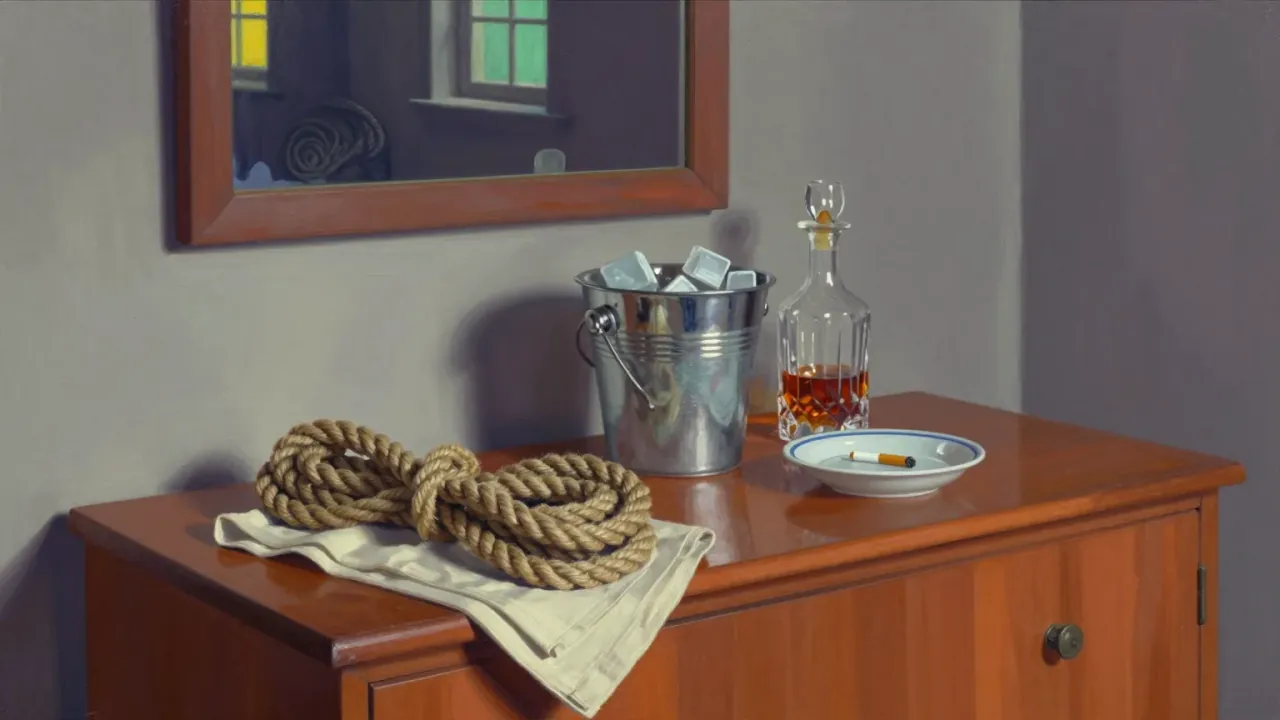
The story unfolds through tightly controlled sequences: the Buntings’ kitchen ceiling turning transparent to reveal the lodger pacing above; the lodger’s hand sliding down the banister in a vertiginous downward shot; portraits of blonde women turned face-inward before being removed. Gaetano di Ventimiglia and Hal Young’s cinematography uses high-contrast lighting, oblique angles, and layered compositions — often borrowing from German expressionism without replicating its symbolism wholesale. Ivor Novello’s performance is restrained, internalised, relying on posture and glance rather than gesture. June Tripp, as Daisy, conveys shifting allegiance through small shifts in proximity and eye contact. Marie Ault and Arthur Chesney ground the domestic sphere in weary realism. Ivor Montagu’s editing sustains momentum without title cards for long stretches — sixty-five shots in one six-minute sequence, as reported, rely entirely on visual logic. The film avoids intertitles where possible, trusting composition, movement, and reaction to carry meaning. Even the cameo — Hitchcock at a telephone desk — functions as a quiet punctuation mark, not a wink. Every technical choice serves the central question: what do we believe, and why do we believe it?
The weight of watching
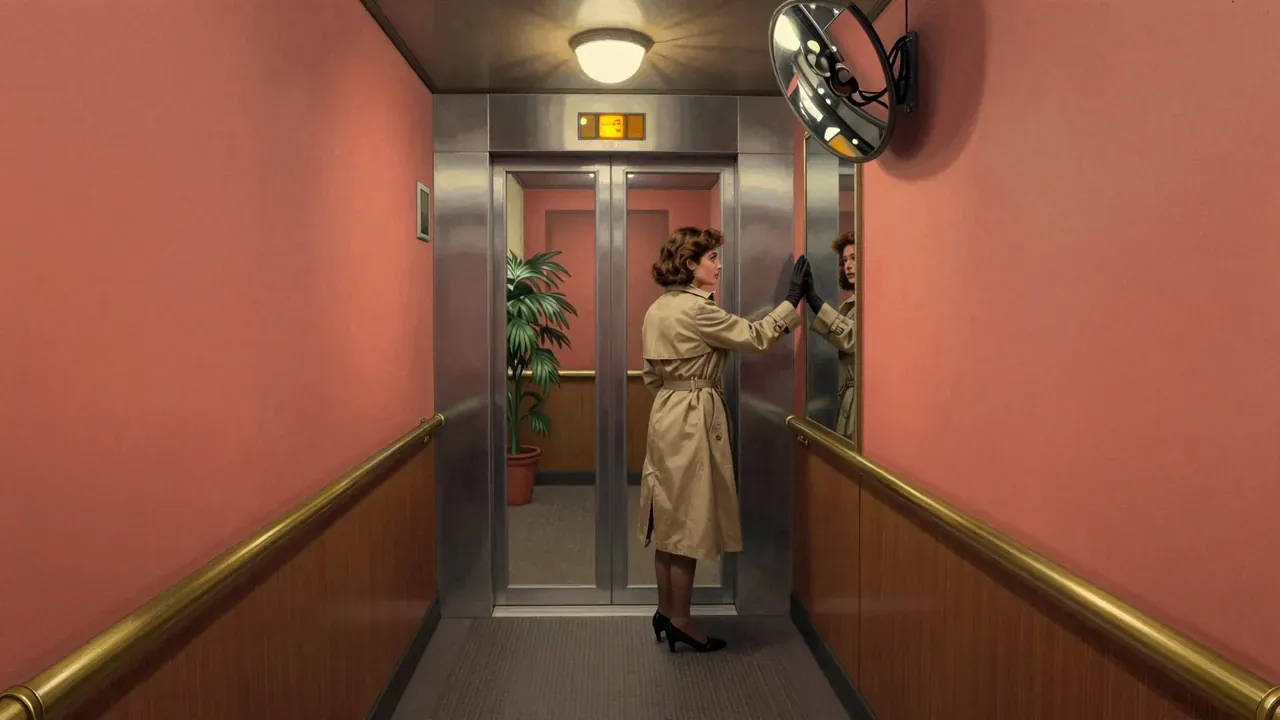
What lands is the sustained atmosphere of dread built from ordinary spaces made strange: a staircase becomes a throat; a ceiling becomes a membrane; a locked cabinet becomes a moral test. The Buntings’ home feels both claustrophobic and porous — sound travels upward, footsteps echo, glances linger too long. Hitchcock’s use of subjective framing — the camera tilting with Daisy’s rising anxiety, or holding tight on Mrs. Bunting’s face as she listens for danger — makes the audience complicit in the surveillance. The mob sequence near the end works not because of choreography but because of cumulative misdirection: every earlier shot of neighbours whispering, peering, hesitating has prepared us for their sudden, violent certainty. The resolution — the paperboy’s interruption — lands cleanly because the film has spent so long training us to read newsprint, headlines, and public reaction as narrative agents. Even the final embrace feels earned, not sentimental: it follows injury, exposure, and collective error. The film’s restraint means its emotional payoffs are narrow but precise — relief, not catharsis; recognition, not revelation.
Where the scaffolding shows
What does not land is the romantic thread between Daisy and the lodger, which lacks sufficient grounding in shared history or mutual discovery. Their attraction appears as plot necessity rather than psychological inevitability — she responds to his mystery, not his character. Joe Chandler, played with earnestness by Malcolm Keen, remains functionally two-dimensional: a cipher for institutional authority rather than a rival with interiority. The film’s reliance on visual shorthand occasionally slips into cliché — the blonde victims as interchangeable icons, the Burne-Jones paintings as heavy-handed foreshadowing — and some transitions between domestic and public space feel abrupt, as if the editing prioritises rhythm over continuity. The studio-mandated clarification of the lodger’s innocence also flattens the moral ambiguity that the source material and early script drafts embraced. Without that uncertainty, the film loses some of its philosophical edge — it becomes less about the instability of truth and more about the vindication of virtue. That shift weakens the critique of mob logic, which depends on the possibility that the crowd might be right.
The contagion of belief
The themes that matter are suspicion as contagion, the fragility of reputation, and the violence of collective certainty. The film treats the city not as setting but as nervous system: newsprint circulates faster than facts, rumour migrates through windows and stairwells, and identity dissolves under scrutiny. Hitchcock returns repeatedly to thresholds — doorways, staircases, windows — as sites where private and public selves collide. The lodger’s locked cabinet is less a plot device than a metaphor for the unknowable interior; the Buntings’ decision to search it is an ethical breach disguised as duty. There is also a quiet interrogation of masculinity: Joe’s authority is procedural and brittle, the lodger’s is silent and wounded, Mr. Bunting’s is passive and ineffectual. The film does not foreground sexuality or homosexuality explicitly, but it registers discomfort around male intimacy, coded in glances, proximity, and the lodger’s isolation. These are not themes declared but implied — held in the angle of a head turn, the duration of a pause, the way light falls across a face in shadow.
Who the film asks for
This film is for viewers who value visual storytelling over exposition, who find suspense in stillness and implication over action, and who are willing to meet a silent film on its own terms — attentive to composition, rhythm, and gesture. It rewards patience with structural intelligence and stylistic consistency. It is not for those who require psychological realism, narrative transparency, or rapid pacing; the seventy-minute runtime feels deliberate, not rushed, and its silences are functional, not atmospheric filler. Some modern viewers may find the acting stylised or the moral framework outdated — particularly the treatment of Daisy as catalyst rather than agent. Others, especially fans of later Hitchcock, will recognise the DNA of his preoccupations but miss the irony or self-awareness that would emerge in sound films. The film assumes a viewer familiar with silent conventions — title cards used sparingly, expressive faces, symbolic props — and offers no concessions to unfamiliarity.
Why it holds
Yes, it is worth your evening — provided you approach it as a foundational text rather than a polished entertainment. Its seventy minutes unfold with the gravity of a clockwork mechanism: each gear turns only when necessary, each pause calibrated. It repays attention not because it is obscure, but because it is economical — every shot advances mood, theme, or structure. Those who expect narrative propulsion or character depth may leave unsatisfied, but viewers open to formal rigour and historical significance will find it richly instructive. It is not ‘entertaining’ in the contemporary sense, but it is absorbing in a different register — tactile, architectural, insistently visual. To dismiss it as archaic is to miss how deliberately it builds its world from scratch. Its power lies not in what it says, but in how relentlessly it shows — and how much it trusts the viewer to follow.