The crash and the sand
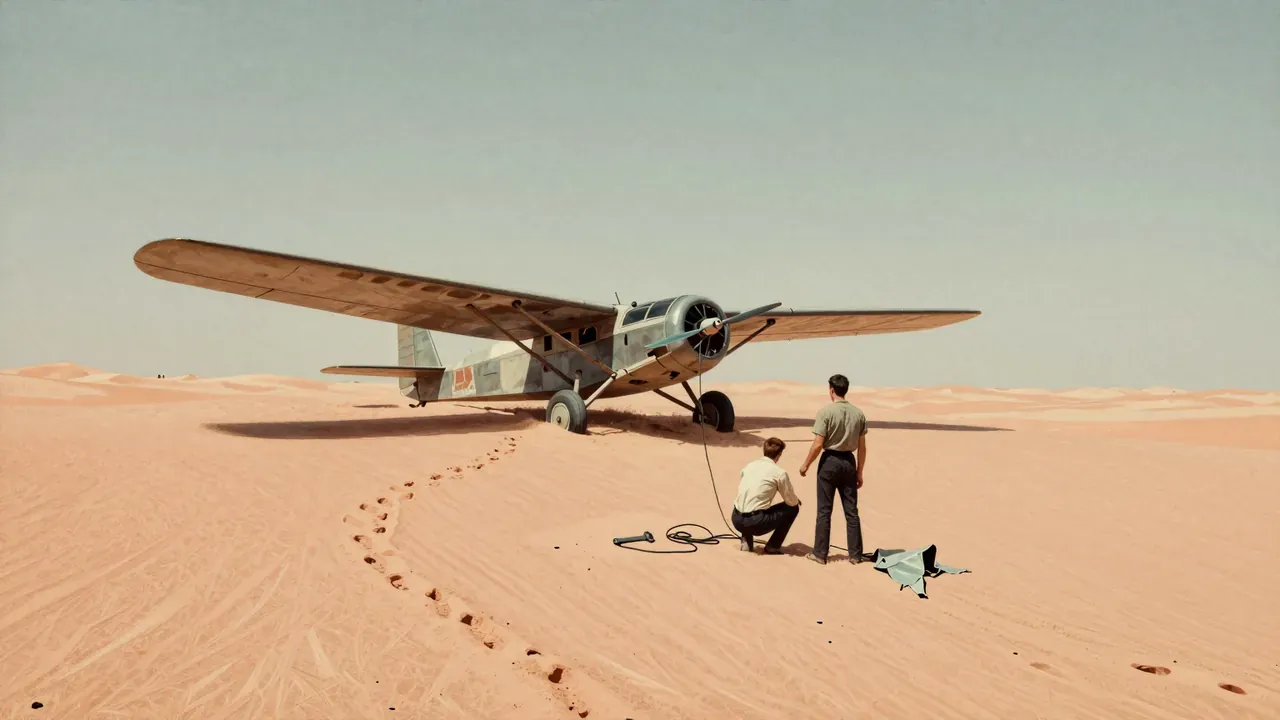
The Flight of the Phoenix is a 1965 American disaster film that dramatises survival and collective ingenuity after a cargo plane crashes in the Sahara. It adapts Elleston Trevor’s 1964 novel, narrowing its focus to a tight ensemble of men—pilots, soldiers, engineers, labourers—stranded with no radio, dwindling water, and no prospect of rescue. Its central proposition is not suspense about whether they will survive, but whether they can build belief in an idea: that a functional aircraft might be assembled from wreckage, under desert heat, without blueprints or expertise. Robert Aldrich directs it as a procedural allegory, where each technical decision—how to re-rig the wings, how to conserve cartridges, how to distribute water—carries moral weight. The film does not treat survival as a test of individual grit alone, but as a negotiation between authority, competence, deception, and shared delusion. It aims for psychological realism within a physically extreme frame, using the desert not as backdrop but as a pressure chamber for hierarchy, nationality, and professional identity. Its ambition is structural: to make the mechanics of construction feel as urgent as the mechanics of thirst.
Who carries the water
The story unfolds in deliberate, unadorned blocks: crash, inventory, failed expedition, proposal, resistance, labour, crisis, flight. Lukas Heller’s script gives each man a function and a flaw—Stewart’s Towns is rigid, Finch’s Dorfmann is arrogant, Attenborough’s Moran is mediating—and lets their conflicts accrue rather than explode. Joseph F. Biroc’s cinematography avoids grandeur: the desert is flat, bleached, unromantic; interiors are cramped, dusty, lit with practical sources. Michael Luciano’s editing sustains rhythm without flourish—cuts land on hands tightening bolts, on faces cracking under sun, on water skins growing lighter. Performances are restrained: Stewart underplays command, Finch modulates certainty and fragility without tipping into caricature, Bannen’s quiet dignity as Gabriele anchors the film’s emotional gravity before his death. Frank De Vol’s score is sparse, mostly absent during construction scenes, returning only at take-off—not as triumph, but as release. There is no voiceover, no flashbacks, no exposition beyond what the men say aloud or do with their hands. The craft serves the premise without embellishment.
The shape of the Phoenix
What lands is the cumulative weight of physical effort. The sequence in which the men haul the Phoenix up the dune—no music, just grunts, shifting sand, strained rope—is the film’s moral centre: a shared act that transcends language, rank, or doubt. The design of the aircraft itself lands: the C-82’s twin-boom layout makes Dorfmann’s plan visually legible, and the jury-rigged Phoenix feels plausible because its parts are visible, named, and handled repeatedly. Stewart and Finch’s final reconciliation lands not as sentiment but as exhaustion and mutual recognition—neither man has won, but both have been remade by the work. The film’s refusal to flinch from Gabriele’s suicide, or Harris’s abandonment by Watson, lands as integrity: hope is not guaranteed, nor is competence. Even the aerial photography—using modified O-47A and Phoenix P-1—lands as grounded spectacle: the take-off is low, fast, unsteady, shot from ground level, not from a soaring crane. These choices cohere. They do not ask for awe, only attention.
The model-maker’s secret
What does not land is the film’s attempt to sustain ambiguity around Dorfmann’s credibility. Once his background as a model-aircraft designer is revealed, the narrative pivots on whether he is dangerously deluded or quietly brilliant—but the film never supplies enough technical detail to let the audience judge. His explanations remain vague; the physics of the rebuild are gestured at, not shown. This leaves the stakes intellectual rather than visceral: we trust Towns’ decision because he is Stewart, not because the engineering persuades us. Similarly, the Arab camp subplot arrives late and vanishes without consequence, feeling like a discarded thread. The desert, though starkly filmed, never acquires symbolic density—it stays literal, which suits the film’s plain style but limits resonance. And while the ensemble is large, several characters—Marquand’s Standish, Fraser’s Ratbags, Krüger’s Heinrich—remain functional rather than dimensional, their arcs truncated by runtime and narrative economy. The film’s rigour becomes its limit: it refuses to deepen what it does not need to move the plot forward.
The seventh cartridge
The themes that matter are endurance as collective ritual, expertise as contested currency, and invention as an act of faith rather than mastery. The film treats engineering not as revelation but as iteration: measurements are guessed, tools improvised, failures absorbed without ceremony. Nationality matters only in friction—Dorfmann’s German identity provokes Towns’ wartime memories, but neither man invokes ideology; their conflict is professional, not political. Class is present but unspoken: Cobb’s mental fatigue marks him as expendable, yet his defiance precedes his death, making his absence felt in the silence after. Water rationing becomes the film’s moral ledger—each sip weighed against labour, each transgression (Dorfmann’s, later Towns’) a breach of contract. The Phoenix is not rebirth but salvage: no ashes, only aluminium, canvas, and desperation. There is no divine intervention, no deus ex machina—only men choosing to keep turning wrenches until the engine catches. The film’s quietest theme is humility: the real miracle is not flight, but that seven men agreed on a single, improbable next step.
The take-off
It is for viewers who value procedural clarity over emotional catharsis, who find tension in calibrated risk and sustained effort, and who accept that competence may be narrow, flawed, and self-taught. It rewards patience with texture: the sound of rivets, the grain of sun-baked canvas, the way light falls on a wing strut at noon. It is not for those who require character backstories, psychological exposition, or narrative symmetry—the film ends where the rescue begins, refusing epilogue or reflection. Those who expect the desert to symbolise spiritual trial, or the Phoenix to signify personal transformation, will find it literal to the point of austerity. It also assumes tolerance for mid-sixties pacing: long takes, minimal coverage, dialogue that serves function over wit. A viewer who values Aldrich’s earlier, more volatile work—like Kiss Me Deadly—may find this too measured. But anyone willing to sit with the weight of a single bolt being tightened, again and again, will find it absorbing.
The oil rig
Yes, it is worth your evening—provided you approach it as a study in applied will, not as escapism. Its 142 minutes pass without hurry but never drag, anchored by Biroc’s unsentimental images and Luciano’s precise cuts. It repays attention not with twists or revelations, but with the slow accumulation of shared purpose. Some will call it dry; others, especially those familiar with aviation history or survival logistics, will recognise its fidelity to constraint. It does not ask for admiration, only engagement. Those who dislike films where the climax is a successful engine start—and where the greatest drama lies in whether the fifth cartridge will fire—will leave unmoved. But for viewers who find dignity in labour, clarity in craft, and quiet force in restraint, it remains a rare, unshowy demonstration of how much can be built from almost nothing—if everyone agrees on the next thing to do.