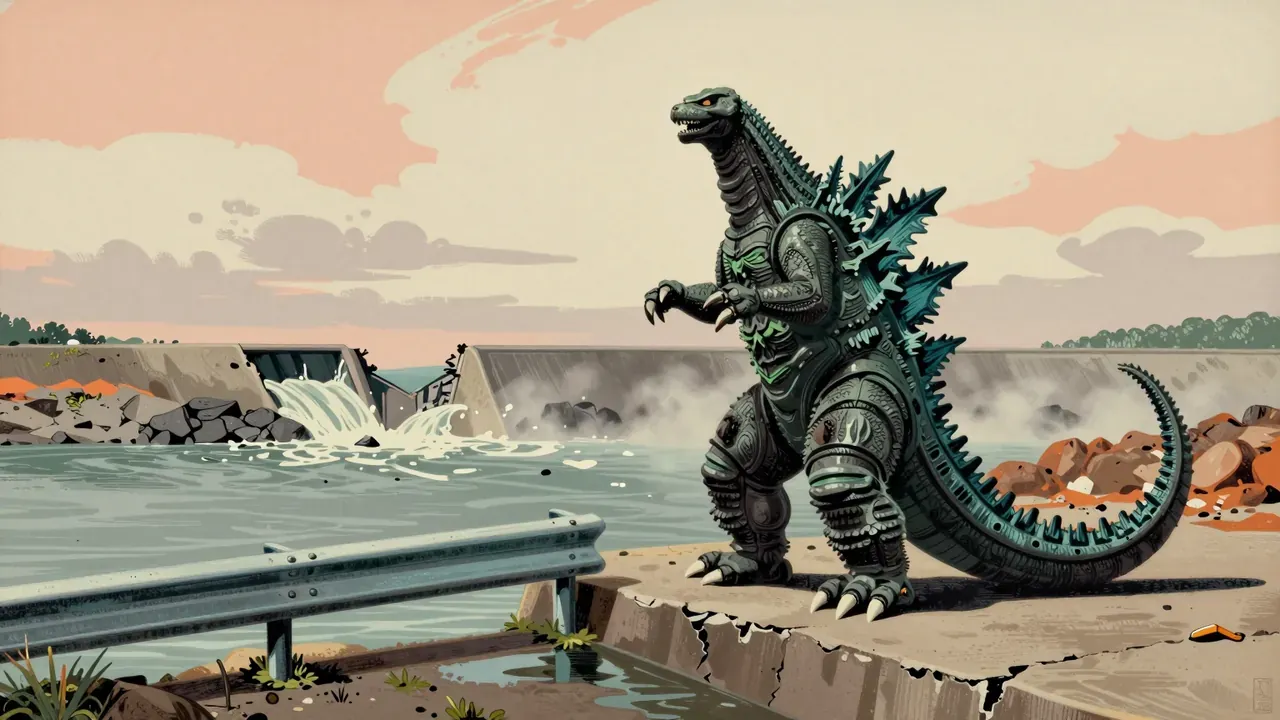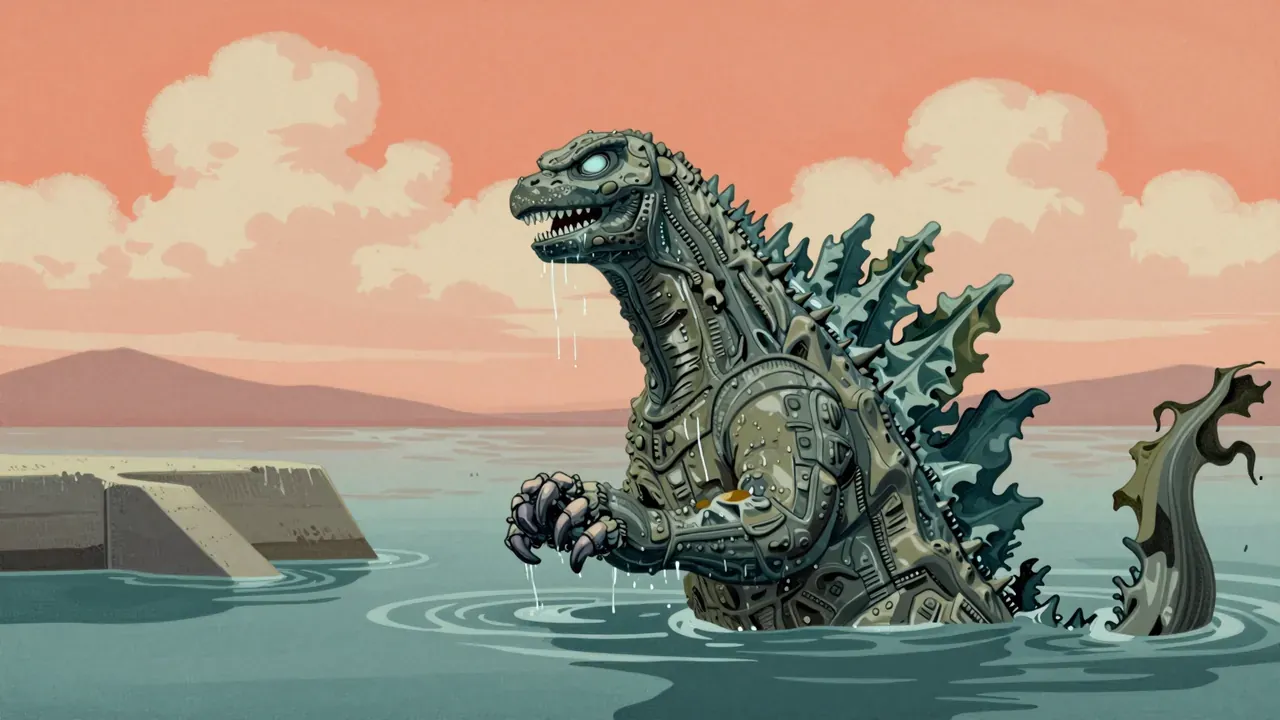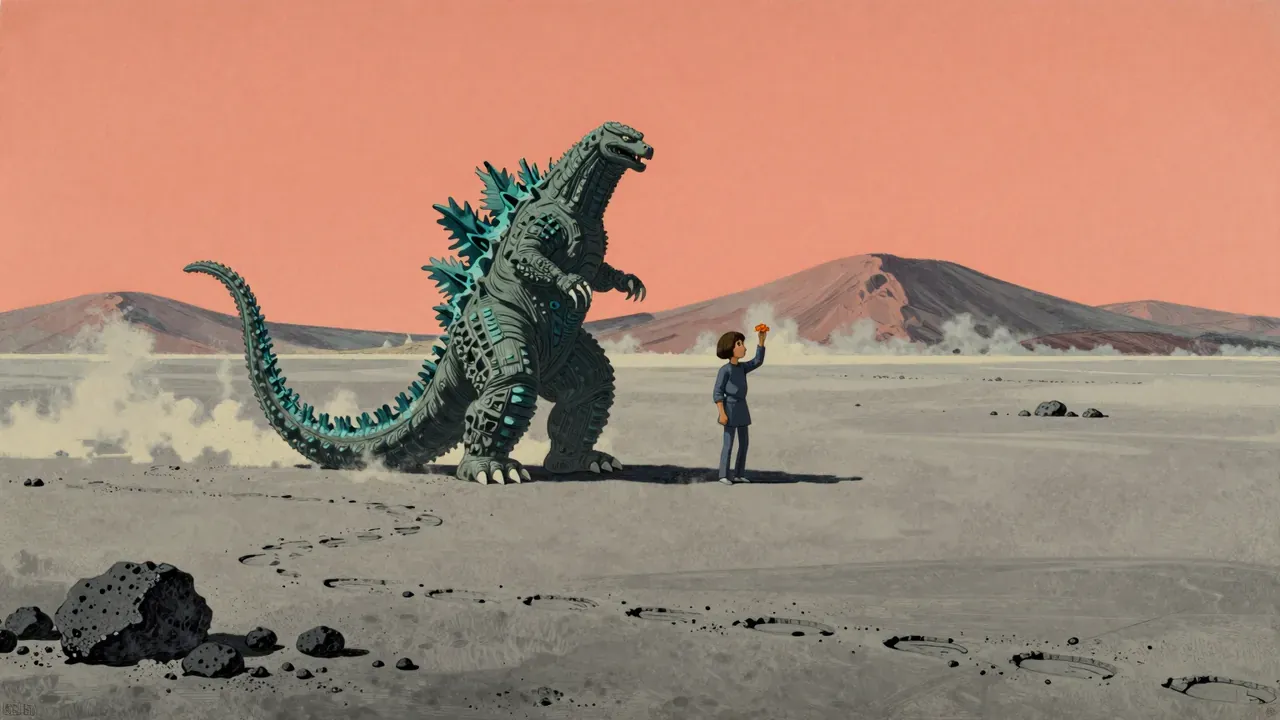
The look of it
Son of Godzilla is the eighth entry in Toho’s Godzilla series and the second directed by Jun Fukuda, made on a reduced budget while the studio prioritised King Kong Escapes. It attempts a tonal pivot: away from Cold War allegory or nuclear dread, towards familial bonding and juvenile spectacle. The film introduces Minilla — Godzilla’s infant son — not as a narrative device for escalation but as a structural anchor, reframing the kaiju as parent rather than force of nature. Its island setting, weather-control subplot, and emphasis on telepathic communication between monsters all serve this shift. The production explicitly targeted Japan’s ‘date crowd’, aiming to broaden the franchise’s appeal with cuteness, gentle humour, and inter-species tenderness. This was a commercial calculation, not a thematic deepening: the paternal Godzilla is less an evolution of the character than a rebranding, designed to soften the monster for younger audiences and couples seeking light entertainment. The film’s ambitions are modest and functional — to sustain the series with fresh iconography, not to interrogate its own mythology.
The shape of it
The story follows scientists testing a weather-control system on Solgell Island, disrupted by giant mantises (Kamacuras) and later a spider (Kumonga), whose presence ties back to Saeko’s father’s warnings. Haruo Nakajima appears briefly as Godzilla, though most of the role falls to Seiji Onaka and Hiroshi Sekita in a newly oversized suit meant to convey paternal bulk. Marchan the Dwarf plays Minilla, whose design borrows from Osomatsu-kun’s Chibita — wide-eyed, waddling, expressive in limited ways. Kazuo Yamada’s cinematography favours flat, sun-bleached exteriors, with Guam and Fuji Five Lakes locations giving a scrubby, unromantic tropicality. Masaru Sato’s score leans into jaunty brass and playful percussion for Minilla’s scenes, contrasting with heavier, more traditional motifs for Godzilla’s entrances. Shinichi Sekizawa’s script avoids exposition dumps but relies on repetition — Minilla’s failed atomic breath, Godzilla’s tail-stomping corrections — to build rhythm rather than tension. Performances are functional: Tadao Takashima’s reporter Maki Goro is affable but inert; Akira Kubo and Akihiko Hirata deliver dry, procedural line readings as scientists. There is no psychological depth, only situational clarity.
The weight of it
What lands is the physical contrast between Godzilla and Minilla — their size difference, gait, vocal timbre — which carries the film’s central idea without needing dialogue. The staging of Minilla’s first steps, his smoke-ring ‘breath’, and his clumsy intervention during Saeko’s peril all land with a kind of low-stakes sincerity. Marchan’s physical performance inside the rubber suit gives Minilla a tangible, almost Chaplinesque vulnerability: his rolls, tumbles, and wide-eyed glances register as childlike rather than merely cute. The Kamacuras’ marionette work — jerky, insectile, unnervingly precise — creates a consistent sense of scale and threat without overreliance on spectacle. The snow effect, made from paraffin and styrofoam, looks deliberately artificial, reinforcing the film’s handmade charm. Even the weather-control balloon’s malfunction feels grounded in cause-and-effect logic, not arbitrary plot convenience. These elements cohere because they operate within the film’s self-imposed limits: it does not try to be profound, nor terrifying, nor even particularly coherent in its science — it tries to be legible, rhythmic, and visually distinct, and succeeds on those terms.
The gap in it
What does not land is the attempt to treat Godzilla as a nurturing figure without undermining his established menace. The script deletes earlier, harsher versions of their relationship — scenes where Godzilla abandons Minilla or head-butts him — leaving only gestures that feel unearned: a roar interpreted as encouragement, a tail-stomp as pedagogy. Without those edges, the paternal dynamic flattens into sentimentality. Saeko’s character has no agency beyond being a conduit for exposition and maternal projection; her bond with Minilla is asserted, not developed. The scientists remain interchangeable technicians, their weather project never meaningfully integrated into the island’s ecology or the monsters’ origins. The Kumonga sequence arrives late and underdeveloped, its threat dissolving into a perfunctory showdown rather than climax. The American television cut trimmed two minutes, but the original’s pacing still drags in the middle stretch — long shots of Minilla wandering, repeated close-ups of scientists adjusting dials, static wide shots of empty jungle — all of which suggest budget constraints mistaken for atmosphere. The film’s gentleness becomes indistinction.
The lesson in it
The themes that matter are not about nuclear anxiety or ecological collapse — those recede — but about dependency, instruction, and the awkwardness of growth. Minilla’s struggle to produce atomic breath mirrors adolescent fumbling: he requires stress or provocation to access his power, and even then, it emerges as smoke before fire. Godzilla’s teaching is physical, repetitive, non-verbal — less mentorship than muscle memory. This is not mythic inheritance but embodied habit. The island functions as a closed pedagogical space: no outside authority intervenes, no moral framework is imposed — only trial, correction, and eventual replication. Saeko’s mango offering is not symbolic nourishment but literal calibration: food as feedback, sustenance as reinforcement. The film treats learning as tactile, iterative, and often comical — a theme more aligned with post-war Japanese educational films than with kaiju tradition. There is no triumph over evil, only incremental competence. Even the final battle serves this: Minilla does not defeat Kumonga, but distracts him long enough for Godzilla to act — a lesson in timing, not victory.
The audience for it
This film is for viewers who value craft continuity over narrative ambition — fans of Toho’s Shōwa-era special effects, students of puppetry and suit performance, or those interested in how genre franchises pivot commercially without abandoning their material grammar. It rewards attention to texture: the grain of the rubber suits, the syncopation of marionette strings, the way Sato’s music cues Minilla’s wobble before his fall. It is not for viewers expecting thematic density, psychological realism, or sustained suspense — those will find its pacing slack and its emotional beats thin. Anyone seeking the gravitas of Honda’s early entries or the operatic scale of Destroy All Monsters will be disappointed. The film assumes familiarity with Godzilla’s iconography and asks only that you accept its premise as given. That assumption works if you’re already inside the frame — but fails if you approach it as standalone drama or allegory. Its pleasures are specific, tactile, and historical — not universal.
The time in it
Yes, it is worth your evening — provided you watch it as a document of mid-1960s Japanese genre filmmaking at a particular inflection point: when kaiju cinema began accommodating youth culture without surrendering its artisanal roots. Its 86 minutes pass without strain, and its visual ideas — the paternal Godzilla suit, the Chibita-faced Minilla, the paraffin snow — linger longer than its plot. Those who dismiss it as ‘kids’ stuff’ miss how seriously it takes its own mechanics: every puppeteer’s pull, every suit actor’s stumble, every musical cue is calibrated to a single, quiet aim — making the impossible feel tactile. It would not hold up as a first Godzilla film, nor as a late-career statement, but as a pivot — modest, deliberate, materially rich — it earns its place. To call it slight is accurate; to call it empty is to misread its economy.