The premise
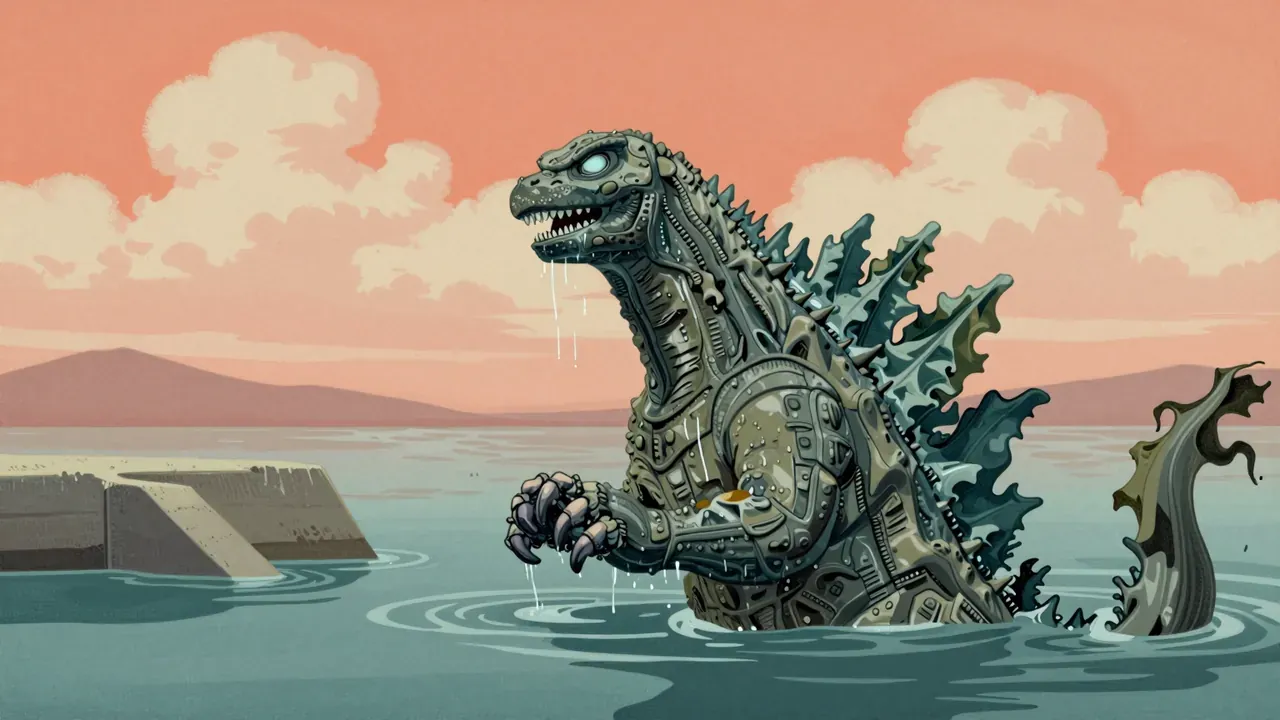
Godzilla vs. the Sea Monster is a 1966 Japanese kaiju film produced by Toho, directed by Jun Fukuda, and released in Japan as Ebirah, Horror of the Deep. It attempts to pivot the Godzilla franchise toward tropical adventure and juvenile spectacle, shifting from urban destruction to a South Seas island setting populated by captive humans, a giant crustacean, and Mothra. The film’s central aim is structural economy: it repurposes existing suits (Mothra, Rodan’s condor), avoids expensive city miniatures, and reworks a script originally conceived for King Kong — substituting Godzilla late in development without substantial revision. Its tone leans into lightness, aided by Masaru Sato’s breezy score and a narrative that treats Godzilla less as a force of nature than as a grumpy but loyal guardian. This is not a film about nuclear anxiety or postwar trauma, but about rescue, hierarchy among monsters, and the logistics of staging large creatures on a low budget. It seeks coherence through repetition — familiar actors, recycled effects techniques, and a plot built around escape rather than confrontation.
The structure
The story follows a group of shipwrecked humans taken captive by the ape-like inhabitants of Letchi Island, who worship the giant lobster Ebirah. Godzilla arrives, fights Ebirah, and later teams with Mothra to defeat him. Haruo Nakajima performs Godzilla in waterlogged suits, often submerged in winter shoots; Kazuo Yamada’s cinematography keeps the island daylight flat and functional, avoiding dramatic contrast. Shinichi Sekizawa’s script retains Kong-era beats — a damsel-in-distress dynamic, a monster’s affection for a human (Daiyo), and a climactic duel staged for visual clarity over emotional weight. Akira Takarada plays the earnest leader; Kumi Mizuno, cast last-minute after Noriko Takahashi’s appendectomy, delivers calm authority without flourish. Sadamasa Arikawa’s special effects rely on aquarium shots, rear projection, and minimal compositing — a deliberate retreat from Tsuburaya’s layered illusions. The underwater sequences are physically taxing but visually monotonous; the island set is a single miniature, reused across angles. Dialogue is expository, pacing brisk but uninflected.
The look of it
What lands is the film’s tactile physicality: the heft of Nakajima’s Godzilla suit resisting water, the grain of the miniature island under Yamada’s lens, the slight unease of Ebirah’s jerky, stop-motion-adjacent movements. The pairing of Godzilla and Mothra feels earned not by narrative logic but by shared screen presence — two established icons sharing space without competition. The low-budget choices cohere into a distinct texture: the lack of city destruction makes the island feel genuinely isolated, and the absence of elaborate effects forces attention onto performance and rhythm. Even the dub — Hal Linden’s dry, mid-Atlantic voice for Takarada’s character — adds an accidental layer of deadpan irony that suits the film’s unpretentious tone. The music, lighter than Ifukube’s scores, avoids gravitas and instead underscores action with jaunty percussion and woodwind flourishes. These elements do not aspire to profundity, but they settle into a consistent register: modest, procedural, and quietly committed to its own constraints.
The gaps
What does not land is the attempt to sustain emotional investment in the human subplot. The captives’ plight lacks urgency or specificity — their suffering is gestural, their rebellion perfunctory. The ape-like natives are reduced to silent, costumed background figures with no cultural or narrative function beyond obstacle. Mothra’s appearance feels tacked on, her followers’ ritualistic chanting underserved by both script and staging. The substitution of Godzilla for Kong leaves narrative seams visible: Godzilla’s protectiveness toward Daiyo reads as arbitrary, and his motivation remains unexamined. The underwater photography, while technically demanding, yields murky, indistinct images that flatten spatial relationships. Fukuda’s direction is efficient but uninflected — there is no tonal variation between a chase, a speech, or a monster’s entrance. The film’s attempt at lightness occasionally tips into vacancy, particularly in scenes meant to be playful or wondrous, which instead pass without resonance. It is not badly made, but it is narrowly made — every choice serves expediency over expression.
The ideas
The themes that matter are substitution and endurance. This is a film built on replacements: Kong for Godzilla, Takahashi for Mizuno, Tsuburaya’s oversight for Arikawa’s execution, Ifukube’s gravity for Sato’s levity. It treats myth-making as a logistical exercise — monsters are props, stories are templates, meaning accrues through repetition rather than invention. There is also a quiet theme of environmental containment: the island is both prison and sanctuary, Ebirah both threat and ecosystem anchor, Godzilla both invader and stabiliser. The humans are not agents of change but nodes in a pre-existing chain — rescued not because they deserve it, but because the structure requires a rescue. Colonial dynamics surface obliquely: the island is unnamed, its people voiceless, its resources (pearls, labour) extracted by unseen forces. But these are textures, not arguments. The film does not interrogate hierarchy — it reproduces it, between monsters, between humans and monsters, between Japan and the imagined South Pacific — and does so without irony or critique.
The audience
This film is for viewers who value craft continuity over narrative ambition: fans of Toho’s Shōwa-era production rhythms, students of practical effects history, or those interested in how genre franchises pivot under budgetary pressure. It rewards attention to suit performance, miniature construction, and musical leitmotif reuse. It is not for viewers seeking psychological depth, thematic complexity, or stylistic distinction — Fukuda’s direction offers no interpretive friction, and the script provides no ambiguity to unpack. Those expecting the moral weight of Honda’s Godzilla or the operatic scale of Ghidorah will find it thin. A viewer who dislikes repetition, appreciates strong human stakes, or prioritises visual clarity over tactile authenticity will likely disengage. The film’s virtues are cumulative and subtle; they require patience with its pace and tolerance for its limitations. Without that baseline, it reads as hollow rather than economical.
The time
Yes, it is worth your evening — provided you watch it as a document of industrial adaptation, not as a self-contained story. Its 87 minutes move without drag, its effects retain a handmade charm that digital remakes cannot replicate, and its score remains one of Sato’s most buoyant. It is not essential viewing, but it is instructive: a case study in how genre infrastructure persists when ideology recedes. Someone who values narrative cohesion above all would reasonably reject it; someone who finds fascination in the gap between intention and execution will linger over its details. A restoration or Criterion presentation enhances its material qualities — the grain, the water refraction, the miniature’s weathering — and that context shifts the verdict. Without that framing, it risks feeling like filler. With it, it becomes a precise, unassuming artefact of mid-1960s Japanese studio practice.