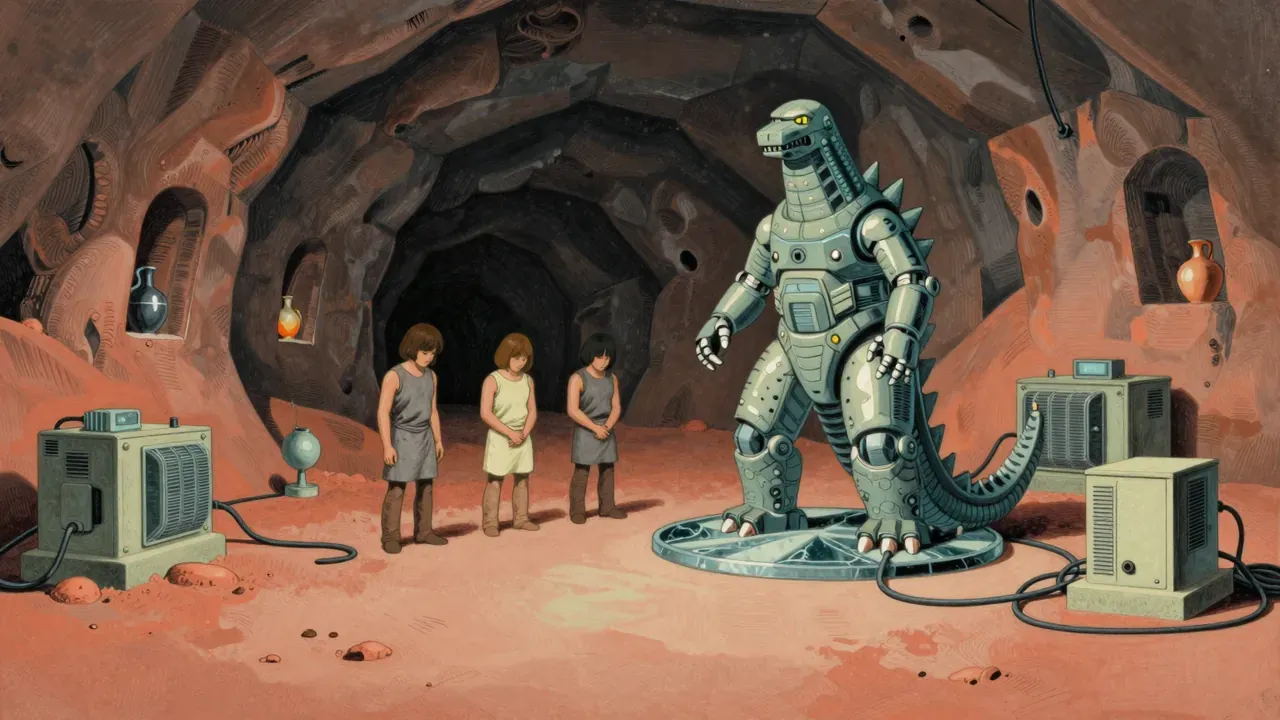
A myth in rubber and titanium
Godzilla vs. Mechagodzilla is the fourteenth entry in Toho’s Godzilla series, a mid-1970s kaiju film built on formula but attempting to stretch it: it introduces an alien-controlled mecha antagonist, ties the monster battle to Okinawan myth and prophecy, and tries to layer human drama with archaeology, interplanetary invasion, and ritual awakening. Directed by Jun Fukuda and written by Fukuda and Shinichi Sekizawa, it aims for mythic weight — citing red moons, west-rising suns, guardian deities — while operating within the tight budget and production constraints of Toho’s Shōwa-era output. It is not a reinvention, but a recalibration: less juvenile than its immediate predecessor Godzilla vs. Megalon, more invested in worldbuilding than in pure spectacle, and consciously trying to anchor its rubber-suit battles in something older and stranger than Cold War allegory or atomic anxiety. Its ambition lies in synthesis — of folklore, sci-fi, and franchise mechanics — even if the execution remains tethered to the rhythms of Saturday matinee serials. (158 words)
The rhythm of the suit
The story moves briskly but unevenly, pivoting between cave expeditions, alien infiltration, and monster duels without fully integrating them. Performances are functional: Akihiko Hirata, Kenji Sahara, and Hiroshi Koizumi bring quiet authority as scientists and officials, while Shin Kishida’s Simeon commander Kuronuma is underwritten and underplayed. Teruyoshi Nakano’s special effects rely on suitmation — Kazunari Mori inside Mechagodzilla’s polyethylene-and-fibre-reinforced-plastic frame — and miniature work that feels dated even for 1974, especially in wide shots where scale and physics falter. Masaru Sato’s score stands out: percussive, brassy, and rhythmically insistent, lending urgency where the editing falters. Jun Fukuda’s direction is economical but uninflected; he stages action clearly but rarely finds visual tension or tonal consistency. The script’s mythic scaffolding — the Azumi prophecy, King Caesar’s slumber — is introduced with care but left underdeveloped, its logic subordinate to the need for a third-act double-monster entrance. There is craft here, but little cohesion between its narrative, thematic, and physical layers. (159 words)
Where the weight falls
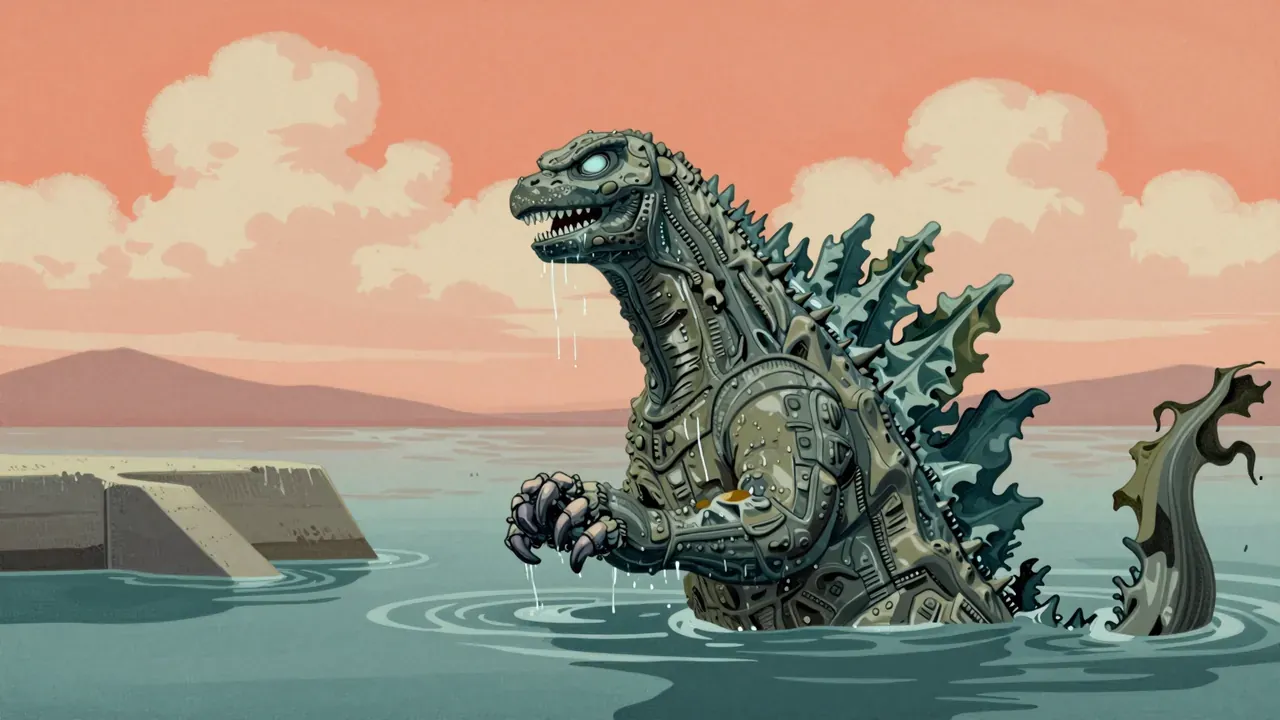
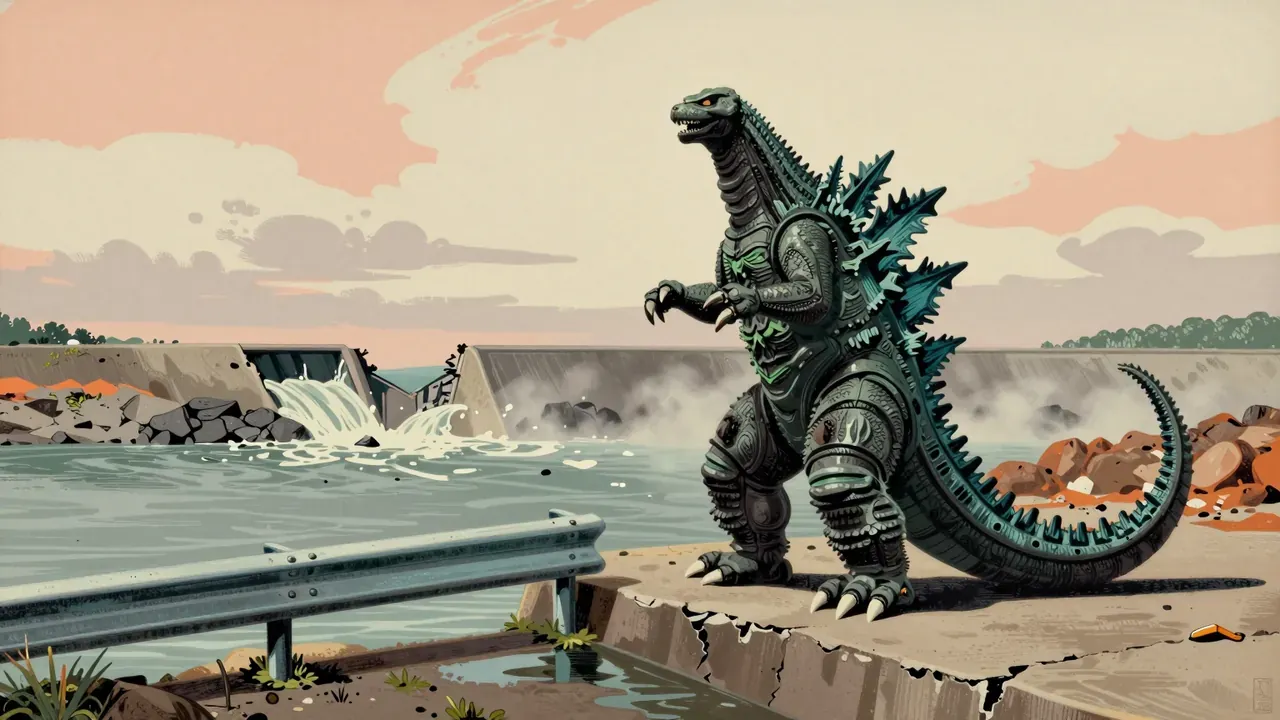
What lands is the central confrontation: Godzilla versus Mechagodzilla is the film’s structural and emotional core, and it works because it fulfils genre expectations with precision. The two monsters trade blows with weight and consequence — Mechagodzilla’s lasers leave visible scorch marks, Godzilla’s tail sweeps debris across miniature cityscapes, and their mutual retreat after the first clash establishes stakes without overcommitting to realism. The design of Mechagodzilla itself holds up: angular, insectile, unnervingly still until activated, its metallic sheen contrasting sharply with Godzilla’s organic bulk. Masaru Sato’s theme for the mecha — a staccato brass motif layered with electronic pulses — gives it presence beyond the suit. The final battle gains momentum from its geography: the temple grounds, the lunar eclipse, the simultaneous arrival of Caesar and Godzilla. Even the thunderstorm recharging Godzilla feels earned, not arbitrary — a rare moment where natural phenomenon and kaiju biology align without exposition. These sequences do not transcend the genre, but they honour it, delivering clarity, rhythm, and a sense of event that the human plot often lacks. (156 words)
The prophecy without teeth
What does not land is the human subplot’s attempt at gravitas. The Simeons — ape-faced aliens from the Third Planet of the Black Hole — are visually unconvincing and narratively inert: their motives are stated but never dramatised, their technology explained but never demonstrated beyond Mechagodzilla’s weaponry. The prophecy is recited multiple times yet never interpreted meaningfully; its ‘red moon’ and ‘sun rising in the west’ are treated as checklist items rather than symbolic anchors. The Interpol agent Nanbara appears too late and vanishes too soon, his backstory and competence left unexamined. Character relationships — Keisuke and Saeko’s archaeology partnership, Masahiko and Miyajima’s father-son dynamic — exist only to service exposition or provide hostages. Even the Okinawan priestess, whose vision opens the film, becomes a passive conduit for ritual rather than an active agent. The film mistakes repetition for resonance: saying ‘King Caesar will awaken’ three times does not make the awakening feel inevitable or earned. The result is a story that gestures toward depth but defaults to convenience, where motivation is replaced by cutaways to roaring monsters. (157 words)
Copy and keeper
The themes that matter are inheritance and imitation. Not just in the literal sense — Mechagodzilla is a copy of Godzilla, built from space titanium and alien programming — but in how the film treats myth: King Caesar is not a god but a dormant protector, awakened not by faith alone but by correct placement of a statue and precise celestial alignment. The Azumi prophecy is less oracle than instruction manual, its power contingent on human fidelity to form. This extends to the franchise itself: Godzilla vs. Mechagodzilla is acutely self-aware of its own conventions, deploying them deliberately — the lightning recharge, the ally-monster’s injury, the last-minute dual arrival — as ritual rather than accident. The Simeons fail not because they lack power, but because they misunderstand the rules of the world they invade: they see myth as superstition to be exploited, not syntax to be obeyed. The film’s quietest theme is humility before systems older than science — geological time, oral tradition, even the studio’s own decade-long kaiju grammar — and the cost of treating them as mere scenery. (155 words)
For those who know the roar
This film is for viewers who already know the grammar of Toho’s Shōwa kaiju films — those who recognise the weight of a 1974 release date, who track how suitmation evolved between 1962 and 1975, and who find pleasure in the specific cadence of Sekizawa’s dialogue or Sato’s scoring choices. It rewards attention to continuity, to recurring faces like Hirata and Sahara, and to the incremental shifts in tone across the series. It is not for those approaching Godzilla for the first time, nor for viewers seeking coherent worldbuilding or psychological realism: the Simeons’ biology, the logistics of their base, the political implications of their invasion — none of these are developed. Nor is it for fans of tightly plotted sci-fi; the film’s logic runs on narrative gravity, not internal consistency. A viewer who values thematic rigour over ritual repetition will find it thin. But someone who watches to feel the heft of a rubber suit hitting a miniature building, or to hear Sato’s brass swell as a red moon rises — that viewer will find it rich. (159 words)
The middle of the storm
Yes, it is worth your evening — provided you watch it as part of the Shōwa sequence, not in isolation. Its pleasures are cumulative: the way Mechagodzilla’s design prefigures later mecha in anime and tokusatsu, the confidence of its pacing despite its 84-minute runtime, the restraint in its monster fights compared to the freneticism of Megalon. It improves on its predecessor not by being ‘better’ in absolute terms, but by tightening focus — fewer comic relief characters, less digression, a clearer throughline from prophecy to climax. Detractors like Stuart Galbraith, who call it a ‘complete mess’, are not wrong about its flaws, but they mistake coherence for value in a genre that thrives on repetition and variation. Change the context — remove it from the series, demand modern continuity standards — and the verdict shifts. But as a mid-point evolution in a long-running studio tradition, it earns its place. That is enough. (158 words)