A Second Godzilla, Made Fast
Godzilla Raids Again is Toho’s immediate sequel to Godzilla (1954), made under instruction from executive producer Iwao Mori to capitalise on the first film’s box-office success. It is not a continuation of the 1954 film’s moral gravity or political texture, but a genre pivot: a kaiju action-horror built around spectacle, repetition, and escalation — two monsters, one city, a faster pace. Motoyoshi Oda was assigned not for thematic alignment but for speed and familiarity with effects-driven B-pictures; the production schedule was tight, the budget modest (32 million JPY), and the intent clear from the outset: deliver a second Godzilla while the name still sold tickets. It assumes audience recognition of the first film’s iconography — the silhouette, the roar, the destruction — but strips away much of its weight. There is no Oxygen Destroyer reprise, no scientist’s guilt, no sustained meditation on nuclear trauma. Instead, it offers a streamlined, almost procedural account of threat identification, military response, and monster-on-monster resolution. It is less a sequel than a franchise prototype: functional, efficient, and deliberately unburdened by introspection.
The Shape of the Threat
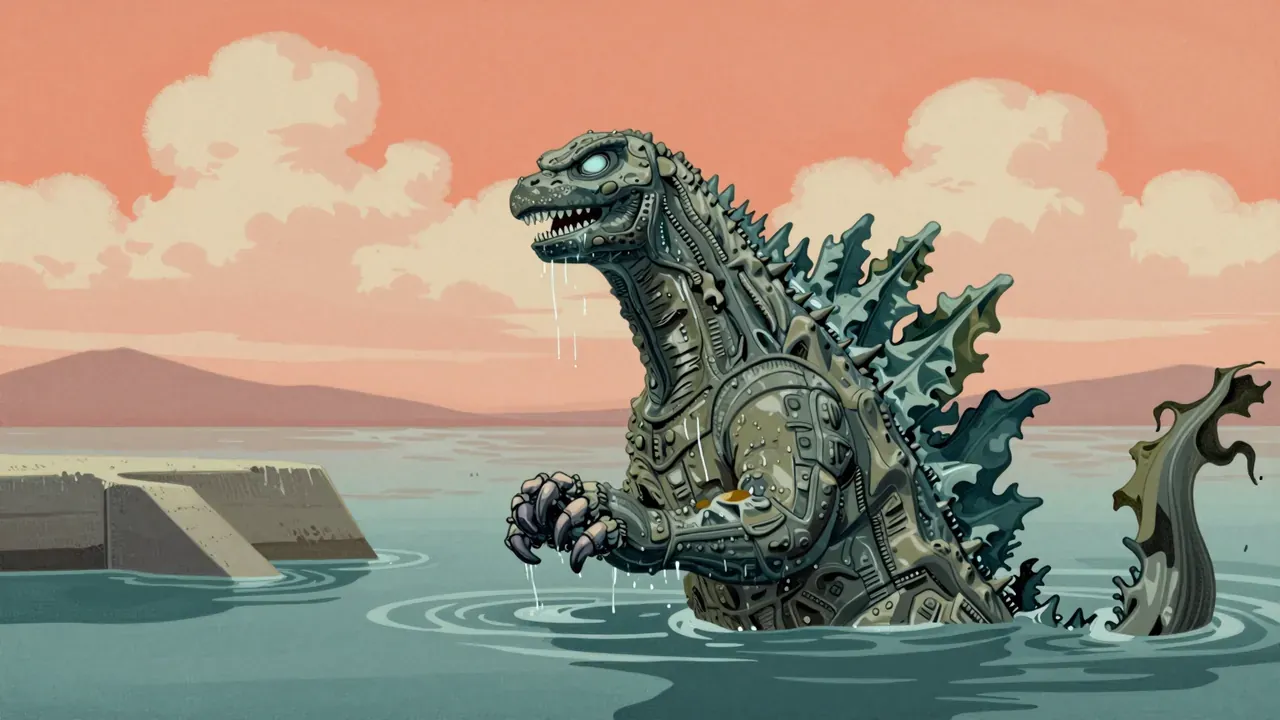
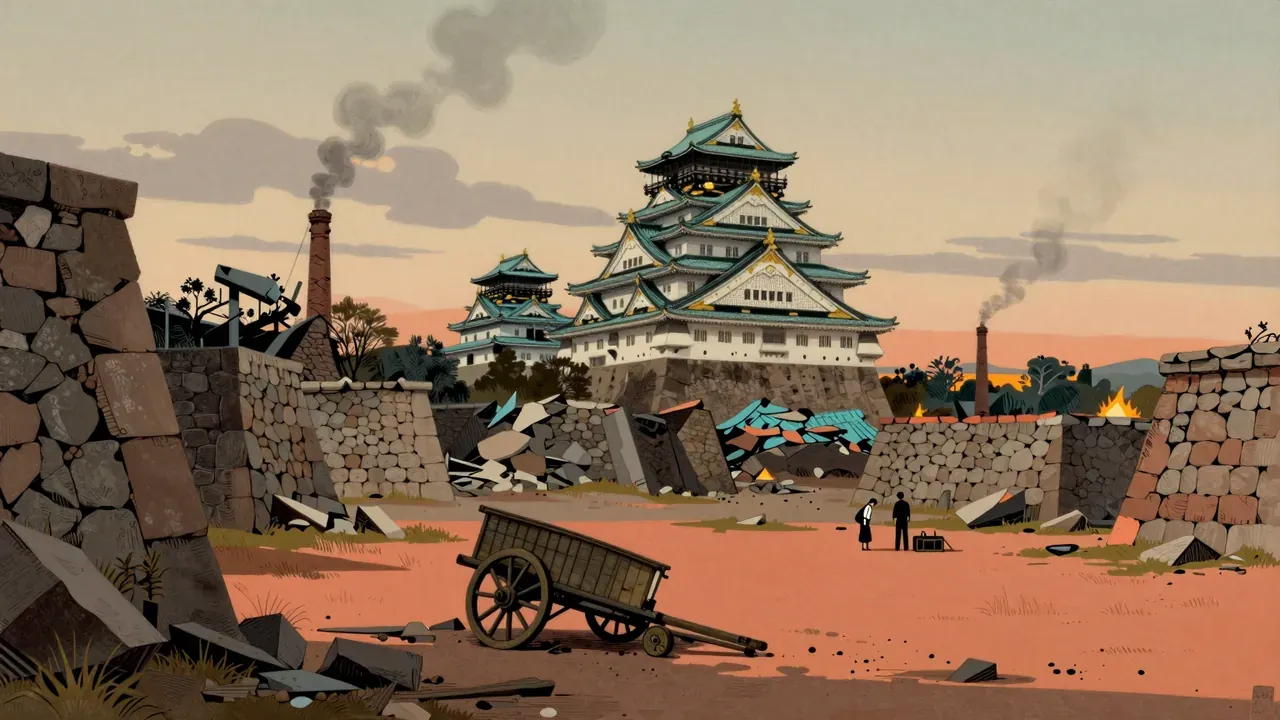
The story follows pilot Shoichi Tsukioka as he witnesses Godzilla and Anguirus battling on Iwato Island, then helps coordinate Japan’s response in Osaka. The script by Takeo Murata and Shigeaki Hidaka moves briskly, using exposition — especially in the conference scene where Dr. Yamane identifies Anguirus via The Dinosaur Book — to compress backstory and establish stakes. Takashi Shimura lends quiet authority as Yamane, though his role is truncated compared to 1954; Haruo Nakajima’s physical performance as Godzilla remains central, now enhanced by a lighter suit and motorised head mechanisms that allow subtle eye and jaw movement. Seiichi Endō’s cinematography favours low angles during battle scenes to amplify scale, and Eiji Tsuburaya’s effects team deploy varied camera speeds — including an accidental 18fps take later adopted intentionally — to control rhythm and impact. Masaru Sato’s score is urgent and percussive, underscoring action without lingering on mood. The Osaka miniature set, built on Toho’s new soundstage No. 8, gives more room for choreography, though structural flaws — like the Osaka castle failing to crumble on cue — reveal the production’s haste.
Two Monsters, One City
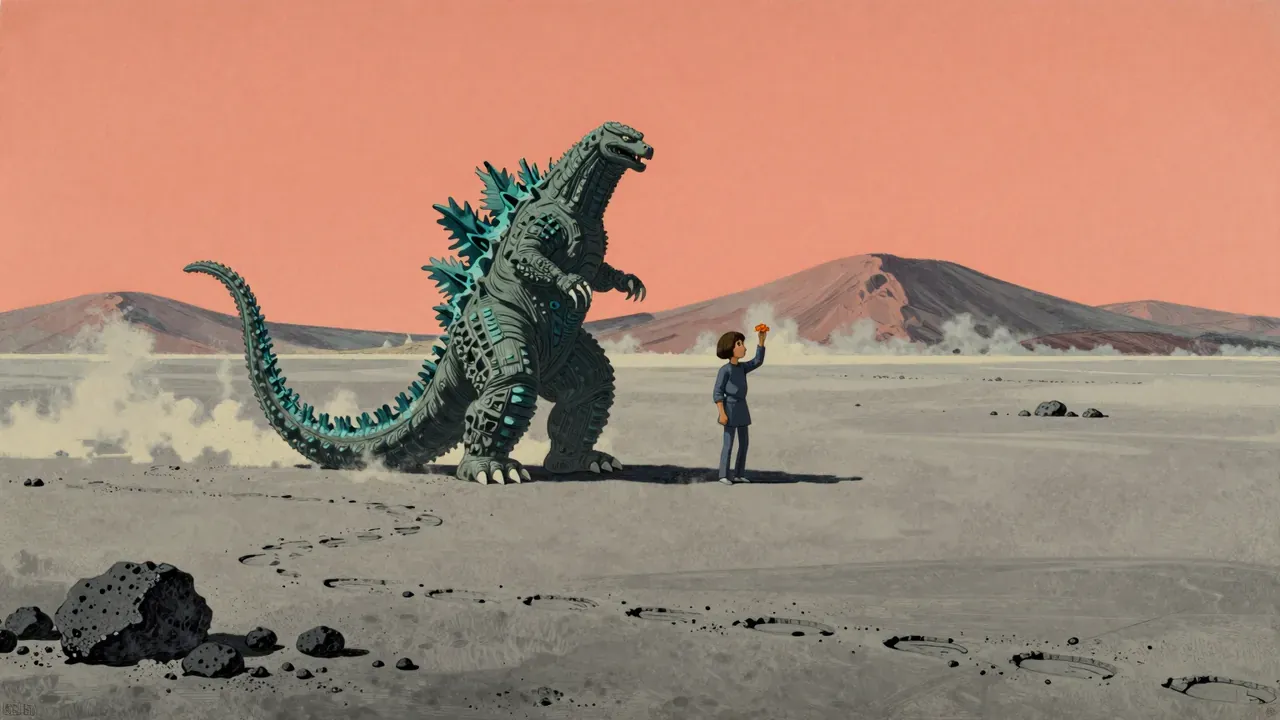
What lands is the visceral clarity of the monster duel. Godzilla and Anguirus are distinct in design, motion, and presence: Anguirus moves with a heavy, grounded lurch, his quadrupedal gait emphasised by foreground obstructions hiding the performer’s knees; Godzilla strides with deliberate, top-heavy menace, his atomic breath rendered through a spray-equipped puppet for close-ups. The ice island sequence — shot outdoors with real snow and borrowed ice from a Tokyo rink — delivers a rare sense of environment, its chill and isolation contrasting with the urban chaos of Osaka. The low-angle photography during their final clash in the city works consistently, making both creatures feel physically imposing rather than symbolic. Even the dubbing choices in the American version — Keye Luke, Paul Frees, George Takei — lend a certain pulpy coherence to the English cut, though that version truncates character beats. The film’s efficiency becomes its strength in these moments: no wasted frames, no over-explanation, just two ancient predators meeting again after millennia, and the human world caught between them.
What the Pilots Carry
What does not land is the emotional architecture. The romance between Tsukioka and Hidemi feels perfunctory, its dialogue functional rather than felt; her concern for Osaka registers as plot necessity, not lived anxiety. The supporting cast — Minoru Chiaki as Kobayashi, Hiroshi Koizumi as Tsukioka — perform capably but are given little interiority or development. The film’s attempt at thematic continuity — Yamane’s warning about the loss of the Oxygen Destroyer — lacks the resonance of the original’s ethical reckoning; here, it reads as logistical inconvenience rather than tragedy. Budget and time constraints forced the abandonment of Murata’s idea for a looting sequence mid-battle, which might have added social texture, but its absence leaves the human response oddly uniform and untroubled. The Osaka castle miniature collapse — filmed off-camera due to miscommunication — is emblematic: the ambition outpaces execution, and the seams show. The film’s rush means its quieter moments — a pause before evacuation, a civilian’s reaction — are flattened or omitted entirely.
The Return, Not the Reckoning
The themes that matter are recurrence and contingency. This is not a film about nuclear fear as such, but about what happens when catastrophe returns without warning and without remedy: the first Godzilla was killed, but the method died with its inventor, leaving only improvisation — blackouts, flares, aerial bombardment — as options. Anguirus is not a metaphor but a counterpoint: an older, prehistoric threat, awakened not by radiation but by geological accident, suggesting that humanity’s vulnerability is not singular but layered — technological, ecological, evolutionary. The film treats disaster as iterative, not exceptional: the pilots’ rescue mission repeats the opening of the first film, the Osaka attack mirrors Tokyo’s, and even the monster design echoes earlier cinema — Anguirus recalls the Ankylosaurus illustrations in Colbert’s book, Godzilla’s new suit evokes Teizo Toshimitsu’s sculptural precision. There is no grand statement, but a steady accumulation of evidence: threats evolve, responses adapt, and survival depends less on mastery than on endurance.
Who Watches the Watchers
This film is for viewers who value the mechanics of early kaiju cinema — the craft of miniature work, suit performance, and practical effects timing — and for those interested in how franchises consolidate after a breakthrough. It rewards attention to Tsuburaya’s evolving techniques, like the use of variable frame rates or the spatial logic of the Osaka set. It is not for viewers seeking the philosophical density of the 1954 original or the tonal richness of Honda’s later entries; fans expecting moral ambiguity or sociological observation will find the film thin. Those put off by stiff mid-century acting or exposition-heavy dialogue may disengage early. A viewer who values narrative economy over psychological realism, or who finds pleasure in the tactile imperfection of analogue effects, will connect more readily. Anyone expecting thematic continuity with the first film — or a Honda-directed expansion of its ideas — will be disappointed, and rightly so: this is not that film, and its merits lie elsewhere.
The Ice, the Suit, the Wire
Yes, it is worth your evening — provided you watch it as a pivot point, not a peak. At 82 minutes, it moves without drag, and its limitations — the rushed pacing, the thin character work — are instructive, not merely irritating. It shows how a studio translates cultural resonance into repeatable form, and how effects artists solve problems on the fly: the malfunctioning walking Godzilla prop, the accidental slow-motion footage, the ice machine borrowed from a skating rink. These are not flaws to overlook but signatures of a particular moment in Japanese genre filmmaking. Someone who watches only for allegory or prestige will find it slight; someone attuned to craft, history, and the material conditions of production will find it revealing. Its value lies not in standing alone, but in clarifying what came before and enabling what followed — King Kong vs. Godzilla, three years later, could not exist without this functional, flawed, necessary second step.