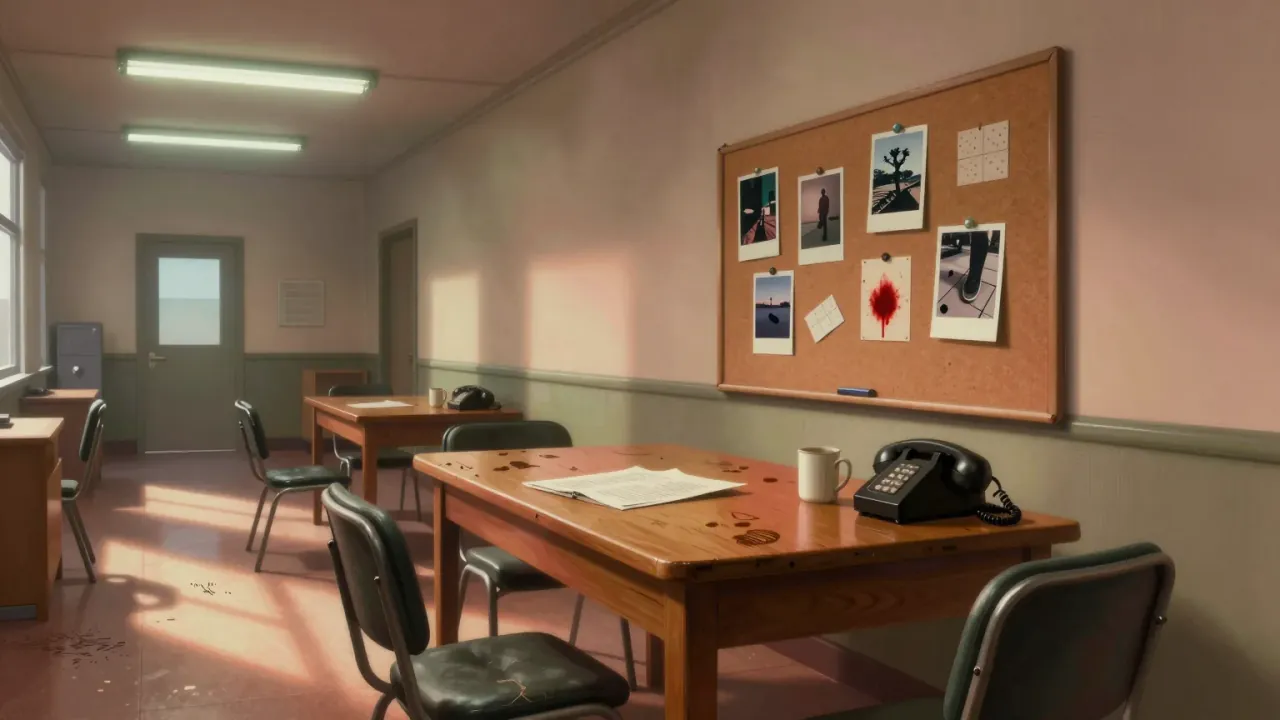
The look of it
House of Games is David Mamet’s 1987 directorial debut: a tightly wound neo-noir thriller built around confidence tricks, not crime in the conventional sense. It does not aim to depict realism in criminal procedure or psychological pathology, but to stage a controlled descent — from clinical detachment into complicity, then into self-deception, and finally into irreversible moral rupture. The film treats con artistry as a grammar of attention, misdirection, and ritualised violation, with each scam functioning as both plot device and structural metaphor. Mamet adapts his own screenplay, co-written with Jonathan Katz, and works within the constraints of low-budget production to sharpen rather than soften the architecture of deception. There are no flashbacks, no exposition dumps, no voiceover explanation: the narrative proceeds by implication, repetition, and withheld information, trusting the viewer to follow the logic of the grift as closely as Margaret does. Its ambition is formal and philosophical — to make the mechanics of belief feel tactile, dangerous, and seductive.
The shape of the story
The story unfolds in strict cause-and-effect sequence, each scene tightening the coil: Margaret’s first visit to the House of Games, her initiation into the language of tells and marks, the hotel sting, the betrayal, and the airport confrontation. Lindsay Crouse holds the film with calibrated restraint — her psychiatrist’s composure never breaks until it shatters completely, and even then, the violence feels less like eruption than conclusion. Joe Mantegna’s Mike is all surface charm and calibrated silence; his performance lives in pauses and shifts of weight, not monologues. Juan Ruiz Anchía’s cinematography keeps interiors dim and shallow-focus, favouring tight two-shots and static frames that refuse to let characters escape the frame — or their choices. Alaric Jans’ score is sparse, percussive, and deliberately unmelodic, underscoring tension without cueing emotion. Trudy Ship’s editing sustains Mamet’s rhythmic dialogue without overcutting, letting scenes breathe just long enough to make the next twist land with physical weight.
The weight of the turn
What lands is the film’s unwavering commitment to its own logic: every con follows rules that are stated, demonstrated, and then weaponised against the protagonist. The poker game’s false tell, the water pistol, the pocket knife as prop and punchline — these are not gimmicks but structural anchors. The film’s pacing never falters because it refuses to explain what it has already shown. Margaret’s transformation feels earned not through exposition but through accumulation: her growing comfort with lies, her increasing fluency in the con men’s jargon, her quiet thrill at stealing the lighter in the final shot. Even minor roles land with precision — Ricky Jay’s dry authority as the cardsharp, J. T. Walsh’s unnerving stillness as the fake cop, William H. Macy’s barely concealed glee as Joey. The film trusts its audience to notice the red convertible, the missing briefcase, the way Mike’s hand rests on the knife before she takes it — and rewards that attention with a structure that folds back on itself like a locked box.
Where the mechanism slips
What does not land is the film’s occasional over-reliance on Mamet’s signature cadence at the expense of character texture. Some exchanges — particularly between Margaret and her colleague Dr. Littauer — feel more like dramatised theory than lived conversation, their clipped syntax occasionally flattening emotional nuance. The hotel sting sequence, while narratively essential, strains credibility in its staging: the ease with which Margaret identifies the undercover officer, the speed of the subsequent car theft past uniformed police, and the abrupt disposal of the evidence all lean on plot necessity over plausibility. The ending’s moral ambiguity is deliberate, but the final theft of the lighter risks feeling less like psychological inevitability and more like thematic punctuation — a flourish that asserts rather than reveals. Critics who found the film ‘rechewing film noir’ were responding to this: the tropes are knowingly deployed, but not always deepened beyond their genre function.
The lie you keep close
The themes that matter are self-deception as professional hazard, the seduction of competence, and the porous boundary between observation and participation. Margaret begins the film diagnosing obsession in others; she ends by enacting it — not as symptom but as choice. The con is not about money but about control: over perception, over narrative, over another person’s reality. Mamet treats therapy and grifting as parallel disciplines — both rely on reading micro-behaviours, constructing plausible fictions, and extracting value from vulnerability. The film interrogates how expertise can become a form of arrogance, and how intellectual mastery can blind one to moral consequence. There is no redemption arc, no catharsis — only a slow, logical erosion of ethical constraint, made visible in small acts: taking the knife, driving the stolen car, pulling the trigger, lifting the lighter. The final line — about forgiving oneself for the unforgivable — is not resolution but diagnosis: the ultimate con is the one we run on ourselves.
Who walks in, and who walks out
This film is for viewers who value precision of construction over emotional exposition, who find pleasure in narrative economy and linguistic rhythm, and who are comfortable sitting with moral unease without resolution. It suits those familiar with Mamet’s stage work or with neo-noir’s formal rigour — viewers who will track the pocket knife across three acts and feel the satisfaction of its reappearance. It is not for those who require psychological realism, empathetic protagonists, or narrative closure. Anyone expecting a procedural thriller, a character study with therapeutic insight, or a conventional morality tale will find the film withholding, cold, or contrived. A viewer who values emotional transparency over structural intelligence — or who finds Mamet’s dialogue mannered rather than musical — would reasonably reject its terms. The verdict changes only if one accepts that the film’s austerity is its argument, not its limitation.
The price of watching
Yes, it is worth your evening — not as entertainment but as an exercise in sustained attention and ethical calibration. At 102 minutes, it moves with the economy of a short story, refusing filler, digression, or reassurance. Its power lies in how little it gives away, and how much it demands in return: to listen closely, to watch for slips in posture or phrasing, to hold two contradictory truths — that Margaret is both victim and architect, analyst and mark, healer and killer. Those who find its tone too dry, its ending too bleak, or its dialogue too stylised may leave unsatisfied, but that dissatisfaction is part of the design. It is not a film to be liked, but one to be reckoned with — and reckoning takes time, focus, and willingness to sit with discomfort. Its value is not in offering answers but in making the questions impossible to ignore.