The shape of it
Saving Face is a romantic comedy written and directed by Alice Wu, released in 2004, that centres on Wilhelmina ‘Wil’ Pang — a Chinese American surgeon in New York — her recently pregnant, unmarried mother Hwei-Lan, and her relationship with dancer Vivian Shing. It attempts something specific: to render visible the overlapping pressures of filial duty, queer identity, and intergenerational cultural negotiation within a Flushing, Queens community, without recourse to trauma-as-spectacle or assimilationist resolution. The film does not position itself as sociological reportage, nor as allegory; its ambitions are tonal and relational — to hold lightness and gravity in the same frame, to treat Mandarin dialogue as unmarked vernacular rather than exotic texture, and to anchor a lesbian romance in domestic rhythms rather than political confrontation. Its structure follows classical rom-com scaffolding — meet-cute, obstacle, near-breakup, reconciliation — but reassigns the stakes from individual happiness to collective face-saving and quiet mutual recognition. It is a first feature, made for $2.5 million, and it insists on bilingualism, Asian American authorship, and narrative autonomy where studios proposed whitewashing and genre dilution.
The sound of it
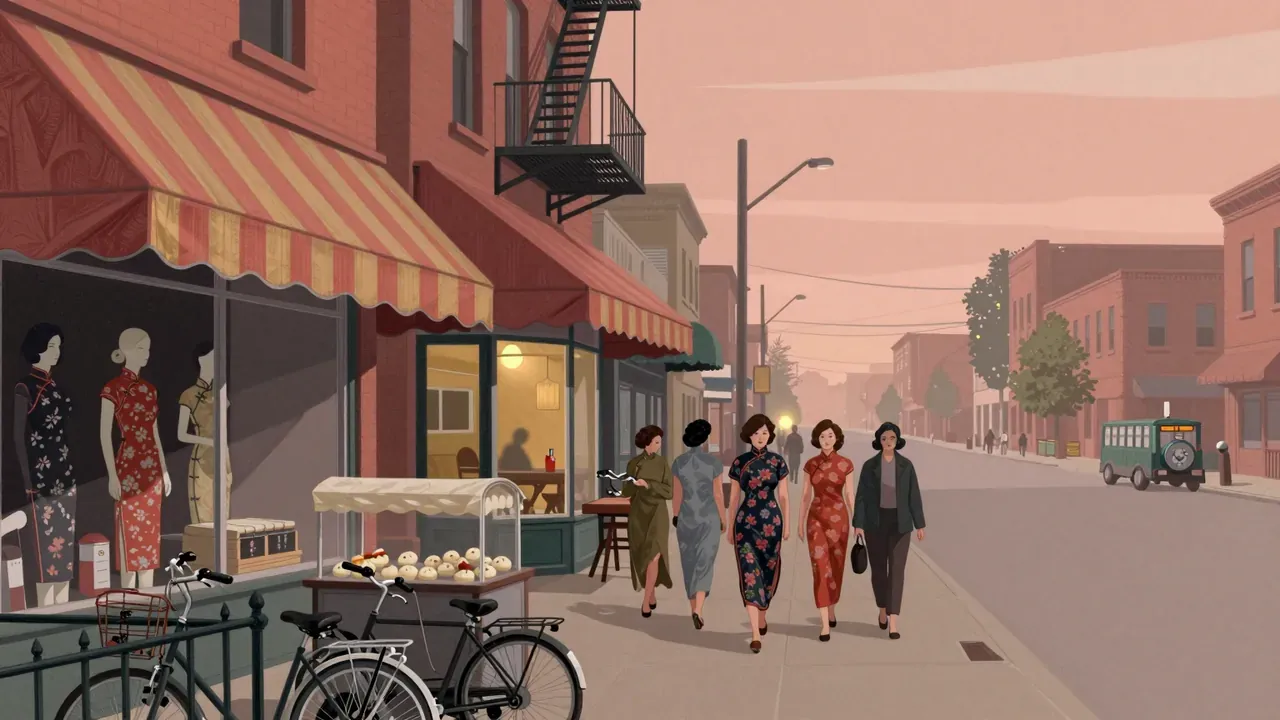
The story moves cleanly across three acts, pivoting on Wil’s dual concealments — her sexuality from her mother, and her mother’s pregnancy from the neighbourhood. Michelle Krusiec grounds Wil in physical precision and restrained expressiveness: she listens more than she speaks, her posture tightens when lying, and her surgical competence is shown through action, not exposition. Joan Chen gives Hwei-Lan warmth without sentimentality, her Mandarin delivery carrying both authority and vulnerability. Lynn Chen’s Vivian balances spontaneity and emotional steadiness, her dancing used not as metaphor but as embodied contrast to Wil’s clinical stillness. Gordon Willis is not involved; Anton Sanko’s score is unobtrusive, favouring piano motifs over orchestral swell. The 35 mm photography by Richard Wong keeps interiors warm and daylight scenes crisp, with Flushing’s storefronts and apartment stairwells given equal weight to Manhattan skyline shots. Wu’s direction avoids stylisation: cuts are functional, coverage is generous, and the bilingual dialogue flows without translation cues — English for Wil’s professional world, Mandarin for family friction and tenderness.
The rhythm of it
What lands is the specificity of the domestic space: the way Hwei-Lan folds dumplings while delivering moral lectures, the shared silence between Wil and Vivian on a subway platform, the unspoken tension in a crowded mahjong game where no one mentions the pregnancy but everyone knows. The film’s comic timing rests in understatement — a glance held too long, a sentence cut off mid-rebuke, a Mandarin phrase delivered with deliberate flatness that English subtitles cannot fully carry. The chemistry between Krusiec and Chen feels lived-in, not performative; their arguments are about logistics and timing, not identity crises. The supporting cast — particularly Ato Essandoh as Wil’s supportive colleague and Jessica Hecht as her pragmatic friend — avoid caricature, anchoring the film in recognisable social texture. The wedding finale, though criticised elsewhere for rushed resolutions, works as a formal release: the gathering that began the plot ends it, now reshaped by small, cumulative acts of courage — Hwei-Lan speaking first, Wil holding Vivian’s hand without looking around, neighbours adjusting their gaze without fanfare. These gestures land because they are earned in increments, not declarations.
The gaps in it
What does not land is the structural thinness of Wil’s professional life. Though named a surgeon, her work remains abstract — no operating room, no patient interaction beyond a single hallway exchange, no sense of medical hierarchy or daily strain. This weakens the contrast between her public competence and private uncertainty. The film also underdevelops Vivian’s interiority: her dance career is present as backdrop, not vocation — we see rehearsals but not artistic struggle, ambition, or doubt. The subplot involving Wil’s father is introduced then dissolved without consequence, leaving emotional logic unanchored. Some secondary characters — particularly the mahjong group — verge on type: affectionate but undifferentiated, their function limited to communal pressure and comic relief. The pacing sags slightly in the second act, where exposition about Hwei-Lan’s past is delivered in monologue rather than dramatised memory or visual echo. And while the Mandarin-English code-switching is authentic, the decision to have Wil reply to her mother only in English occasionally flattens the linguistic power dynamic the film otherwise acknowledges — it makes resistance legible, but at the cost of linguistic reciprocity.
The weight of it
The themes that matter are not ‘coming out’ in the singular sense, but the layered labour of saving face — for oneself, for one’s mother, for one’s community — and how that labour shifts shape across generations. It treats tradition not as static inheritance but as negotiable practice: Hwei-Lan’s adherence to custom is neither mocked nor romanticised; it is shown as adaptive, even strategic. The film locates dignity in compromise that does not require surrender — Wil does not abandon medicine, Vivian does not stop dancing, Hwei-Lan does not renounce her friends, yet all three revise what belonging requires. It treats queerness as ordinary rather than exceptional: no coming-out scene, no crisis of self-acceptance, no external homophobia as plot engine — the conflict is intrafamilial, rooted in expectation, not prejudice. The concept of ‘face’ operates quietly but insistently: not as shame, but as relational accountability — the weight of being seen, and the care required in how one allows others to see you. This is not a film about rupture, but recalibration — about who gets to define the terms of continuity.
The company it keeps
It is for viewers who value character-driven storytelling over plot mechanics, who recognise the emotional weight of small concessions and unspoken understandings, and who are comfortable with endings that resolve tension without resolving every question. It is for those who want to see Chinese American life rendered without ethnographic framing, and queer romance presented without trauma as prerequisite. It is not for viewers who require high-stakes narrative propulsion, psychological excavation of motive, or stylistic flourish as proof of seriousness. Those who expect surgical realism from a surgeon protagonist, or who read cultural specificity as niche rather than universal in its human concerns, will find it slight. Critics who judged it against prestige dramas or formal experiments — like Jonathan Rosenbaum, who called the latter half ‘nonsense’ — missed its deliberate modesty. A stronger medical thread or deeper exploration of Vivian’s artistry would sharpen its impact, but its current balance — gentle, precise, unhurried — is consistent with its aims.
The time it takes
Yes, it is worth your evening — not as a landmark, but as a sustained, humane attention to how people live inside contradiction. Its ninety-three minutes pass without strain, anchored by performances that refuse grandstanding and a script that trusts subtext over speech. It rewards patience, not analysis; it asks for presence, not interpretation. Those who find its tone too mild, its conflicts too contained, or its resolutions too soft may prefer sharper-edged fare — but that is a difference of temperament, not deficiency. Its value lies in what it refuses: to conflate visibility with spectacle, identity with crisis, or cultural specificity with exclusion. It is a film that assumes its audience can hold complexity without explanation — that a mother’s silence after hearing her daughter’s truth, or a daughter’s choice to speak Mandarin only when she needs to be heard, carries more weight than any monologue. That quiet confidence makes it durable, not dated.