The shape of change
Now, Voyager is a studio-era American drama built around psychological transformation and restrained romantic yearning. It attempts to dramatise interior recovery — not as medical narrative but as slow, tactile reassembly of selfhood — through the arc of Charlotte Vale, a woman unmade by maternal tyranny and remade through therapy, travel, and quiet emotional reciprocity. The film does not seek realism in its psychiatry or its geography; it treats Brazil as backdrop, Boston as inherited architecture, and the sanitarium as both refuge and staging ground. Its ambition lies in sustaining tension between social constraint and inner expansion without recourse to melodrama’s usual exits: no villainy is punished, no rebellion is triumphant, no love is consummated. Instead, it holds space for what persists after crisis — habit, duty, tenderness deferred — and asks the audience to register change in increments: a lifted chin, a steadier hand, a pause before speaking. It is a film about holding on to feeling without acting on it, and about dignity as a practice rather than a state.
The look of it
The story unfolds in three calibrated acts: confinement, release, return — each anchored by Sol Polito’s precise, high-contrast lighting that isolates faces in shadow while keeping rooms dimly legible. Bette Davis modulates Charlotte’s voice, posture, and gaze with forensic control: her early stammer gives way not to confidence but to measured articulation; her weight loss is visible but never fetishised. Paul Henreid avoids charm, playing Jerry as weary, attentive, morally bound — his restraint makes the Sugarloaf Mountain sequence land not as romance but as shared vulnerability. Claude Rains’ Dr. Jaquith is neither sage nor saviour; he listens, observes, and intervenes only once, when Charlotte’s guilt threatens to collapse her gains. Casey Robinson’s script tightens Prouty’s novel without flattening its ambivalence: dialogue is functional, rarely poetic, always weighted. Max Steiner’s score swells at key transitions but avoids sentimentality; Warren Low’s editing sustains rhythm across long takes and avoids cutting away from discomfort. There are no false notes in performance or craft — just sustained, unhurried attention to how people hold themselves when they are trying not to break.
What stays quiet
What lands most firmly is the film’s refusal to resolve its central relationship. The final line — ‘Oh, Jerry, don’t let’s ask for the moon. We have the stars’ — works because it arrives without fanfare, after months of withheld glances, delayed letters, and deliberate distance. It lands because the film has spent 117 minutes earning the quiet gravity of that admission: that some attachments are real, binding, and permanently incomplete. Charlotte’s agency also lands — not as liberation but as hard-won capacity to say no, to choose Tina over Elliot, to sit with grief without collapsing into it. The camellias arrive not as a gesture of courtship but as punctuation: a reminder that Jerry sees her, remembers her, and honours her boundaries. Even the cruise ship scenes — often dismissed as contrived — function precisely: they are Charlotte’s first rehearsal of presence among strangers, where her shyness is not cured but accommodated. The film trusts its audience to notice the difference between being seen and being known, and to understand that the former can be enough.
Where the frame ends
What does not land is the film’s treatment of class and inheritance. Mrs. Vale’s cruelty reads less as aristocratic entitlement than as generic maternal pathology — her Boston lineage is named but never embodied in setting, speech, or social texture. The Vale house feels like a soundstage set, not a lived-in relic of old money. Similarly, the sanitarium lacks specificity: its therapeutic methods are vague, its patients interchangeable, its authority derived from Rains’ gravitas rather than clinical plausibility. The Brazilian sequences rely entirely on stock footage and rear projection, making geography feel arbitrary rather than symbolic. Tina’s arc — from withdrawn child to confident adolescent — is emotionally persuasive but narratively compressed: her improvement happens off-screen, then is affirmed by Charlotte’s decision to keep her, without showing the daily labour of care. The film also sidesteps the material reality of Charlotte’s independence: she has no profession, no income, no stated plan beyond patronage and platonic guardianship. Her freedom rests on inherited wealth and male permission — a limitation the script names but does not interrogate.
The weight of small things
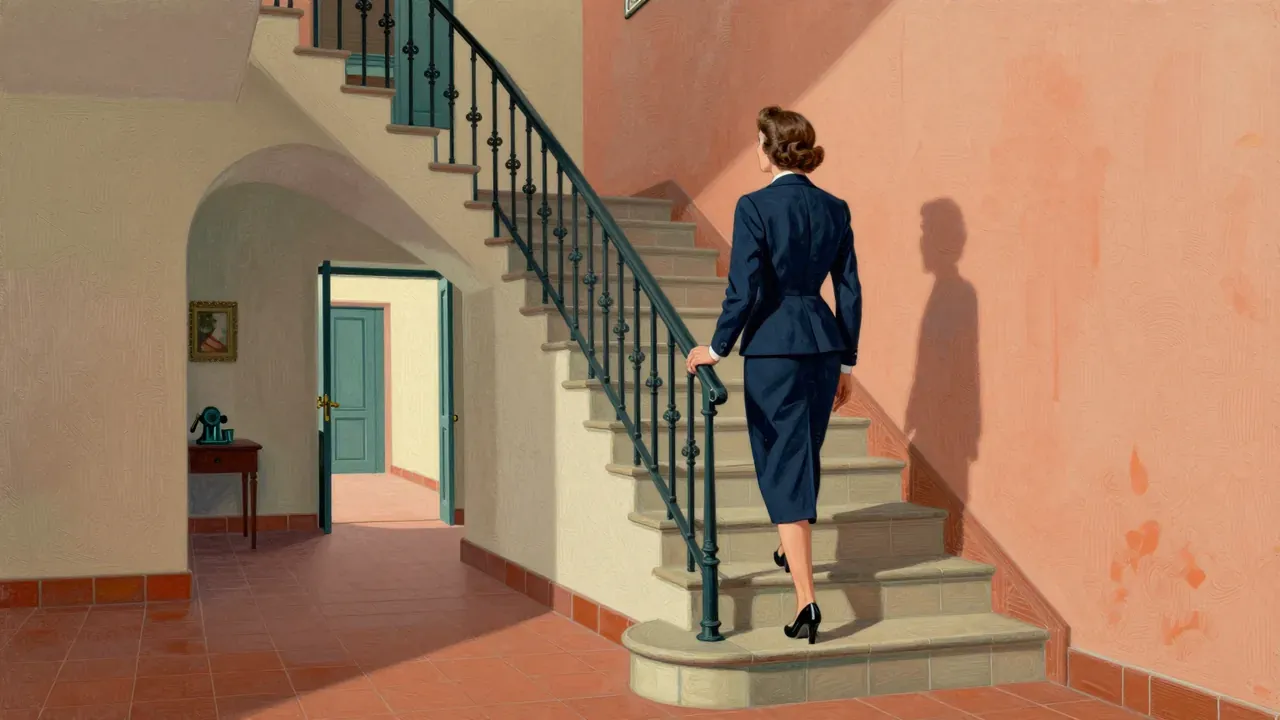
The themes that matter are containment and quiet persistence. Not healing as cure, but healing as recalibration: Charlotte learns to occupy space without apology, to speak without preface, to want without demanding. The film treats mental health not as a condition to overcome but as a landscape to navigate — one shaped by intergenerational harm, gendered expectation, and the sheer exhaustion of performing compliance. It also treats love as continuity rather than climax: Jerry’s devotion is shown in remembered details (the camellias), in professional respect (his work on the psychiatric wing), and in shared silence. Motherhood appears twice — as weapon and as repair — and the film refuses to equate either with biology. Charlotte’s care for Tina is not substitution but recognition; her grief for Mrs. Vale is not absolution but acknowledgment of shared damage. Architecture recurs as metaphor: the Vale mansion is a cage of carved wood and heavy drapes; the new psychiatric wing is open, light-filled, purpose-built — a structure designed not to contain but to hold space for becoming.
Who it asks to stay
This film is for viewers who value emotional precision over plot momentum, who find resonance in restraint, and who trust actors to convey complexity without exposition. It suits those familiar with mid-century studio craft — the weight of a pause, the meaning in a costume shift, the significance of a single prop repeated across time. It is not for viewers who require narrative propulsion, moral clarity, or resolution of romantic tension. Those expecting catharsis from confrontation or closure from union will find the ending withholding. People who read psychology as diagnosis rather than description may struggle with Dr. Jaquith’s non-interventionist approach. The film assumes patience with stillness, tolerance for ambiguity, and willingness to sit with unresolved grief. Its pacing and tonal consistency demand attention, not background viewing. A viewer who prefers irony, satire, or structural experimentation will find its sincerity unrelenting — not naive, but unwavering.
What it leaves in your hands
Yes, it is worth your evening — provided you watch it as a study in accumulation rather than destination. Its power lies in how much it achieves without raising its voice: Charlotte’s transformation registers not in speeches but in how she holds a teacup, how she meets a stranger’s eye, how she chooses to remain silent in a room full of people who expect her to shrink. It rewards attention to gesture, to editing rhythm, to the way Steiner’s strings swell just before a cut. Those who dismiss it as ‘dated’ or ‘soapy’ mistake its formal discipline for sentimentality. Critics who prioritise narrative innovation over psychological fidelity may undervalue its craft. A different verdict would follow if the film tried to modernise its psychiatry or amplify its romance — but it does neither. Its endurance comes from refusing to explain itself, and from trusting the audience to feel the weight of what is left unsaid.