A parable dressed as an epic
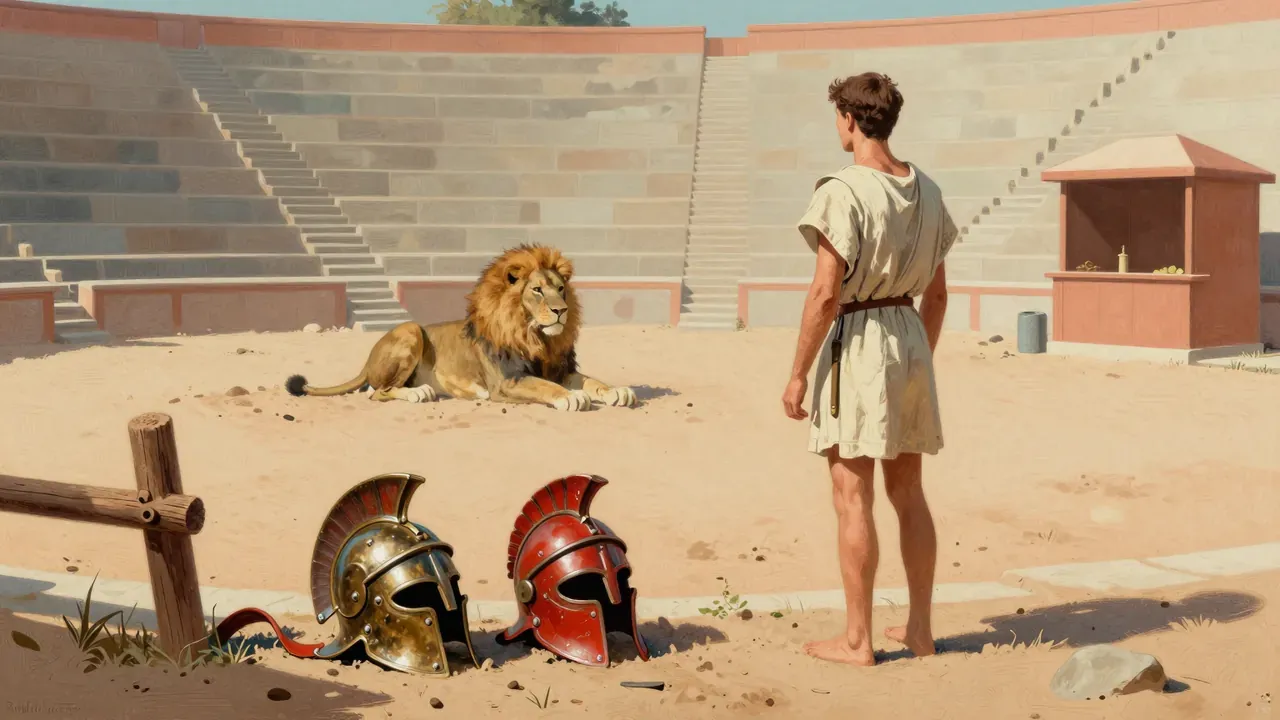
Spartacus is a 1960 American historical drama adapting Howard Fast’s 1951 novel about the Third Servile War — the slave revolt led by Spartacus in 73–71 BCE. It attempts two things at once: to dramatise a large-scale uprising as both visceral spectacle and moral argument, and to assert the dignity of collective resistance against institutional power. Its scope is deliberately epic — armies, quarries, villas, gladiatorial schools — but its focus remains tightly bound to individual agency within systems of coercion. The film does not seek historical fidelity in detail; it uses Rome as a stylised architecture of hierarchy, with British accents marking aristocratic Romans and American or unplaced speech signalling subordination. This is not a reconstruction but a parable, shaped by Cold War concerns about censorship, loyalty oaths, and the erasure of dissent. Its ambition is political as much as narrative: to make defiance legible, visible, and emotionally sustained across nearly three hours. It treats slavery not as background but as the organising principle of every relationship, every composition, every cut.
The rhythm of resistance
The story follows Spartacus from quarry slave to gladiator to rebel leader, intercut with Roman political manoeuvring in the Senate and Crassus’ villa. Dalton Trumbo’s screenplay tightens Fast’s novel into a series of set-piece confrontations — the crucifixion road, the arena, the Senate floor — each calibrated to escalate moral stakes. Kirk Douglas gives Spartacus physical presence and restrained fury, avoiding grandiloquence; Laurence Olivier modulates Crassus between intellectual arrogance and quiet menace; Peter Ustinov, who also co-wrote, brings levity and sly humanity to Batiatus without undercutting the system he profits from. Russell Metty’s cinematography favours deep-focus compositions and high-contrast lighting, especially in interior scenes where shadow pools around senators’ faces. Alex North’s score avoids leitmotif cliché, using dissonant brass and percussive strings to underscore tension rather than heroism. Editing by Robert Lawrence and Irving Lerner sustains rhythm across long sequences, though battle scenes occasionally flatten into repetition. The art direction and costume design — both Oscar-winning — anchor the film’s world in tangible texture: cracked marble, sweat-stained tunics, the weight of iron collars.
Clarity through contrast
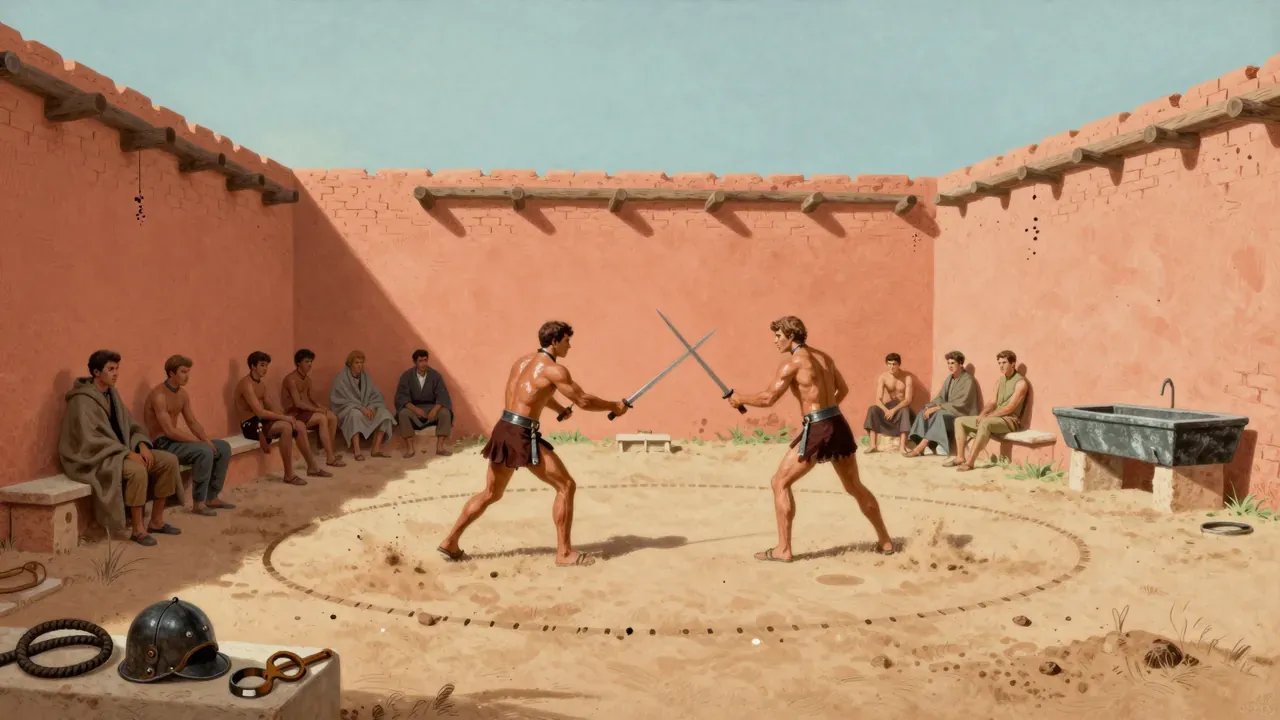
What lands most firmly is the film’s moral clarity, expressed through gesture and framing rather than speech. The moment when Spartacus refuses to name his fellow rebels — ‘I am Spartacus’ — works because it arrives after sustained visual groundwork: the camera has already lingered on faces in the crowd, on hands gripping weapons, on eyes shifting between fear and resolve. The contrast between Crassus’ villa — all cool marble, symmetrical gardens, controlled light — and the quarry — sun-baked rock, bent spines, dust-choked air — is sustained and legible without exposition. Ustinov’s performance lands precisely because it resists caricature: his Batiatus is neither comic nor monstrous, but pragmatically complicit, making his occasional flashes of conscience more unsettling. The film’s use of accent as class marker holds up: Olivier’s clipped vowels feel like policy made audible, while Tony Curtis’ Antoninus speaks with an inflection that signals both education and displacement. The battle sequences, though technically accomplished, land less as action than as choreographed consequences — the cost of rebellion rendered in mud, exhaustion, and diminishing numbers.
Where the scale slips
What does not land is the romantic thread between Spartacus and Varinia. Jean Simmons is capable and sincere, but the character lacks interiority beyond devotion and vulnerability; her scenes function mostly as emotional punctuation rather than dramatic counterpoint. The subplot involving Julius Caesar (John Gavin) feels perfunctory — inserted for historical verisimilitude rather than narrative necessity — and his single scene adds no pressure to the central conflict. Some of the senatorial debates, particularly those involving Charles Laughton’s Gracchus, veer into theatrical declamation without sufficient grounding in character motivation. The film’s length — 198 minutes — exposes structural slack: the middle third drifts between camp life and Roman politics without tightening the central dilemma. Kubrick’s direction, though disciplined, shows strain under scale: some wide shots of armies lack spatial coherence, and transitions between locations occasionally blur temporal logic. The film’s refusal to dwell on Spartacus’ internal life — a choice consistent with its emphasis on collective action — leaves certain emotional beats underserved, particularly his final moments.
Slavery as system
The themes that matter are not ancient but immediate: the mechanics of dehumanisation, the conditions under which solidarity becomes possible, and the cost of naming oneself in opposition to power. Slavery here is not a historical condition but a system — one that operates through legal fiction, economic dependency, and performative loyalty. The film interrogates how institutions sustain themselves: Crassus does not rule by brute force alone but by manipulating law, currency, and perception. The recurring motif of the cross — first as instrument of terror, then as symbol of martyrdom — underscores how meaning is imposed, resisted, and reclaimed. Class is treated as material fact: the difference between Crassus’ villa and the quarry is not aesthetic but ontological. The film’s engagement with censorship is literal and allegorical — Trumbo’s credited authorship was itself an act of reclamation, and the script reflects that urgency in its insistence on speech as both weapon and risk. There is no redemption arc for Rome; the ending affirms endurance, not victory.
For those who read the credits as history
This film is for viewers who value moral architecture over plot velocity — those willing to sit with longueurs if they serve thematic weight, and who find resonance in formal restraint. It suits audiences familiar with mid-century studio craft, or those studying how political ideas settle into cinematic grammar. It is not for viewers who require psychological realism in protagonists, or who expect battle sequences to prioritise geography over implication. Those put off by deliberate pacing, or who read historical settings as escapism rather than allegory, will find it heavy-handed. A viewer expecting Kubrick’s later precision — the clockwork dread of Dr. Strangelove or the recursive logic of 2001 — may register the film’s compromises: its studio-bound compromises, its collaborative script, its producer-led interventions. Someone who values Trumbo’s screenwriting as an act of resistance may still find the film’s dramatisation of that resistance muted — the politics are clear, but the personal cost remains abstract.
A film that named its writer
Yes, it is worth your evening — not as entertainment but as a calibrated artefact of its moment, bearing the weight of its production history in every frame. Its 198 minutes unfold with deliberation, not indulgence; the runtime serves its thesis that resistance is slow, cumulative, and physically exhausting. You will not leave energised, but you may leave clearer about how power names itself, and how defiance begins with refusing that naming. Those who dismiss it as dated spectacle miss how its stylistic choices — accent as class, silence as strategy, crowd as character — remain operative tools in contemporary storytelling. A viewer who prefers tighter narrative economy might argue for Gladiator (2000) or Quo Vadis (1951); but neither carries Spartacus’ documentary weight as cultural intervention. Its endurance lies not in perfection but in persistence: a film that insisted on speaking plainly, at a time when plain speech carried risk.