The look of it
Repo Man is a low-budget Los Angeles science fiction film that uses car repossession as its narrative engine and punk ideology as its moral compass. It sets out to satirise Reagan-era America—not through allegory but through accumulation: televangelists, government agents with metal hands, neutron-bomb rumours, and a glowing Chevrolet Malibu whose trunk contains something unnameable but lethal. Alex Cox’s debut does not build a coherent world so much as assemble one from detritus—of consumer credit, Cold War paranoia, and Southern California infrastructure. Its tone is neither earnest nor ironic, but deadpan, treating radiation burns and UFOs with the same bureaucratic gravity as a repossession form. The film avoids exposition; characters state facts without context, and the audience is left to triangulate meaning from mismatched details. It is less a story about aliens than about how systems—financial, political, even cosmic—fail to contain what they claim to manage.
The sound of it
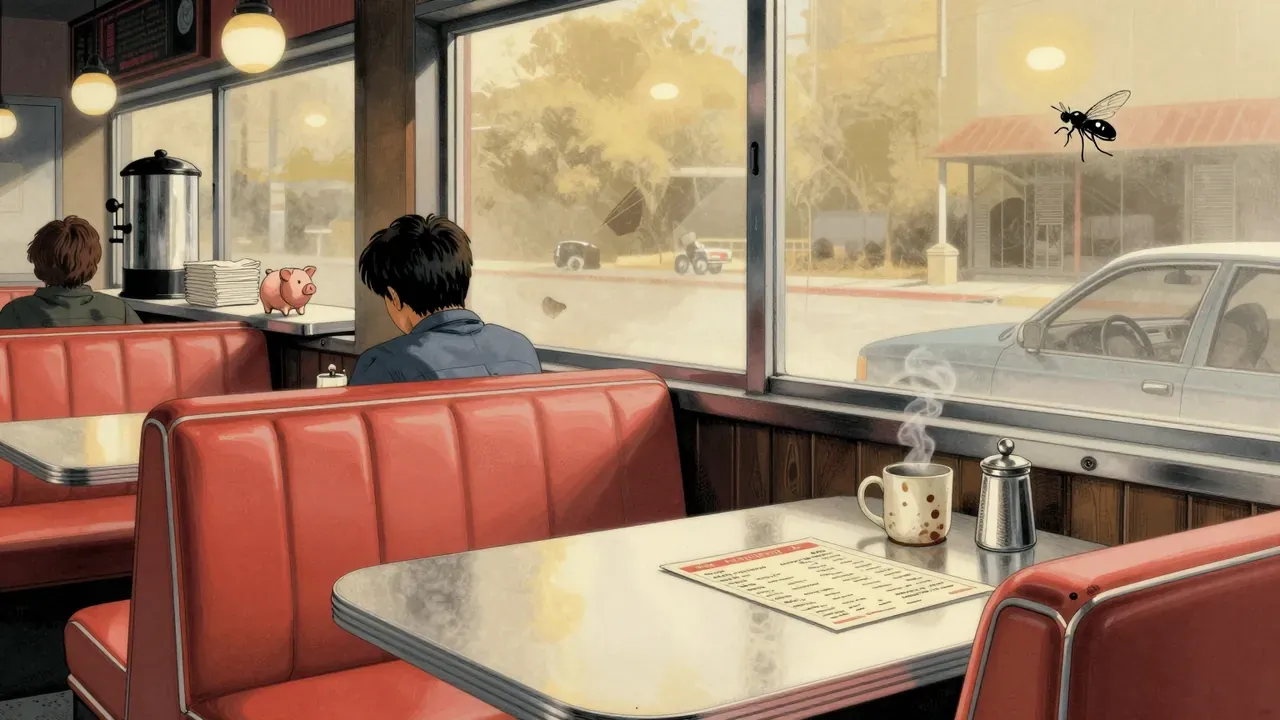
The plot moves in short, jagged bursts: Otto loses his job, his girlfriend, his parents’ trust, then gains a badge, a gun, and a malfunctioning vehicle. Emilio Estevez plays Otto with minimal inflection, letting his posture and silence do the work; Harry Dean Stanton’s Bud is all weary authority, his voice a dry riverbed. Robby Müller shoots in natural light, often handheld, keeping the frame loose and slightly off-kilter—street corners feel unstable, interiors are washed in sodium-vapour yellows and parking-lot greys. Tito Larriva’s score is sparse, tense, built around bass pulses and sudden silences, while the soundtrack’s punk cuts (Black Flag, Circle Jerks, Iggy Pop) arrive like interruptions rather than cues. Cox encourages improvisation, and it shows: dialogue stutters, pauses hang too long, reactions lag just enough to unsettle rhythm. The editing avoids continuity logic—cuts jump time, geography, even causality—so that a chase scene might end before it begins, or a character reappears mid-sentence in a different location.
The pace of it
What lands is the texture of lived-in absurdity: the way a repo man checks insurance papers while standing beside a smoking wreck, or how a televangelist’s broadcast cuts into a conversation about alien radiation as if both were equally plausible news. The film’s Los Angeles feels real because it is filmed where people actually live and work—the Garment District, the Arts District, the 4th Street bridge—not on studio backlots. The supporting cast, especially Tracey Walter as the perpetually distracted mechanic Miller and Dick Rude as the nihilistic repo rival, deliver lines with such flat conviction that their strangeness becomes ordinary. The Malibu itself works as a perfect MacGuffin: no one knows what’s in the trunk, but everyone wants it, and the film never explains why beyond the fact that it glows, kills, and resists ownership. That refusal to clarify—paired with Müller’s unsentimental framing and the soundtrack’s abrasive immediacy—makes the satire land not as commentary but as atmosphere.
The shape of it
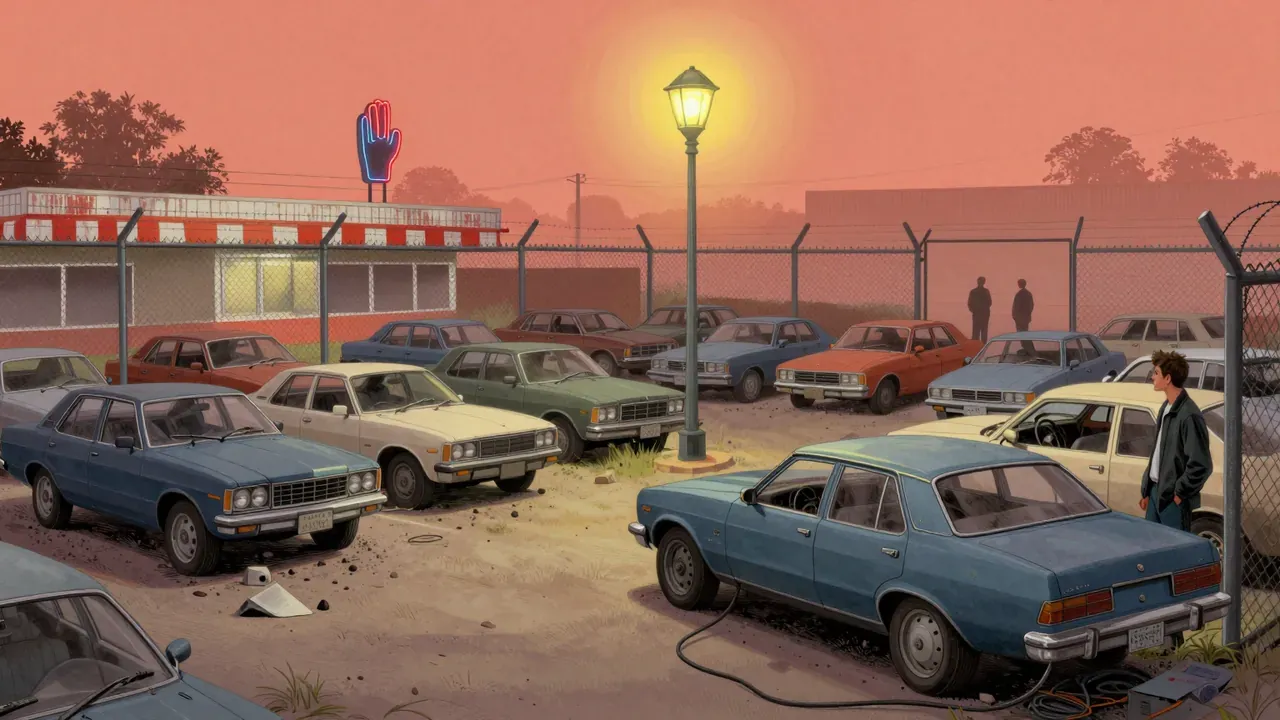
What does not land is the attempt to bind its disparate threads into a single resolution. The final convergence at the Helping Hand lot—government agents, UFO scientists, televangelists, punks—all chasing one car—feels less like climax than collapse, a surrender to cartoon logic after ninety minutes of grounded weirdness. Some performances tip into caricature: Olivia Barash’s Leila, though well-acted, functions mostly as exposition delivery, her alien photographs arriving like PowerPoint slides. The film’s resistance to explanation occasionally becomes evasion: Parnell’s motives, the nature of the radiation, even the origin of the bounty notice remain opaque not because they’re mysterious but because the script declines to anchor them. And while the green glow of the Malibu is visually striking, its escalation—from hot trunk to levitation—undermines the earlier restraint, trading quiet dread for spectacle that lacks weight.
The weight of it
The themes that matter are systemic failure and the illusion of control. Repo Man treats capitalism, bureaucracy, and science not as ideologies but as operating systems—clunky, outdated, prone to catastrophic error. Every institution in the film is compromised: the repo agency runs on cash and rumour; the government operates through helicopters and metal hands; the church sells salvation by mail order. Even the aliens are inept—stranded, miscommunicating, unable to retrieve their own technology. The film locates its critique not in speeches but in logistics: the difficulty of repossessing a car in a city where addresses blur, where paperwork contradicts reality, where a vehicle can become radioactive overnight. It is a film about late-stage infrastructure—roads that lead nowhere, radios that broadcast static, trunks that hold everything and nothing—and how people keep working anyway, filling out forms, driving cars, waiting for paydays that never come.
The audience for it
This is for viewers who tolerate disjunction, who find humour in administrative breakdown and tension in unresolved premises. It suits those familiar with 1980s American punk, LA geography, or the grammar of B-movie sci-fi—but none of those are prerequisites. It is not for viewers who require narrative closure, psychological realism, or consistent tone; those who expect cause-and-effect storytelling will find the film frustrating, its pacing erratic, its stakes deliberately diffuse. Anyone needing clear moral positions or character arcs will leave unmoored. The film assumes patience with ambiguity and rewards attention to detail over emotional payoff. A viewer who dislikes irony delivered without winking, or who finds sustained deadpan exhausting, would likely reject it outright. Its value depends on willingness to sit inside its logic rather than decode it.
The time for it
Yes, it is worth your evening—if you accept it on its own terms. Ninety-two minutes pass quickly, not because the film rushes, but because its rhythms resist habituation: no scene lingers long enough to bore, no joke repeats, no visual motif recurs without variation. It demands little beyond attention, and repays it with density—every background sign, every radio snippet, every discarded line carries weight. Those who dislike it usually do so on principle: they object to its refusal to explain, its embrace of nonsense as structure, its rejection of cinematic polish. Change the ending to ground the Malibu’s power in tangible rules, or tighten the plot’s causal chain, and the film would lose its central argument—that systems fail not at the edges but at the core. As it stands, it remains a precise, unsentimental artefact of its moment, still sharp, still strange, still functional.