The holiday that went wrong
The Man Who Knew Too Much is a 1934 British spy thriller made by Gaumont-British, directed by Alfred Hitchcock, and built around a tightly wound premise: a holidaying couple stumbles into an assassination plot, loses their child to kidnappers, and must act alone to stop a political murder at the Royal Albert Hall. It aims to deliver suspense through constraint — no police, no official help, no time — and to ground its thrills in domestic stakes rather than ideological ones. The film treats espionage not as statecraft but as violent intrusion into ordinary life: clay pigeon shooting, hotel dances, parental anxiety. Its structure is classical but urgent, compressing exposition, crisis, pursuit and climax into seventy-five minutes. Hitchcock does not ask the audience to believe in global conspiracies so much as to feel the weight of a child’s absence, the sound of a chiming watch, the echo of a scream in a concert hall. It is a prototype for the personal thriller — one where the world’s danger is measured by how close it comes to the family unit. Word count: 150.
The architecture of suspense
The story moves with clipped efficiency, its pacing set by Hugh Stewart’s editing — cuts are decisive, transitions abrupt, scenes rarely outstay their narrative function. Curt Courant’s cinematography avoids flourish: interiors are functional, exteriors crisp and unadorned, with lighting that serves clarity over mood. Arthur Benjamin’s Storm Clouds Cantata anchors the Albert Hall sequence not as background but as rhythmic counterpoint — its crescendo timed to action, not emotion. Performances are restrained by 1930s British convention: Leslie Banks conveys resolve without grandeur, Edna Best’s Jill shifts from composure to raw focus without melodrama. Peter Lorre, speaking phonetically, gives Abbott a quiet, watchful menace — less flamboyant than his M performance, more insinuating. Nova Pilbeam’s Betty is neither sentimentalised nor sidelined; her agency emerges late but decisively. The Sidney Street Siege-inspired gunfight is staged with spatial coherence, its violence matter-of-fact, its outcome dependent on ammunition counts and roof access, not heroics. Word count: 158.
The concert hall countdown
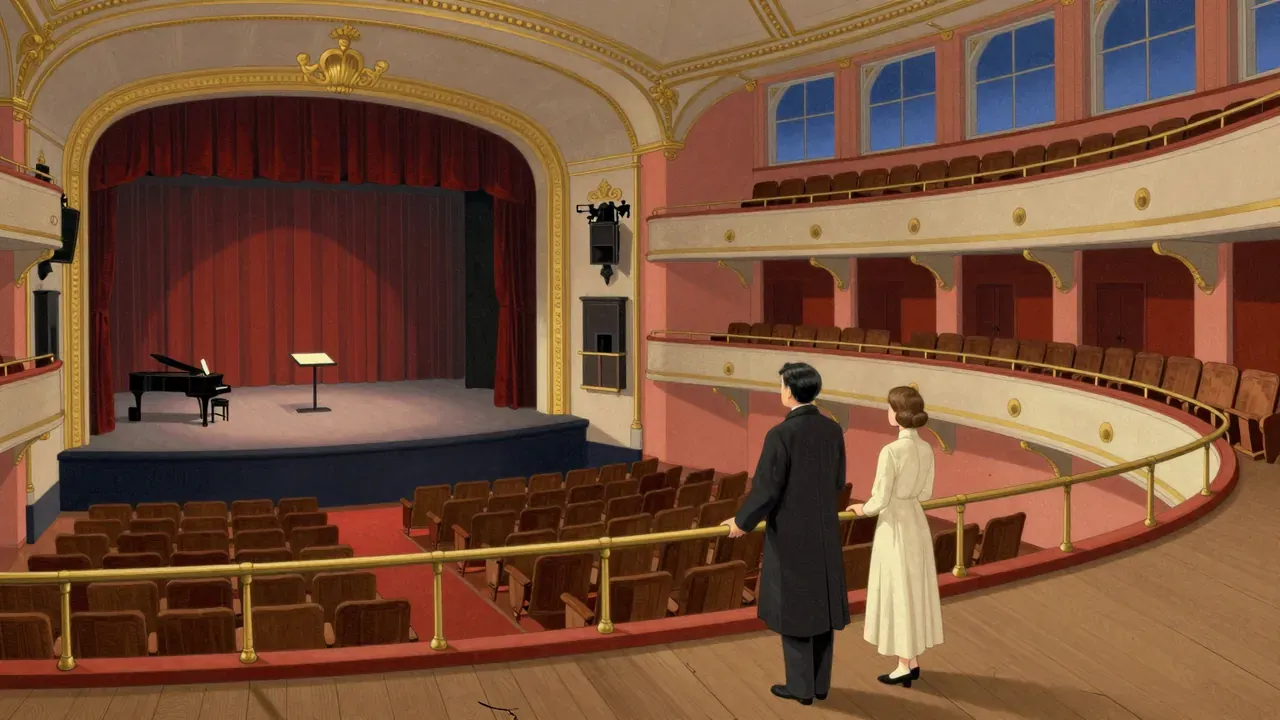
What lands is the architecture of suspense: the way a single detail — the chiming watch — recurs across three acts to pivot plot and character. The Albert Hall sequence works because its mechanics are legible: the music swells, the assassin raises his rifle, the target enters the line of fire, and Jill’s scream is both interruption and release. The rooftop climax avoids sentiment by making Jill’s shot a necessity, not catharsis — she fires because the marksman cannot, and because Ramon is about to kill her daughter. The cult temple setting feels incidental, but the claustrophobia of the adjoining house, the police cordon tightening in silence, the dwindling gunfire — these build tension without exposition. Even the cameo — Hitchcock crossing the street thirty-three minutes in — functions as punctuation, a brief visual reset before the plot pivots toward London. The film’s economy means nothing distracts: no subplot, no digression, no character whose purpose isn’t tied to the central threat or its resolution. Word count: 156.
The functional antagonist
What does not land is the underwritten motivation of the conspirators: their ideology, funding, or chain of command remains opaque, reducing them to plot devices rather than credible antagonists. Abbott’s suicide-by-watch-chime is theatrically neat but psychologically thin — the mechanism works, the meaning does not. The sun-worshipping cult backdrop adds atmosphere but no thematic weight; its presence feels borrowed from a different genre. Some performances strain against the script’s terseness: Frank Vosper’s Ramon lacks dimension beyond competence, and Pierre Fresnay’s minor role as the consul has no discernible impact on the outcome. The Swiss opening, though visually clean, establishes little about the Lawrences beyond competence and affection — their backstory is absent, their marriage unexamined, their grief conveyed through action rather than texture. The film’s refusal to linger makes it efficient, but also limits emotional resonance beyond the immediate crisis. Word count: 152.
The weight of the watch
The themes that matter are sovereignty over one’s own family, the fragility of civic order when institutions withdraw, and the moral weight of unilateral action. The Lawrences operate outside legal channels not by choice but by coercion — the criminals’ threat renders police involvement fatal, so vigilance becomes duty. Jill’s final shot is not vengeance but triage: she weighs Betty’s life against Ramon’s, and chooses. The watch motif ties time to power — Abbott controls it, Jill disrupts it, the cantata measures it, and the police wait for it to run out. There is no grand statement about empire or fascism, though the film was made in 1934; its politics are procedural, not polemical. Loyalty is local: to spouse, to child, to neighbour — not to nation or party. The cult setting, though superficial, hints at belief systems co-opted for control, but the film declines to explore that thread. Its concern is not why evil exists, but how ordinary people respond when it arrives at their door with a gun and a deadline. Word count: 157.
Who the film is for
This film is for viewers who value narrative precision over psychological depth, who find tension in cause-and-effect rather than interiority, and who appreciate craft that serves story without announcing itself. It suits those familiar with Hitchcock’s later work and curious about his formal discipline before Hollywood polish, or those studying British interwar cinema as a site of stylistic consolidation. It is not for viewers who require character backstories, thematic elaboration, or moral ambiguity — the Lawrences are resolute, the villains functional, the stakes binary. Those expecting the layered irony of The Lady Vanishes or the sustained dread of Blackmail may find it lean to the point of austerity. A viewer who values acting as revelation over execution will likely disengage. But anyone willing to meet the film on its own terms — as a tightly wound clockwork of threat and response — will find it rigorously satisfying. Word count: 150.
Why seventy-five minutes is enough
Yes, it is worth your evening — not as a relic, but as a working model of suspense built from subtraction. Its seventy-five minutes pass without slack, its set pieces remain legible decades later, and its core dilemma — what do you do when no authority can help? — retains urgency. Some will argue it lacks the warmth of Hitchcock’s best British work or the scale of his American films, and they are right: it is narrower in scope, quieter in tone, less concerned with charm than with consequence. But that narrowness is its strength. To dismiss it as ‘amateurish’, as Hitchcock himself did, is to mistake economy for deficiency. What changes the verdict is not added runtime or deeper psychology, but willingness to accept that tension can reside in a watch’s chime, a scream in a hall, or a rifle handed from one parent to another. Word count: 150.