A journalist, a city, and no fixed plot
La Dolce Vita follows Marcello Rubini, a gossip journalist played by Marcello Mastroianni, across seven nights and the mornings after in a Rome of parties, starlets, and aristocrats, none of which give him what he’s actually looking for. Fellini structures the film as a prologue, seven episodes split by an intermezzo, and an epilogue, rather than a conventional plot with rising stakes, which was itself an argument: this is a life without direction, so the film about it shouldn’t pretend to have one either. Marcello wants to be a serious writer and keeps not becoming one, drifting instead toward the next event, the next woman, the next distraction, and Fellini lets that drift be the entire shape of the film.
Mastroianni, Ekberg, and a fountain in winter
The film’s best-remembered sequence has Marcello and the American actress Sylvia, played by Anita Ekberg, wading into the Trevi Fountain at night, an image shot over roughly a week of winter cold. Ekberg reportedly stood in the water in her dress for hours without complaint, while Mastroianni needed a wetsuit under his clothes and, by his own account, a full bottle of vodka before he could get through the take. Elsewhere the film moves through a costume party at a real aristocratic palace outside Rome, where some of the guests were actual nobility, and a set built at Cinecittà reproducing the Via Veneto in extraordinary detail, all photographed by Otello Martelli with Nino Rota’s score threading the episodes together.
Where the satire actually bites
The film’s turning point isn’t a party at all: Marcello’s friend Steiner, an intellectual who represents the serious life Marcello claims to want, kills his two children and then himself, with no explanation the film offers directly. Co-writer Tullio Pinelli based the character partly on a real Italian novelist whose intellectual life had curdled into something hollow enough to end in suicide, and the episode lands with a weight nothing in the surrounding glamour prepares you for. It reframes everything before and after it: the parties aren’t just empty, they’re a refuge from an emptiness that, taken seriously instead of chased with distraction, can kill you. Fellini never returns to comment on it; he just lets it sit there.
Where the episodes sprawl
At 174 minutes, built from largely self-contained episodes rather than a single escalating story, the film’s momentum rises and falls with whichever sequence you’re currently in rather than building cumulatively. Some episodes, particularly the middle stretch involving a staged religious miracle and its media circus, run long relative to what they add, and the structure by design resists the kind of narrative pull that would make three hours feel shorter. Characters drift in and out without full development, which suits Fellini’s point about a social world of surface connections, but it also means several figures, Marcello’s father among them, get a single memorable scene and then vanish, leaving less impression than the film’s best sequences.
A word the film accidentally invented
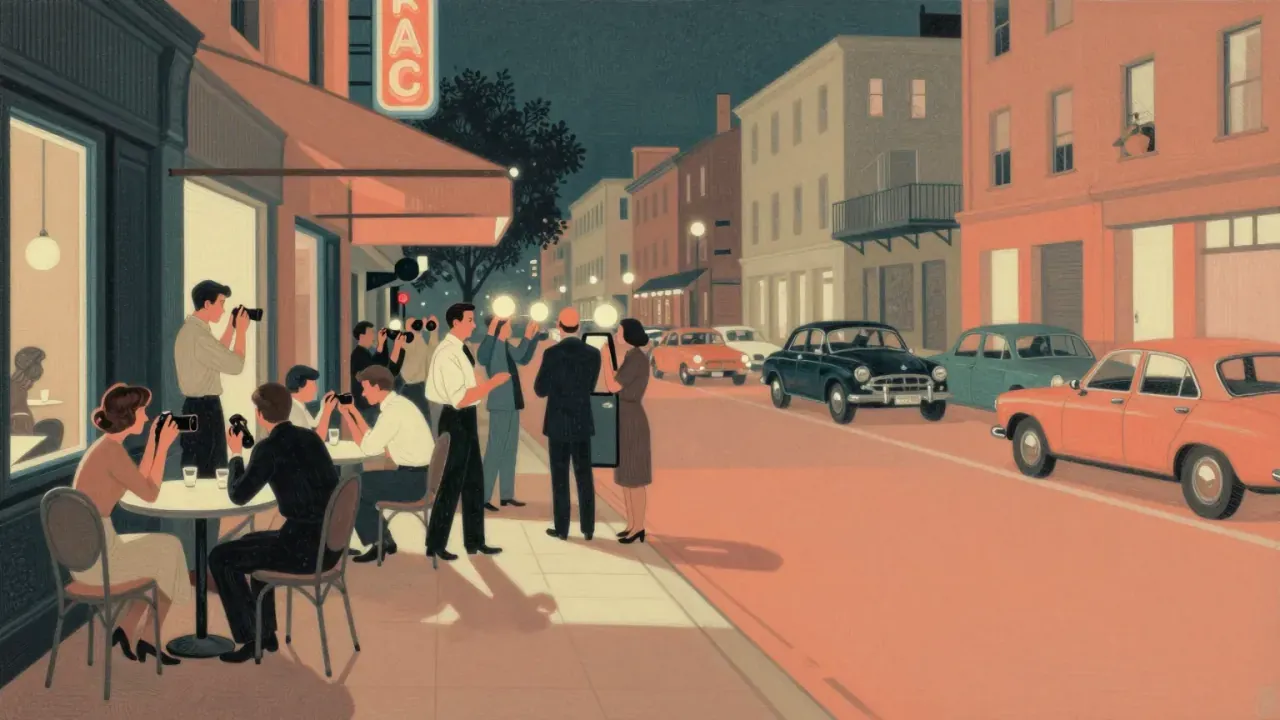
Walter Santesso plays a photographer named Paparazzo, based partly on a real Roman photojournalist known for aggressive celebrity pursuit, and the character’s name has since become the generic term for that entire profession in dozens of languages. That’s a strange kind of legacy for a supporting character, but it fits a film obsessed with the manufacture and consumption of fame, journalists chasing miracles, actresses, and scandal with equal appetite, none of it distinguishing between the sacred and the trivial. Marcello himself works this same beat and despises himself for it, which is the film’s clearest statement: the sweet life isn’t corrupting anyone from outside, it’s the job everyone in it has chosen and can’t stop choosing.
Who should spend an evening in this Rome
This suits viewers who want a vivid social document of Rome at a specific cultural moment, and who don’t need a plot with mounting stakes to stay engaged for the runtime. It rewards patience with tone and episode over incident, and anyone interested in the postwar shift from religious to celebrity culture in Italy will find plenty to chew on here. It’s a harder sell for viewers who want narrative momentum or a protagonist actively pursuing something, since Marcello’s whole arc is a failure to choose. If nearly three hours of party scenes without a driving story sounds like a slog rather than an immersion, this isn’t the film to change your mind.
Is the sweet life worth the length
La Dolce Vita won the Palme d’Or at Cannes and took home the Academy Award for Best Costume Design, a modest reward set against how much the film reshaped both Italian cinema and the wider culture’s vocabulary for celebrity intrusion. It also did serious business at the box office despite censorship battles in several countries, proof that its scandal and its craft sold tickets in equal measure. The film’s length is real and its episodic looseness won’t suit every mood, but the specific texture of its Rome, glamorous, exhausted, occasionally lethal, has aged remarkably well. For an evening given over to atmosphere and a slow-dawning sense of futility, it remains one of the most fully achieved examples of the form.