A heist told entirely as aftermath
Reservoir Dogs is Quentin Tarantino’s 1992 debut feature, following six career criminals recruited under colour-coded aliases for a jewellery heist that collapses within minutes, leaving them to regroup at a warehouse and work out which of them tipped off the police. Tarantino never shows the robbery itself, a choice made partly for budget reasons and partly to keep its details permanently uncertain. The film compresses its present-tense action into a single day and largely one location, while flashbacks fill in each man’s route to that warehouse floor. Made for close to the price of a house on the strength of Harvey Keitel’s early support, it set out to prove that a crime picture could run almost entirely on conversation and mounting threat rather than the heist set-piece the genre usually promises, and to build tension purely from men who no longer trust one another.
One set, six aliases, constant suspicion
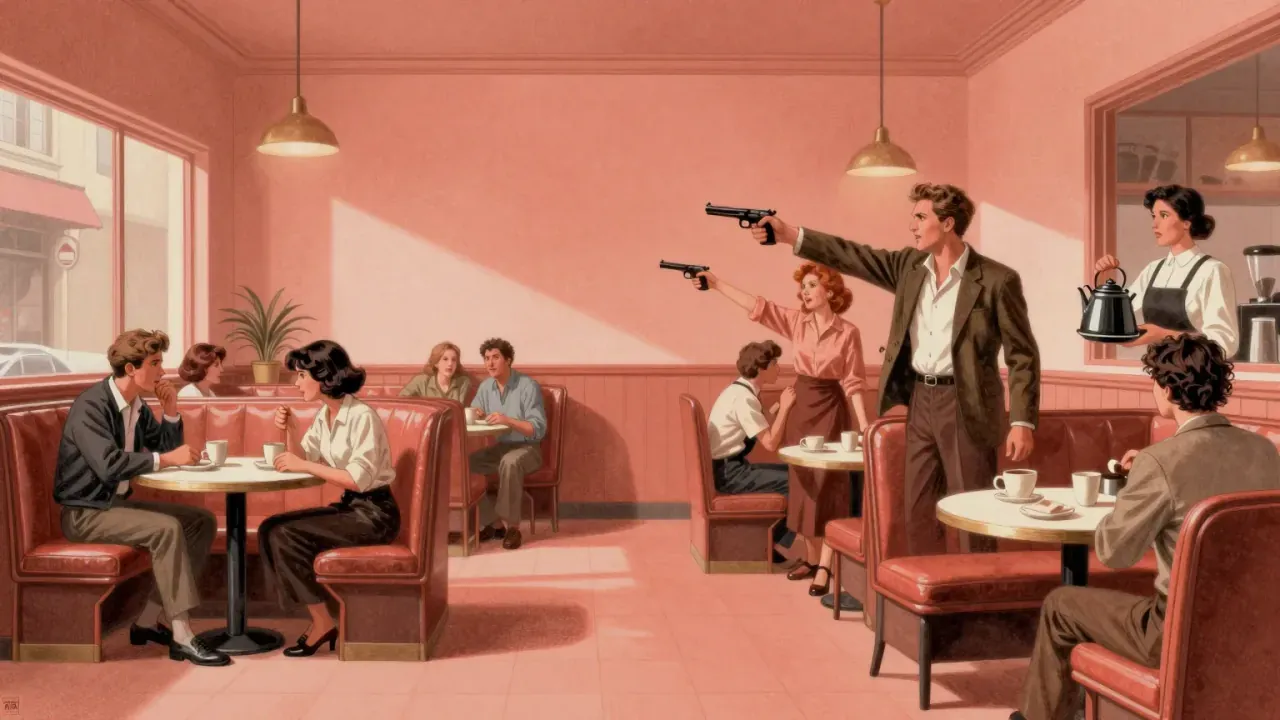
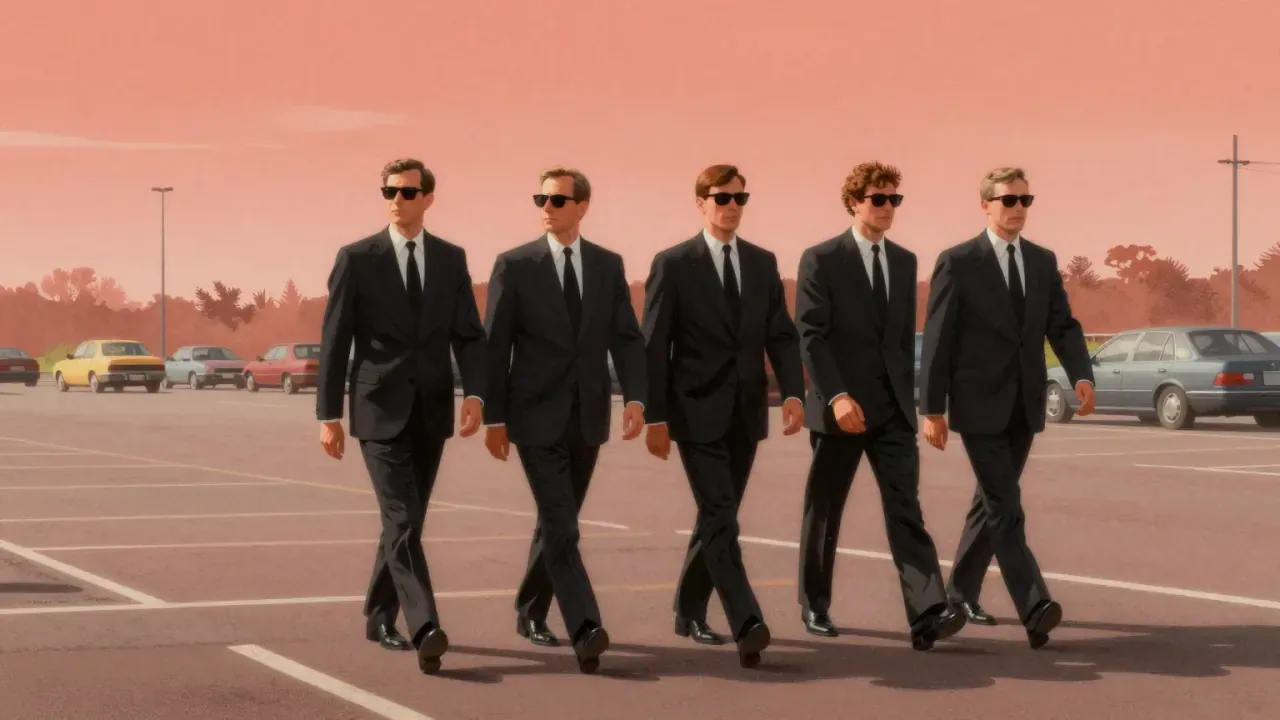
The ensemble is built around aliases, White, Orange, Pink, Blonde, Brown, Blue, assigned by boss Joe Cabot so the men cannot identify one another if caught, and the cast plays the tension between professional discipline and mounting suspicion in a single warehouse set for most of the runtime. Harvey Keitel’s Mr White anchors the group’s moral centre, however compromised, while Tim Roth’s Mr Orange carries a slow-reveal storyline as an undercover officer bleeding out on the floor for most of the film. Michael Madsen’s Mr Blonde supplies the picture’s single most notorious sequence, torturing a captured policeman while dancing to a radio hit, played for a queasy comedy that never lets the violence off the hook. Andrzej Sekuła’s cinematography stays close and functional rather than stylised, and Sally Menke’s editing jumps between the warehouse present and character flashbacks without losing the audience’s place.
Where the tension actually bites
The ensemble’s chemistry, formed partly through a short proof-of-concept film shot before the real production, gives the warehouse scenes the sense of men who have worked together before even when their characters have only just met, which sells the paranoia once it turns. The torture scene, scored to a chart hit rather than anything ominous, remains effective precisely because the film refuses to look away or cut for relief. Steve Buscemi’s Mr Pink, arguing furiously for professional discipline while everyone around him bleeds out or panics, gives the film its clearest voice of reason and its sharpest comic timing. Withholding the robbery is the smartest structural choice here: by the time flashbacks finally explain how badly the job went wrong, the audience has spent so long inside the aftermath that the reveal lands as confirmation rather than surprise.
Where the writing thins out
The colour-coded alias device, while a clean piece of screenwriting, occasionally works against depth; some of the men remain functions of their assigned name and role rather than fully drawn people by the time the film ends. Chris Penn’s Nice Guy Eddie is largely reactive, present to escalate conflict rather than to add a perspective of his own. The single-location structure, a virtue for tension, does mean the second half has limited places to go once the mystery of the informant narrows to a short list of suspects. And Tarantino’s own performance as Mr Brown, a role written for another actor before he cast himself, is the least persuasive turn in an otherwise sharply cast ensemble, present mostly to service plot rather than to hold the screen.
Trust, code and offstage violence
Trust among professionals who are strangers to one another by design is the film’s real subject, and the heist’s failure functions mainly as pressure that forces the men to test loyalties built on nothing but a shared employer. Masculinity is examined through posture and code, insistence on being called a professional, contempt for anyone who breaks under pressure, that the film steadily reveals as brittle once real blood is on the floor. The refusal to depict the crime itself puts the emphasis on consequence and character rather than spectacle, treating the heist the way a stage play might treat an offstage death: as something whose absence shapes everything the audience does see. Popular music, largely drawn from the 1970s, sits in ironic counterpoint to the violence happening under it, most explicitly in the torture scene.
Who the tension is aimed at
This suits viewers interested in how a first-time director made ninety minutes of near-continuous dialogue and confrontation feel as tense as a heist film with a car chase, and in the genre lineage it draws on, from Kubrick’s The Killing to Hong Kong crime cinema. It also rewards anyone curious about where Tarantino’s later, larger films first worked out their rhythms of digression and threat. It is not for viewers sensitive to prolonged, close-up violence, since the ear-cutting sequence is deliberately sustained rather than glancing, or for anyone hoping for a heist film with an actual heist on screen. Those who need a female character of any substance should also look elsewhere, since the cast and story are built entirely around men.
Whether ninety minutes earns its keep
At 99 minutes, Reservoir Dogs asks for less of an evening than most films on a crime-cinema watchlist, and its return on a reported $1.2 million budget, modest at $2.9 million on first release, larger once Tarantino’s next film sent audiences back to seek it out, reflects how it found its real audience after the fact rather than on opening weekend. Critical scores in the high eighties and nineties have held up, and its reputation as a defining independent film of its decade rests on more than nostalgia for Tarantino’s later career. For a viewer trying to understand where a specific strand of 1990s American crime cinema began, this is close to essential; for a casual evening’s entertainment, its violence and claustrophobic setting demand a particular mood rather than general appeal.