The length of it
Phantom India is a seven-part French television documentary, filmed in India between January and May 1968, that attempts to record the country not as a subject for policy or tourism but as a lived reality seen through the eyes of a single foreign observer. Louis Malle made no effort to structure it around interviews, narration, or explanatory graphics; instead, he let long takes accumulate — of street markets, temple rituals, railway platforms, village schools, leper colonies, and monsoon floods — without commentary or contextual framing beyond his own off-camera presence. The film does not argue a thesis about India, nor does it seek to explain poverty, caste, or modernisation. It tries, instead, to hold space for contradiction: reverence and squalor, stillness and chaos, dignity and exhaustion, all coexisting without resolution. Its ambition is observational fidelity, not synthesis — to show what Malle saw, when he saw it, with minimal intervention. That ambition rests on duration: 378 minutes is not a runtime but a condition of attention, one that refuses the shorthand of summary.
The sound of it
The film works through accumulation, not argument. There is no script, no narrator, no score beyond ambient sound recorded on location. Malle and his cameraman, Étienne Becker, used available light and handheld setups, often filming from low angles or across distances that preserve social distance rather than impose intimacy. Sound was captured live by a single recordist, yielding layered, unbalanced audio — chants overlapping train whistles, children’s voices fading beneath temple bells. Editing, done by Malle and Monique Fillion, avoids rhythm or pacing as conventionally understood; sequences run long, sometimes past comfort, and cuts follow no logic but temporal continuity or visual echo. There are no talking heads, no experts, no subtitles for most spoken dialogue — French voiceover translates only fragments, often elliptically. Performance is non-performative: people look at the camera, ignore it, gesture, pray, work, sleep, grieve. The craft is austere: no re-creations, no reconstructions, no archival inserts. What appears is what was filmed, edited down from thirty hours to just over six hours, with nothing added after the fact.
The rhythm of it
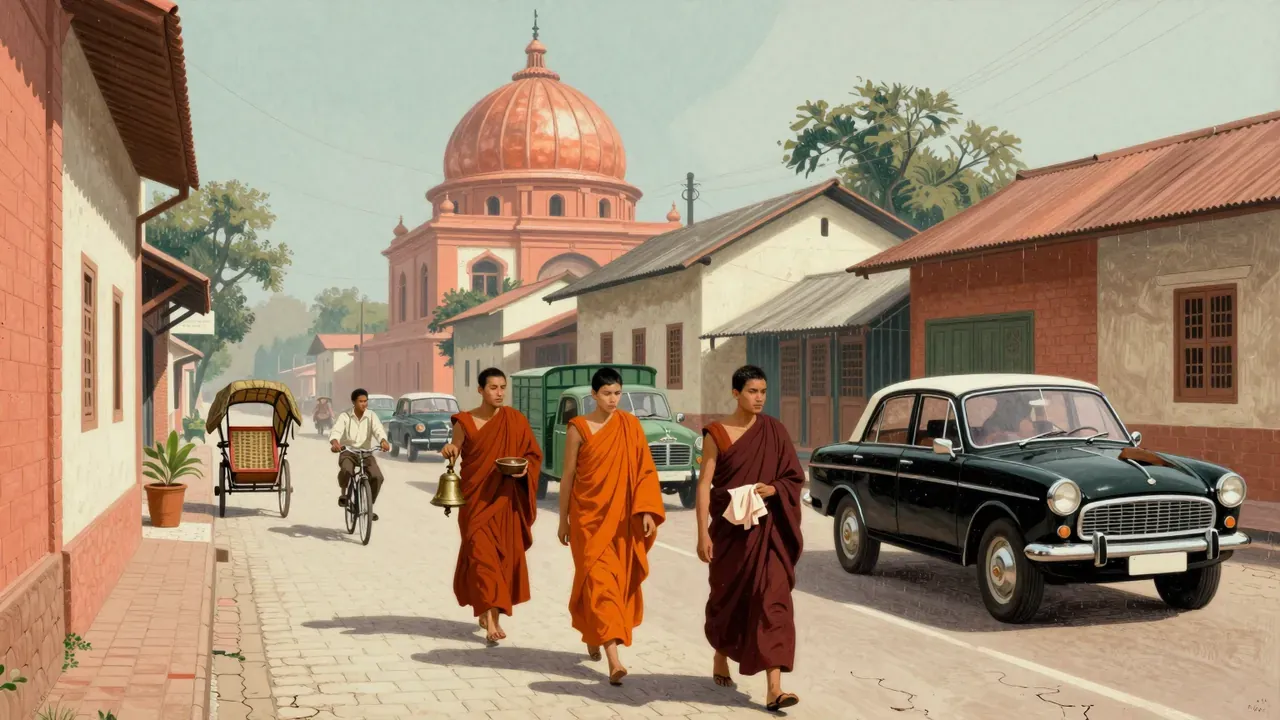
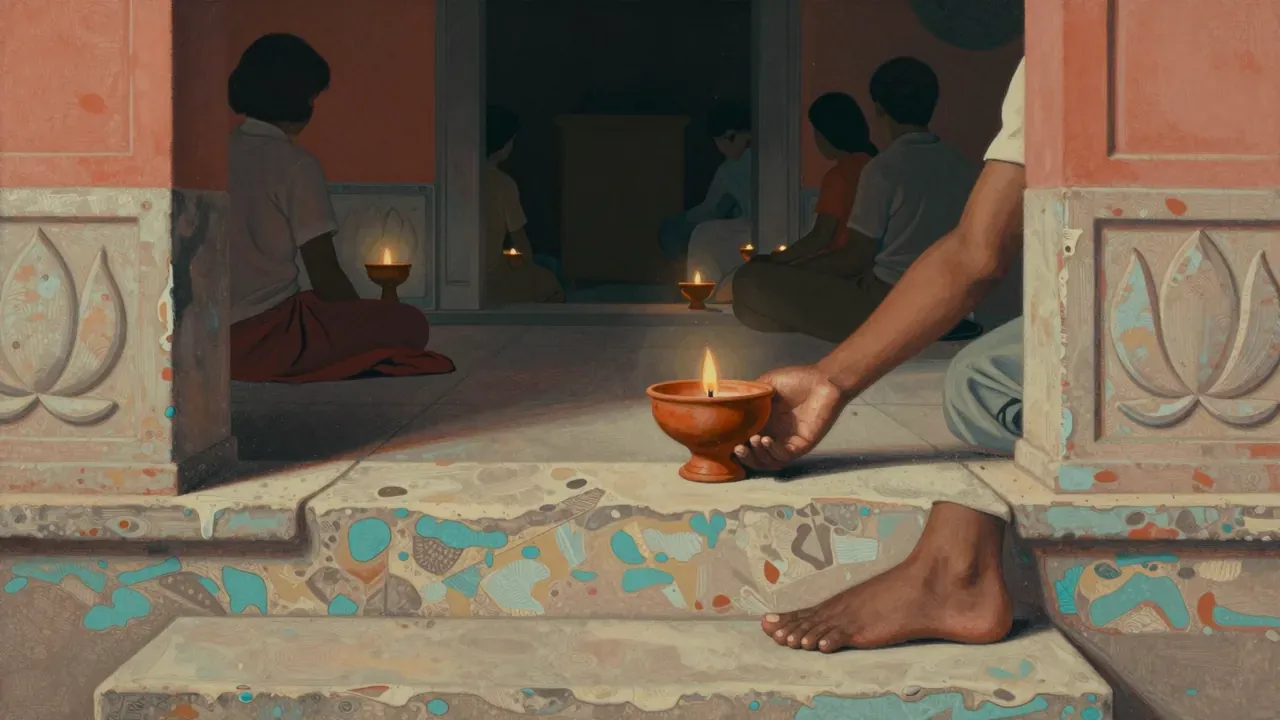
What lands is the weight of duration. Over nearly six and a half hours, the film builds a tactile sense of place — not as geography but as texture: the grit on a child’s cheek, the tremor in an old man’s hands as he lights a clay lamp, the slow collapse of a mud wall under monsoon rain. Malle’s refusal to explain or interpret allows certain images to settle with moral gravity: a group of women washing clothes in a polluted river while a sign reads ‘Clean Water For All’; a schoolroom where pupils recite English grammar from tattered books while flies crawl across their foreheads; a funeral pyre lit at dawn beside a busy highway. These moments do not shout; they persist. The lack of exposition forces the viewer to sit with ambiguity — to notice how devotion and destitution occupy the same frame, how ritual and routine coexist. That persistence is the film’s quiet achievement: it makes indifference impossible, not through outrage, but through sustained, unsentimental looking.
The silence of it
What does not land is any claim to comprehensiveness. The film’s narrow scope — shot by two people over four months, self-financed and unplanned — becomes a liability when read as representation rather than reflection. Its focus on rural hardship, religious spectacle, and urban marginality leaves out industrial zones, university campuses, newly built dams, or the daily life of the middle class. This omission was noted at the time: the Indian government objected not to inaccuracy but to imbalance, arguing that Phantom India presented India as static, suffering, and spiritually exoticised — a view echoed by many British Indians who felt the series reinforced colonial tropes. Malle’s personal pride in the work does not offset its structural limitations: there is no counterpoint to the poverty he films, no engagement with political agency, no account of resistance or reform. The film’s honesty of observation is real; its silence on context is not neutral — it is a choice with consequence.
The tone of it
The themes that matter are time, witness, and asymmetry. Time appears as both medium and subject: the film’s length insists on duration as ethical demand, resisting the compression of news or travelogue. Witness is complicated — Malle is never off-screen, yet rarely in-frame; his presence is audible in breath, in occasional questions, in the rustle of movement, but never authoritative. Asymmetry runs through every layer: between observer and observed, between French funding and Indian subjects, between the permanence of stone temples and the fragility of human life, between the certainty of Malle’s gaze and the opacity of what he sees. There is no theme of progress or decline, only coexistence — of ancient practice and modern rupture, of communal belonging and individual anonymity. The film treats caste not as sociology but as visible fact: seating arrangements, water sources, burial grounds, the direction people face when praying. These are not explained, but they are shown, repeatedly, until their logic becomes part of the landscape’s grammar.
The demand of it
It is for viewers who accept documentary as encounter, not explanation — those willing to spend six and a half hours without narrative payoff, without resolution, without reassurance. It suits historians of postcolonial representation, students of ethnographic film, and anyone attentive to how power operates in the act of looking. It is not for those seeking context, analysis, or balance — nor for viewers who expect documentaries to clarify rather than complicate. Those who found Malle’s later work too detached or his fiction too cool may find this his most committed piece; others will see its limitations as fatal. A viewer who values clarity over ambiguity, or who believes film should advocate rather than observe, will leave frustrated. The verdict changes only if one accepts that a documentary’s value lies not in what it says about a place, but in how honestly it records the limits of its own understanding.
The end of it
Yes, it is worth your evening — though not in a single sitting, and not as entertainment. Its value lies in its refusal to flatter attention: it demands patience, rewards close watching, and resists easy interpretation. It is worth it for the way it recalibrates perception — after Phantom India, ordinary street scenes feel denser, slower, more layered. It is not worth it if you require coherence, closure, or instruction. Some will call it essential viewing for anyone serious about documentary form; others will find its austerity alienating, its omissions unforgivable. The difference hinges on whether you see the film as portrait or provocation. As portrait, it fails — it is partial, subjective, incomplete. As provocation, it succeeds: it asks, relentlessly, what it means to look, for how long, and with what right. That question has not aged. It remains urgent, uncomfortable, and necessary.