The look of it
Calcutta is a French documentary film directed by Louis Malle and released in January 1969. It is not a travelogue, nor a sociological survey, nor an advocacy piece: it is an observational record made on location in Calcutta between 1967 and 1968, during which Malle filmed without script or narration, relying instead on long takes, ambient sound, and unmediated access to street life, religious ritual, political demonstration, and domestic space. The film attempts no synthesis — no argument about poverty, modernity, or colonial legacy is advanced — and avoids voiceover, interviews, or explanatory titles. Its ambition is structural rather than rhetorical: to hold the camera steady while Calcutta moves past it, to register duration and density without selection or emphasis beyond framing and timing. It treats the city as a continuous present, not a case study. This is not cinema of explanation but of endurance: the film’s logic is chronological and spatial, not causal or thematic. It assumes no prior knowledge of India, offers no context for what is shown, and makes no claim to representativeness. Its method is proximity without intervention — a stance that is neither neutral nor detached, but materially committed to what the lens captures in real time and real light. (158 words)
How it holds the frame
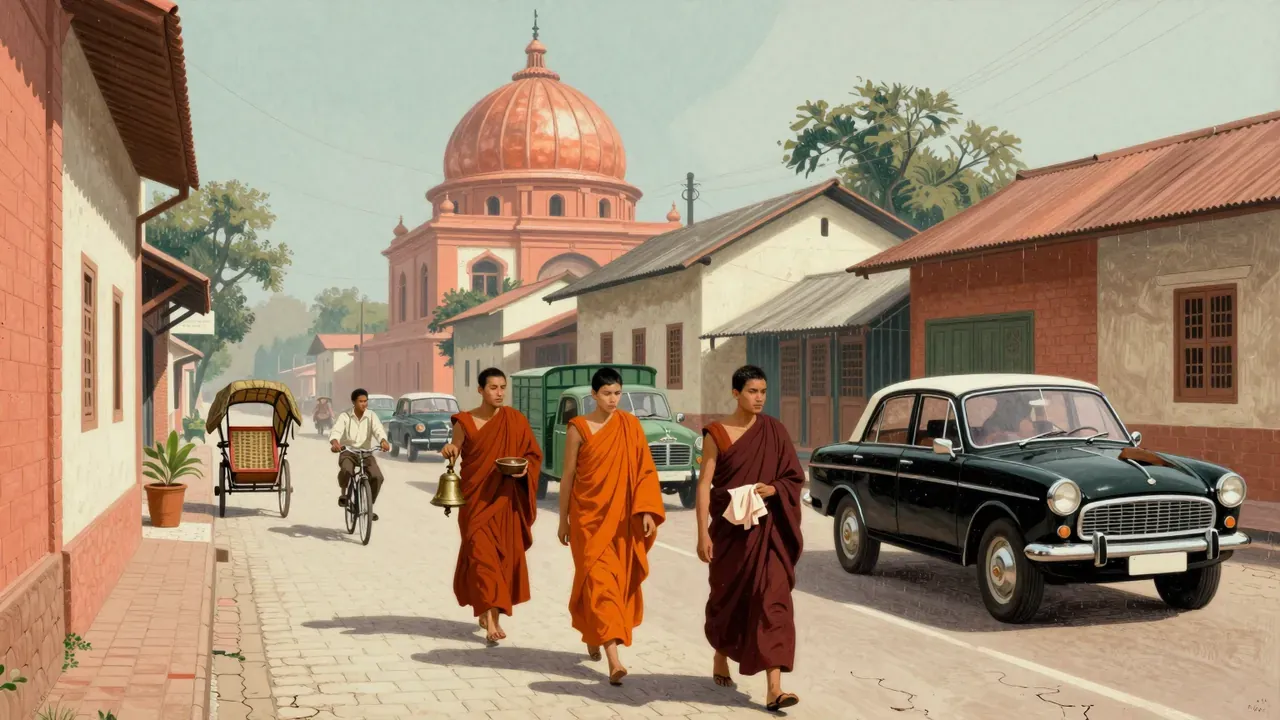
The film works through sustained attention to texture, rhythm, and scale. Malle and his cinematographer — though the fact sheet names no crew — use available light and shallow depth of field to keep faces and surfaces legible amid dust and haze. Shots linger: a man washing clothes in the Hooghly, children playing in rubble, a procession of saffron-robed monks moving through traffic, a funeral pyre at dawn. There is no score; diegetic sound dominates — temple bells, rickshaw bells, shouted slogans, rain on tin roofs, the low hum of crowds. Editing is unhurried, often holding on a single plane of activity until movement or light shifts the composition. No person is named or identified; no institution is labelled. The film does not cut away from discomfort — a leper colony, a crowded slum alley, a man sleeping on a pavement — but neither does it dwell with moral emphasis. Performances are non-performative: people go about their work, worship, protest, or rest as they would with or without a camera. Craft is restrained: no zooms, no tracking shots, few dissolves. What emerges is not a portrait but a surface — layered, inconsistent, resistant to summary. The film’s coherence comes from repetition — of gesture, of light quality, of spatial logic — not from narrative or argument. (159 words)
What settles
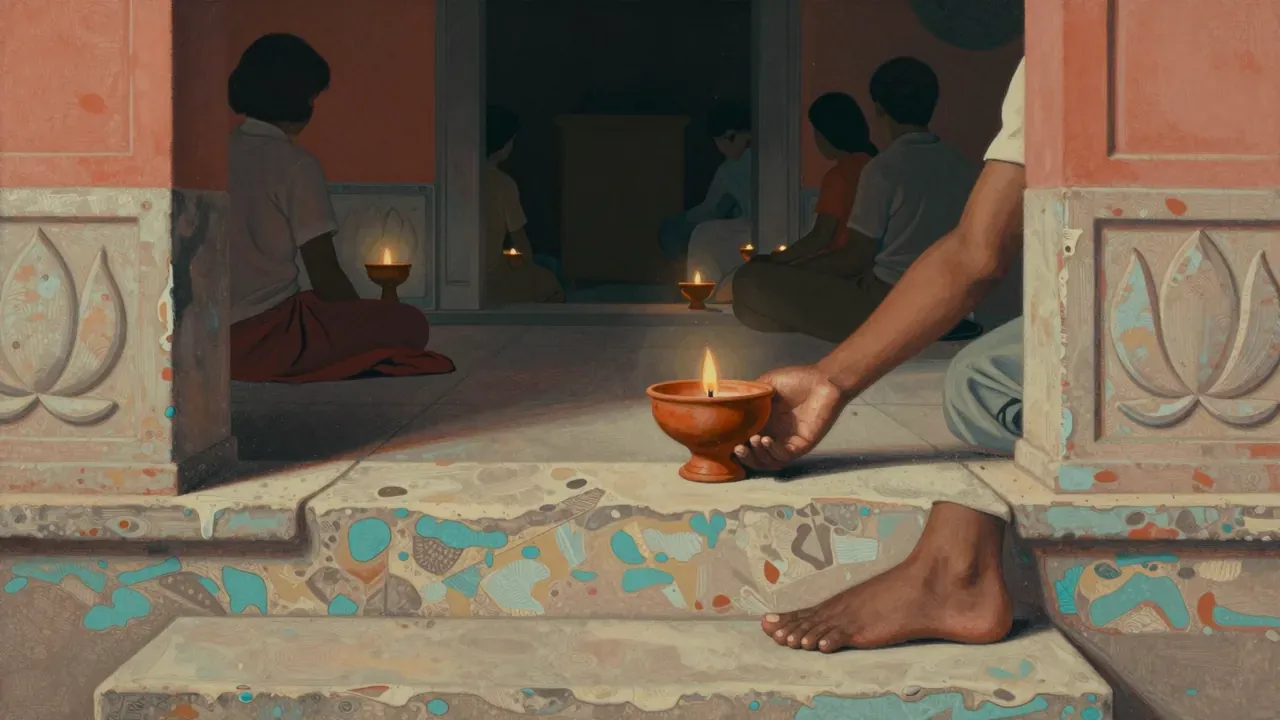
What lands is the sheer physicality of the city as lived space: the weight of heat, the persistence of ritual, the density of coexistence across class and creed. Scenes of daily labour — weaving, brick-making, fish-selling — carry tactile clarity; the grain of skin, the sheen of sweat, the grit in the air all register without commentary. The film’s refusal to explain allows certain moments to settle with quiet force: a woman adjusting her sari in a doorway, a boy balancing a stack of clay pots on his head, the slow collapse of ash from a burning corpse into river water. These are not ‘iconic’ images but accumulated impressions, and their power lies in their refusal to yield meaning on demand. The pacing — deliberate, sometimes static — invites the viewer to adjust perception, to notice how light changes over ten seconds, how a crowd parts and reforms, how silence persists even in noise. The film’s integrity is in its consistency: it never breaks its own terms. It does not ask for empathy, but it permits attention — and that attention, sustained over 105 minutes, becomes its own form of engagement. That is rare, and it lands. (154 words)
Where it leaves space
What does not land is any sense of internal logic beyond chronology and geography. Without structure beyond ‘what was filmed when’, the film risks monotony — not because it is dull, but because its method offers no relief from its own rigour. Some sequences feel unresolved: a political rally fades without resolution; a temple ceremony ends mid-ritual; a hospital corridor yields no diagnosis or outcome. This is intentional, but it also denies the viewer footholds — no transitions, no recapitulations, no visual motifs returned to with variation. The absence of context means that historical or cultural references remain opaque: a banner in Bengali, a slogan shouted in Hindi, a deity’s iconography — all pass without elucidation. Viewers unfamiliar with Indian urban life may register sensation without significance, texture without traction. The film’s discipline becomes, for some, a barrier: its refusal to guide or interpret can read as indifference rather than restraint. Those expecting insight into post-colonial Calcutta, or into Malle’s own position as a foreign observer, will find neither. The film does not conceal its limits — it enacts them — but that enactment is not always legible as choice. (157 words)
What it lets be true
The themes that matter are presence, accumulation, and the limits of observation. Calcutta is less about the city than about the act of looking at it — and the material conditions under which that looking occurs. It engages with time not as progression but as sediment: layers of history, religion, poverty, and resilience occupy the same frame, unranked. Class is visible not as abstraction but as proximity — a luxury car idling beside a beggar, a marble temple gate flanked by sleeping bodies. Religion appears not as doctrine but as rhythm: chants, processions, offerings, ashes — repeated, unexplained, inseparable from the city’s pulse. Colonialism is present only as residue: in architecture, in administrative signage, in the lingering grammar of English on posters — never named, never analysed, but structurally embedded in the fabric. The film treats poverty not as crisis but as condition — persistent, unremarkable to those living it, yet impossible to ignore for the viewer. Most quietly insistent is the theme of endurance: of people, of institutions, of the city itself — not as triumph but as fact. These are not arguments the film makes; they are patterns it permits the eye to trace. (156 words)
Who walks with it
This film is for viewers who value sustained, unmediated attention to place — those accustomed to essay films, ethnographic work, or the long-take aesthetics of later non-fiction like Wang Bing or Pedro Costa. It suits historians of documentary, students of post-colonial urbanism, or anyone willing to sit with ambiguity for over an hour and a half. It is not for viewers seeking narrative, exposition, or emotional arc — those who expect documentaries to clarify, persuade, or resolve will find it withholding. It is also not for those who require cultural scaffolding: no subtitles for banners or chants, no maps, no voiceover to locate scenes. A viewer who expects context to be supplied, rather than discovered, will leave frustrated. Those who believe documentary must serve advocacy or education may see Calcutta as inert — and they would not be wrong, if inertness is judged by conventional metrics. But the film’s value lies precisely in its resistance to instrumentalisation. Change the expectation — from ‘what does it tell me?’ to ‘what does it let me witness?’ — and the verdict shifts. (158 words)
Whether it holds you
Yes, it is worth your evening — but only if you arrive prepared to watch, not consume. Its 105 minutes do not pass quickly, nor are they meant to; they ask for patience, not passive reception. It rewards close viewing: noticing how light falls across a wall at different times of day, how sound shifts between interior and street, how a single shot contains multiple simultaneous actions. It is not ‘entertaining’ in the usual sense, nor does it aim to inform in the manner of a BBC documentary. But it offers something rarer: a record of Calcutta in a specific, unreproducible moment, held without embellishment or apology. Those who find value in seeing the world as it resists summary — in texture over thesis, duration over delivery — will find it rich. Others may call it austere or alienating. That disagreement is legitimate — it stems from different ideas of what documentary should do. What would change the verdict? A shorter runtime, or the addition of contextual titles, would make it more accessible — but it would also break the film’s central commitment: to show, not tell. (159 words)