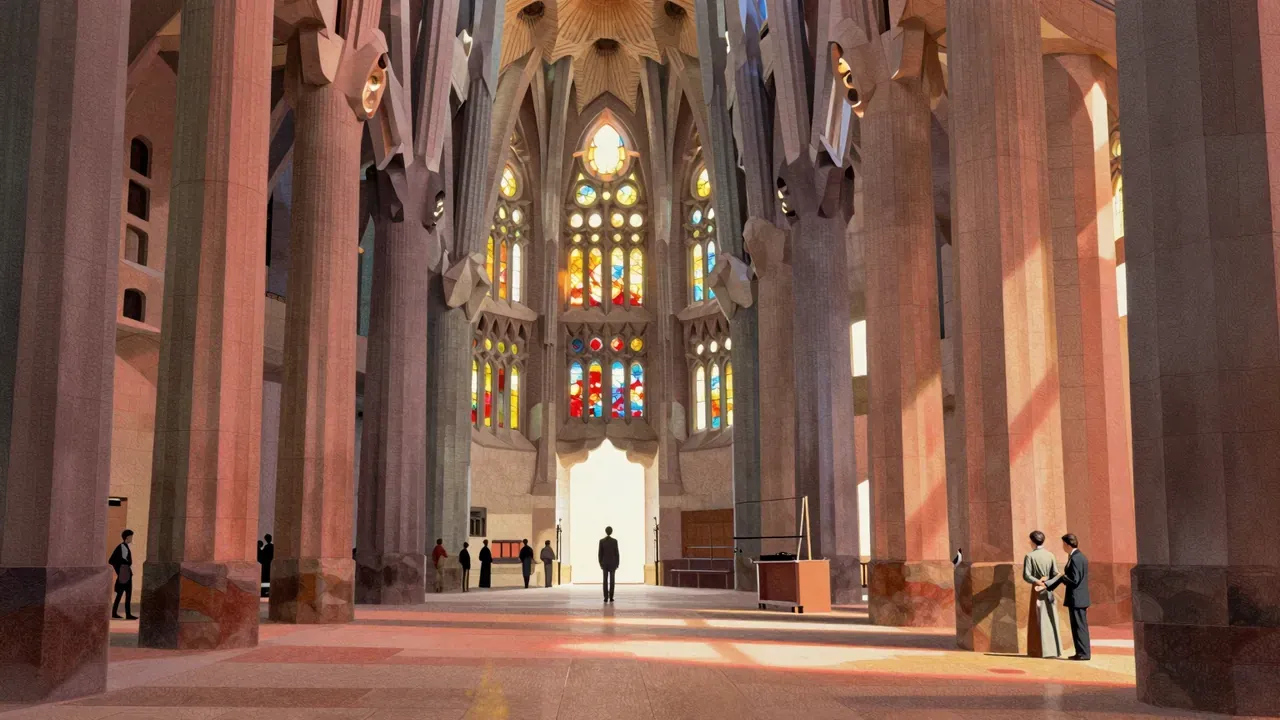
What it shows, not who built it
Antonio Gaudi is a 72-minute Japanese documentary film directed by Hiroshi Teshigahara, released in January 1984. It is not an exposition of biography or historical context but a sustained visual encounter with the built work of Antoni Gaudí in Barcelona: the Sagrada Família, Casa Batlló, Park Güell, and other houses and structures. The film makes no claim to explain Gaudí’s life, motives, or place in architectural history; it does not name dates, patrons, or construction timelines. There is no voiceover narration, no on-screen text, no interviews, and no archival footage. Instead, the film attempts immersion — to register the physical presence of Gaudí’s forms through duration, framing, and movement. Its method is observational rather than analytical, privileging the eye over the ear, the surface over the source. It assumes the viewer will attend to texture, curvature, light, and rhythm without mediation. This is not a primer for newcomers, nor a corrective to misconceptions. It is a director’s return — decades after an earlier visit — to a set of objects he finds irreducibly strange and compelling, and the film holds them up, one after another, as if asking only that they be seen. (158 words)
How the camera walks through stone
The film works through camera movement, editing pace, and Toru Takemitsu’s score. Teshigahara’s crew moves steadily along façades, ascends staircases, lingers inside vaults, and circles columns — never rushing, but rarely holding still. Gordon Willis is not involved; the cinematographer is uncredited in the fact sheet, so no attribution can be made. The editing avoids narrative sequencing: shots do not build argument or chronology but accumulate impression — a stone finial, then a tiled lizard, then a column branching like a tree. Takemitsu’s music, partly electronic, underlines but does not interpret; it pulses, hums, and swells without mimicking Gothic grandeur or Art Nouveau flourish. There are no performances, no actors, no spoken commentary — only architecture as subject and site. The craft lies in restraint: refusing explanation, resisting the urge to contextualise, and trusting the weight of form alone. The film’s coherence comes from repetition — of curve, of light through stained glass, of mosaic surfaces — not from exposition. Its discipline is formal, not rhetorical. It treats buildings as organisms rather than artefacts, and the camera behaves like a slow, attentive visitor who knows no language but sight. (156 words)
The weight of tile and light
What lands is the sheer physicality of Gaudí’s work as rendered in time and motion. The film captures how his structures refuse flatness — how walls bulge, ceilings undulate, and light fractures unpredictably across ceramic and glass. The camera’s steady tracking along a colonnade at Park Güell makes the structure feel alive, its rhythm infectious. The close-ups of wrought iron, twisted like vines, gain force from their duration: thirty seconds on a single balcony railing becomes a study in intention and labour. Takemitsu’s score complements this without illustrating it — its low drones and sudden chimes do not mimic nature but evoke the sensation of standing inside a living geology. The absence of voiceover means nothing competes with the viewer’s own perception: you notice how shadow pools in a doorway, how a staircase spirals without apparent support, how colour shifts with the hour. These are not ‘beautiful’ shots in a postcard sense; they are patient, unflinching registrations of material consequence. The film succeeds when it makes you feel the weight of stone, the tactility of tile, and the disorientation of scale — not as ideas, but as sensations. (159 words)
Where silence leaves gaps
What does not land is any sense of Gaudí’s cultural or historical location. The film offers no anchor in time — no reference to Catalan identity, Catholic symbolism, industrial Barcelona, or the political tensions of early-twentieth-century Spain. Without context, the Sagrada Família risks appearing as pure spectacle, its religious iconography flattened into pattern. Some sequences — long takes on repetitive tilework or extended pans across vaulted ceilings — begin to blur into abstraction, losing distinction between building and backdrop. The lack of explanatory text also means structural innovations go unremarked: the catenary arches, the hyperbolic paraboloids, the use of hanging models — all remain visually present but intellectually mute. A viewer unfamiliar with Gaudí may leave with strong impressions but little understanding of why these forms matter beyond their strangeness. The film’s refusal to name or locate its subject becomes a limitation when the architecture itself demands interpretation — not just observation. It assumes a baseline familiarity that many viewers will not have, and offers no bridge. This is not negligence, but a choice — and one that leaves gaps where curiosity might otherwise take root. (157 words)
Form as organism
The themes that matter are perception, time, and organic form. The film treats architecture not as static object but as something that unfolds in duration: a staircase must be climbed, a dome must be circled, light must shift across a window. Time is not measured in minutes but in the length of a tracking shot or the decay of a shadow. The theme of organic form runs through every frame — not as metaphor but as method. Gaudí’s columns resemble trees, his roofs mimic dunes, his balconies curl like seaweed, and the film honours this by moving with the curves rather than against them. There is no contrast drawn between nature and artifice; instead, the film implies they are continuous. Another theme is silence — not literal quiet, but the absence of verbal framing. This silence forces attention back onto the senses, making the viewer complicit in the act of looking. The film does not argue for Gaudí’s genius, nor critique his conservatism or nationalism. It simply insists that his work resists easy categorisation — neither wholly Gothic nor wholly modernist, neither sacred nor secular in any simple way — and that this resistance is worth attending to, slowly. (155 words)
For those who watch slowly
This film is for viewers who value sustained attention to form, who find fascination in architectural detail, and who are comfortable watching without guidance. It suits those already familiar with Gaudí’s work or with Teshigahara’s earlier films — particularly his 1964 documentary on architect Kenzo Tange, which shares this same observational rigour. It is not for viewers seeking historical context, biographical insight, or narrative progression. Those who rely on voiceover to orient themselves, or who expect documentaries to clarify rather than contemplate, will likely find it opaque or indulgent. Architecture students may appreciate its focus on spatial experience, but historians will miss citations, dates, and critical framing. Someone expecting a survey of Gaudí’s influence on later design will leave unrewarded. The film assumes patience as a condition of viewing — not as a virtue, but as a prerequisite. If your interest is in how buildings feel to inhabit, rather than what they mean to represent, this is essential. If you need to know why something was built, or who paid for it, or how it fits into a broader movement, this film offers nothing. (158 words)
An evening spent looking
Yes, it is worth your evening — provided you approach it as a sensory exercise, not an informational one. Seventy-two minutes is enough time to recalibrate your eye, to notice how light bends in a vault or how a single tile repeats across a hundred square metres. It rewards slowness, and repays attention with moments of genuine perceptual surprise — a sudden glimpse of sky through a fractured dome, or the realisation that a wall is not vertical but deliberately leaning. Those who dislike contemplative pacing, or who expect documentaries to deliver clear takeaways, will find it frustrating. A viewer who prefers David Attenborough’s layered narration or Adam Curtis’s argument-driven editing will reject its silence. But for anyone willing to sit with ambiguity, to let form speak before meaning arrives, it remains quietly potent. Its value lies not in what it tells you, but in how it changes what you see — even after the screen goes dark. (159 words)