What it is
Nanook of the North is a silent, black-and-white film made in 1920–21 and released in 1922, intended as a sustained portrait of Inuit life in the Ungava Peninsula. Robert J. Flaherty conceived it not as ethnographic record alone but as narrative non-fiction — a story drawn from lived conditions, shaped to convey endurance, ingenuity, and familial cohesion under extreme environmental constraint. It does not claim scientific neutrality; its method is observational but also directive, selecting one family, scripting certain interactions, and reconstructing practices that had already begun to change. The film aims to place its subjects at the centre of their own world, not as specimens or curiosities but as protagonists whose daily labour — hunting, building, trading — constitutes both survival and meaning. Its ambition is humanist rather than anthropological: to make visible the coherence of a way of life that most American audiences had never seen, let alone understood as continuous, adaptive, and intentional. It assumes no prior knowledge of Arctic geography or Inuit language, yet refuses to explain itself through intertitles beyond basic identification. Word count: 148
How it works
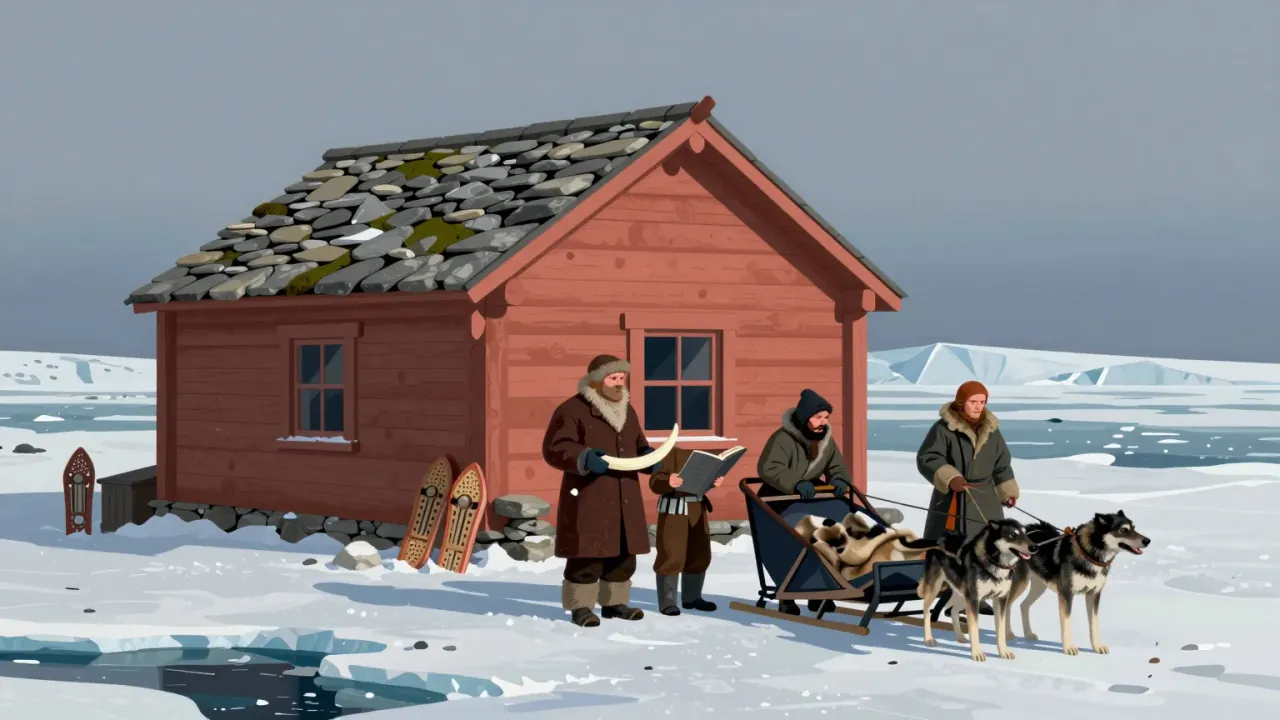
The film unfolds across seasonal rhythms: travel by sled and kayak, walrus hunting with harpoons, igloo construction, and trade at a Hudson’s Bay–style post. Allakariallak — credited as Nanook — performs with calm authority, his movements economical and precise; his wife Nyla (Maggie Nujarluktuk) and children appear unselfconscious, though several scenes were staged for camera access — notably the interior of the igloo, built oversized and partially cut away to admit light and space for Flaherty’s Bell & Howell. Flaherty shot, edited, and produced alone, using nitrate stock that demanded careful handling in sub-zero temperatures. His framing favours medium distances and steady compositions, avoiding the frantic cutting common in fiction films of the era. There is no score in the original release, only live piano accompaniment in theatres; the silence of the image is punctuated only by diegetic sound implied through action — the crack of ice, the rasp of a knife on hide. The editing links sequences thematically rather than chronologically, building cumulative weight rather than plot momentum. Word count: 152
What lands
What lands is the physical presence of the people: their hands, faces, breath in cold air, the texture of sealskin clothing, the weight of a harpoon shaft, the slow geometry of snow-block laying. These are rendered with tactile fidelity, not because the camera is sophisticated — it is bulky, slow, and unforgiving — but because Flaherty stays long enough for gesture to become character. The walrus hunt retains visceral force: the animal’s resistance, the hunters’ coordination, the exhaustion afterwards. The trading-post scene works not as comedy but as cultural interface — the gramophone moment endures because it shows mutual incomprehension without condescension, even if the framing invites laughter. Most enduring is the sense of collective competence: no individual is isolated, no task undertaken without consultation or shared effort. This is not idealised community but observable reciprocity — children carry water, women shape snow blocks, men haul meat. The film’s quiet insistence on continuity — between generations, between season and season, between tool and task — gives it gravity that outlasts its technical limits. Word count: 150
What does not
What does not land is the pretence of transparency. The film presents itself as unmediated reality while systematically reshaping it: substituting traditional tools for contemporary ones, casting non-family members as kin, constructing environments for visibility rather than authenticity. The igloo sequence, though technically ingenious, reveals the artifice behind the ‘real’. More troubling is the framing of Inuit life as timeless — divorced from colonial trade networks already deeply embedded in the region, omitting rifles, metal traps, and imported cloth that many used daily. The narration (in later reissues) and intertitles reinforce this myth of isolation, casting Nanook as noble savage rather than participant in a rapidly shifting economy. The portrayal of the gramophone scene as naive spectacle ignores that Allakariallak knew the device well — a choice that flattens agency into quaintness. These are not incidental omissions but structural decisions that serve a marketable vision of purity, one that erases history, power, and adaptation in favour of aesthetic coherence. Word count: 151
The themes that matter
The themes that matter are endurance as practice, not spectacle; knowledge as embodied skill rather than abstract learning; and resilience as interdependence, not solitary grit. The film treats cold not as antagonist but as condition — shaping movement, architecture, diet, social rhythm. Hunting is shown as negotiation with an animal that fights back, not conquest. Building is iterative, collaborative, vulnerable to collapse — a process, not a product. Trade is transactional but also ceremonial, marked by pauses, mimicry, and shared attention. Underlying all this is a quiet argument about time: Inuit temporality here is cyclical and responsive, measured in tides and migrations, not calendars or clocks. Flaherty does not name these ideas, but they emerge through repetition and duration — the same hand smoothing snow, the same child watching, the same wind moving across the same expanse over weeks. What resists assimilation into Western categories is the film’s refusal to separate labour from care, survival from ceremony, or environment from identity. Word count: 149
Who should watch it
It is essential viewing for anyone studying documentary form, early cinema, or the history of visual representation of Indigenous peoples — not as authoritative record but as a foundational artefact whose assumptions and methods remain legible and instructive. Students of anthropology, film history, or postcolonial studies will find its contradictions generative. It is not suitable for uncritical classroom use without contextualisation: the staging, misrepresentation of relationships, and erasure of colonial context require direct address. Those seeking straightforward ethnography or factual accuracy should look elsewhere — the Library of Congress preservation note cites ‘cultural significance’, not veracity. Anyone expecting immersive realism or moral simplicity will be unsettled by its ambiguities. A viewer who insists on documentary as transparent witness will reject it; one who accepts documentary as constructed testimony may find it indispensable. Its value lies precisely in its unresolved tensions. Word count: 149
Is it worth your evening
Yes, it is worth your evening — not as entertainment but as orientation. Seventy-eight minutes spent with Nanook of the North recalibrates expectations of what non-fiction cinema can do: it cannot deliver truth like a court transcript, but it can hold space for dignity, skill, and quiet persistence in extremis. Its power resides in what remains after the artifice is acknowledged — the weight of a walrus, the warmth of breath in an ice-walled room, the patience of hands shaping snow. It demands attention, not passive reception, and rewards it with a rare kind of intimacy: not psychological, but material and temporal. Those who watch expecting historical fidelity will leave dissatisfied; those willing to sit with contradiction — between staging and sincerity, between myth and memory — will find it quietly monumental. Its endurance is not due to innocence but to the clarity with which it exposes the stakes of representation. Word count: 149