A tutoring job that became a screenplay
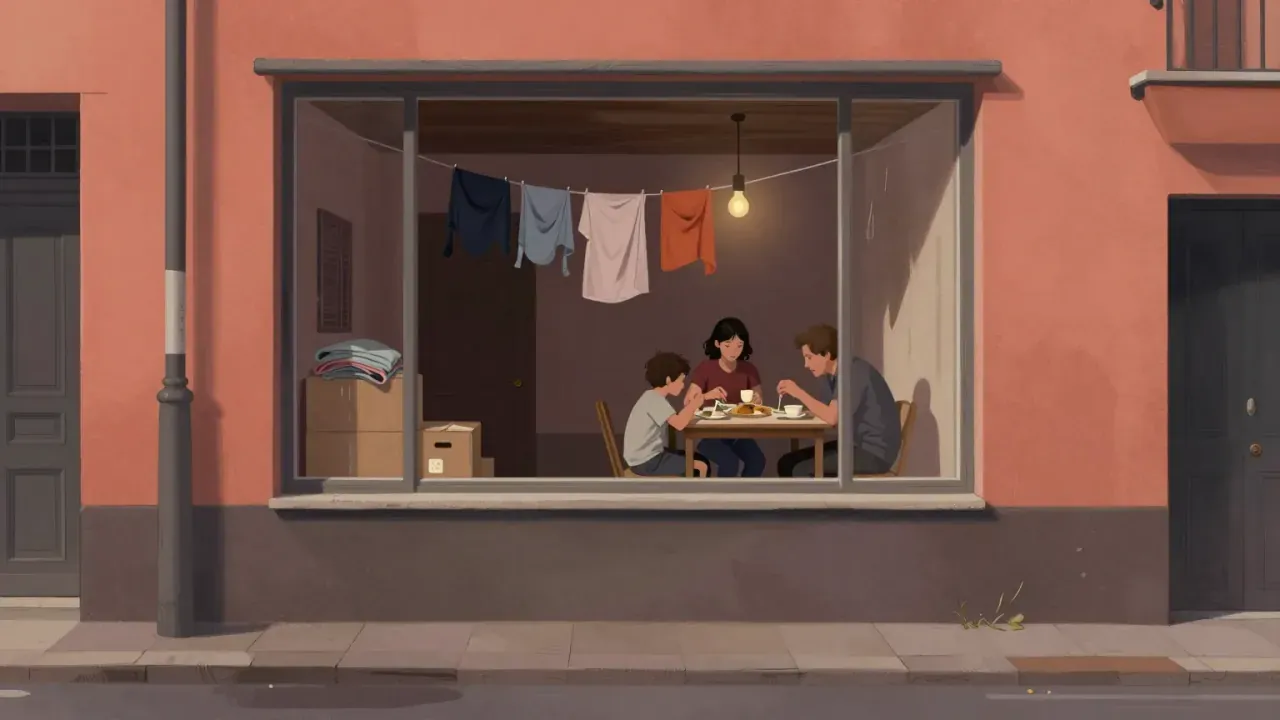
Parasite is Bong Joon-ho’s 2019 film following the Kim family, who live in a cramped semi-basement flat and scrape by folding pizza boxes, as they engineer their way one at a time into staff positions inside the household of the wealthy Park family, posing as unrelated, highly qualified strangers. Bong first conceived the idea in 2013 while working on Snowpiercer, drawing on his own experience tutoring a wealthy family’s son in his early twenties, and initially developed it as a play before turning it into a 15-page treatment that his assistant Han Jin-won expanded into the full screenplay. The title’s double meaning, applying equally to the scheming Kims and to a Park family that cannot function without staff to do its basic domestic labour, was something Bong had to argue for against his own marketing team’s hesitation.
A house built specifically to be read as an argument
Bong cited the 1960 Korean film The Housemaid, about a household destabilised by a live-in maid, and the design of the wealthy family’s home in Kurosawa’s High and Low as direct influences, along with the 1930s case of two French maids who murdered their employers. Filming ran from May to September 2018 around Seoul and Jeonju, with cinematographer Hong Kyung-pyo shooting on an Arri Alexa 65; the Parks’ house was purpose-built, its ground floor and garden constructed on an outdoor lot and its upper floor completed with green-screen work, around a fictional architect Bong and production designer Lee Ha-jun invented specifically to justify the home’s layout. English subtitles were written by Darcy Paquet working directly with Bong, who coined the term ‘ram-don’ for a dish made from two instant noodle brands and swapped in references, like Oxford University for Seoul National, that would land immediately with English-speaking audiences.
A structural turn that resets the story without breaking tone
The film’s structural turn, when the Kims discover they are not the first family to have infiltrated the Parks’ household, resets the story’s stakes without ever breaking its tone, and the transition works because Bong’s camera has already trained the audience to read the house’s geography, floor by floor, as a map of status. Song Kang-ho, as the Kim family’s patriarch, carries the film’s emotional shift in the final act on almost no dialogue, communicating a change in understanding through posture and stillness rather than through speech. The production design, built specifically around sightlines and a single wide living-room window meant to frame the garden, turns the house itself into the film’s clearest expression of the wealth gap it is examining.
A tonal snap between comedy and violence
The film’s early comic register, built on the Kims’ resourceful cons, sits at a genuine tonal distance from its violent final act, and while Bong controls that shift deliberately, some viewers find the tonal snap between the two halves more jarring than purposeful on a first watch. The Park family, despite being drawn with real specificity in scenes like the son’s fixation on a Native American theme, remain somewhat less developed as individuals than the Kims, whose backstory and dynamics the film spends far more time establishing. A subplot involving a hidden basement occupant, while essential to the plot’s turn, asks the audience to accept a fairly significant coincidence to set it in motion.
An odour neither family can name
Class in the film operates through smell, space and small daily habits rather than through wealth alone: the Parks can only articulate what unsettles them about the Kims as an odour they associate with public transport, and that inability to name the actual gap between them is itself the point. Family loyalty is the Kims’ one genuine resource, mobilised entirely to defeat a system that offers them no other way in, and the film never suggests their scheme is unreasonable given what’s actually available to them. Identity, especially the fabricated qualifications each Kim uses to get hired, becomes a kind of currency in itself, exchanged for access to a house that was never built with people like them in mind.
Who the ending won’t satisfy
This suits viewers who want a class drama structured with the tension of a thriller, anyone interested in South Korean cinema’s recent international rise, and admirers of ensemble performances built around precise, escalating plotting. It is a demanding watch for anyone wanting the film’s early comic tone to hold throughout, since the violence of the final act is sudden and, for some, hard to reconcile with the film’s lighter opening stretch. Viewers wanting a clear resolution should also be prepared for an ending that offers little practical hope to either family.
A Palme d’Or and a Best Picture Oscar in the same year
Critical consensus is close to total, a 99 percent Tomatometer score and a 97 Metascore, and the film went on to win the Palme d’Or at Cannes before becoming the first non-English-language film to win the Academy Award for Best Picture, one of only a handful of films ever to win both. At 132 minutes it moves briskly through a plot with real structural complexity, and its craft, from the house’s design to Jung Jae-il’s score, holds up to the scrutiny that all that acclaim invites. It is worth an evening for anyone willing to sit with a film that offers a diagnosis of inequality without pretending to offer a solution to it.