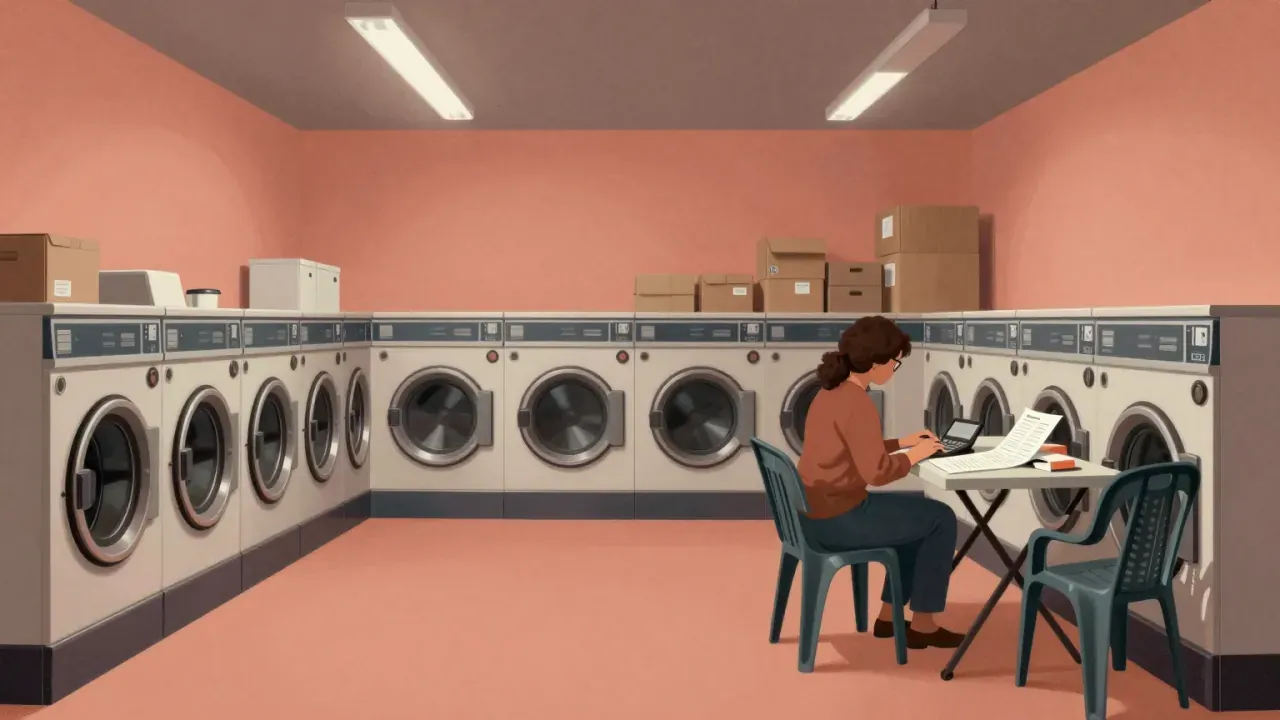
A tax audit becomes a multiverse
Everything Everywhere All at Once starts as a story about an IRS audit and ends up a story about every version of a life a person didn’t choose. Dan Kwan and Daniel Scheinert wrote the lead role for Jackie Chan before reworking it around a woman running a failing laundromat, and that swap is the film’s real engine: Evelyn Wang isn’t an action hero learning to fight, she’s a mother and business owner who gets handed the ability to access every other Evelyn who made different choices. The multiverse conceit, built on AGBO’s backing and a $25 million budget, gives Kwan and Scheinert license to jump genres at will, but the film keeps insisting that the audit, the laundromat and the marriage are what any of it is actually about.
Eight people, no outside studio
The verse-jumping runs on effects the Daniels built themselves: after a difficult experience outsourcing work on their earlier film Swiss Army Man, they assembled a team of eight artists under Zak Stoltz and produced the visuals in Adobe After Effects and Premiere Pro rather than handing the film to a dedicated studio. That choice keeps the film’s stranger images — the everything bagel, the hot-dog-fingered universe — looking handmade rather than polished, which suits material this odd. Shooting took 38 days in Simi Valley, with the fight choreography moving fast enough that the fanny-pack sequence was shot in a day and a half. Paul Rogers’ editing is doing the heaviest lifting, cutting between registers fast enough that the tonal whiplash reads as intentional rather than sloppy.
Yeoh, Quan and the fights that move fast
Michelle Yeoh is doing several different jobs across the film’s timelines — martial artist, film star, ordinary immigrant mother — and the performance holds together because she plays the exhaustion underneath each version the same way. Ke Huy Quan, in his first film role since 2002, gets a small physical comedy with fanny packs that becomes the film’s most purely enjoyable stretch, and James Hong’s presence as Evelyn’s father lands harder for being understated rather than played big. Jamie Lee Curtis based her IRS agent’s look on a photograph of a real auditor and used her own body without prosthetics, which gives Deirdre a specific, unglamorous physicality that a more stylised villain design would have lost.
More universes than the story can use
The premise generates more universes than the film has time to use well. A world where people have hot dogs for fingers, or where Evelyn and her daughter are rocks on a cliff, gets a single striking gag and then disappears without being folded back into anything — charming on first viewing, thin on reflection. The original cut ran around 170 minutes before trims brought it to 140, and the seams of that cut still show in stretches where the plot pauses to let a bit play out before returning to Evelyn’s actual crisis. The film’s commitment to being funny in every direction at once means some of its ideas — the bagel as a symbol of nihilism, in particular — get introduced with more energy than they’re later paid off with.
A mother and daughter, not a philosophy
Strip away the universe-hopping and the film is about a mother who can’t say what she needs to say to her daughter, set inside a family running a laundromat that’s about to be audited into ruin. The tax audit, not the multiverse villain, is the deadline that actually drives Evelyn’s choices for most of the film’s length. Joy’s fluency with despair and Evelyn’s inability to sit still with her own disappointment are the real conflict, and every fantastical detour eventually loops back to whether Evelyn can look at her daughter without flinching. The film’s other big theme — that meaning is a decision rather than a discovery — gets stated plainly enough that it risks sounding like a slogan, but the family scenes underneath it earn the idea more than the dialogue does.
Who this is for
This suits viewers who enjoy watching a film refuse to settle into one genre — it moves through martial arts, science fiction, silent-film pastiche and kitchen-sink family drama inside a single scene without apologising for the whiplash. Michelle Yeoh’s range across the film is reason enough on its own, and anyone curious about what eight artists can do with consumer software rather than a visual-effects house has something to study here. It is a poor fit for anyone who wants a story told once, cleanly, in one register: the tonal shifts are frequent and sometimes abrupt, and a viewer who finds slapstick sitting next to grief distracting rather than additive will find plenty here to be distracted by.
Is it worth the evening
The film went on to win the Best Picture and Original Screenplay Oscars, a Screen Actors Guild ensemble award and a Hugo, and critics logged it at 93% on Rotten Tomatoes and 81 on Metacritic — figures worth noting, not deferring to. On its own terms, the film’s reach exceeds its grip in places, particularly in the back half where the number of open universes outstrips what the plot can resolve in the time it has left. But the laundromat, the audit and the argument between mother and daughter never get lost, and that’s the harder trick: a film this determined to be about everything still manages to stay about one family. Worth the evening, especially for viewers who haven’t seen Yeoh given a canvas this wide before.