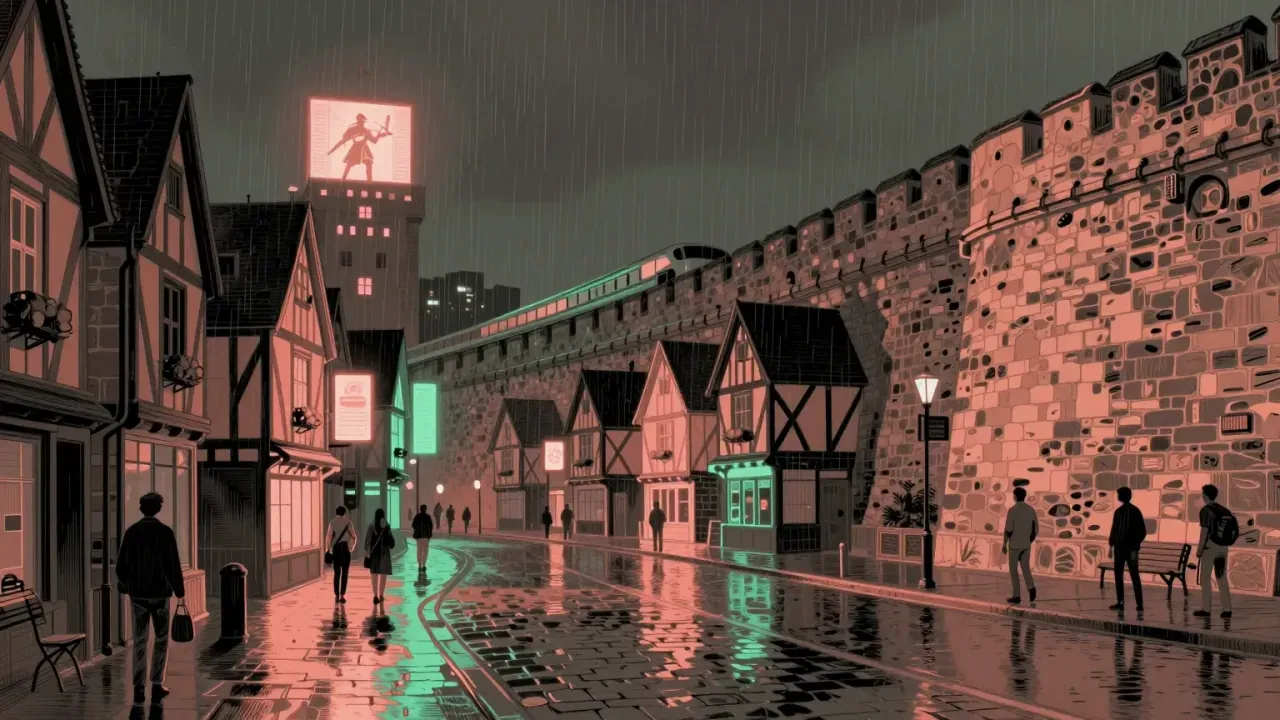
A knight framed, a shapeshifter unbothered
Nimona, based on ND Stevenson’s 2015 graphic novel, is set in a medieval-futuristic kingdom where knight Ballister Boldheart is framed for murdering the Queen and, on the run, reluctantly teams up with Nimona, a shapeshifter who attaches herself to his cause less out of sympathy and more because she finds the chaos entertaining. The film pairs Ballister’s desperate need to clear his name and be readmitted to a society that has just turned on him against Nimona’s total lack of interest in being trusted or understood by that same society. Directors Nick Bruno and Troy Quane inherited the project mid-development and built the finished film around that contrast between a man trying to belong and a shapeshifter who never wanted to.
Cancelled once, finished twice
The film’s road to release was unusually rough: originally developed at Blue Sky Studios from 2015 onward, it was cancelled outright in 2021 when Disney closed the studio down, despite reports from staff that it was close to finished. Annapurna Pictures and Netflix revived the project the following year, keeping Bruno and Quane and much of the original voice cast, including Chloe Grace Moretz as Nimona and Riz Ahmed as Ballister, while DNEG Animation took over the animation pipeline and rebuilt it around Pixar’s RenderMan rather than Blue Sky’s proprietary software. Christophe Beck’s rock-inflected score and a visual design blending Eyvind Earle’s fluid style with Charley Harper’s geometric shapes carried over from the earlier production largely intact.
Where the shapeshifting does more than spectacle
Nimona’s shapeshifting is used as more than a special-effects showcase: her forms, drawn from rhinos to whales to gorillas, register as an explosion of feeling each time, and the Institute that hunts her treats every one of those transformations as proof she is dangerous rather than simply different, which gives the story’s persecution plot a concrete visual language instead of a stated moral. The decision to keep her circular, free-flowing design against Ballister’s rigid squares and the Institute’s diamonds makes the film’s core conflict readable even before any dialogue explains it, a piece of character design carried over from Blue Sky’s original concept work.
The parts that show their scars
The production’s stop-start history is occasionally visible in the finished film: some character beats, particularly around Ballister’s former partner Ambrosius Goldenloin, feel compressed compared to how much emotional work they’re asked to do, a plausible side effect of a story that survived a full studio shutdown and a pipeline rebuild between two companies. The Institute itself, meant to carry the film’s institutional-prejudice theme, is drawn with fairly broad strokes as a villain, which lands the point clearly but without much nuance about how such an institution justifies itself to the people inside it.
A story that was nearly changed to be safer
Former Blue Sky staff have said the film’s queer content, including a same-sex kiss between Ballister and Ambrosius, drew internal pushback before the studio’s closure, and Annapurna’s chief executive has said she specifically encouraged the new creative team to keep and embrace those elements rather than soften them for the revived version. That history gives Nimona’s central metaphor, a woman feared and hunted for shapeshifting into forms others find unnatural, a clear real-world echo, turning what could have been a generic misunderstood-monster plot into a more pointed statement about who gets permitted to define normal in the first place.
Who should watch it
This suits viewers who want an action-adventure willing to make its outsider theme concrete rather than incidental, and anyone invested in ND Stevenson’s original graphic novel or in the wider conversation about LGBTQ representation surviving a difficult production history intact. It is a less satisfying choice for viewers wanting a lighter, lower-stakes fantasy comedy, since the Institute’s persecution plot carries real weight rather than functioning as background conflict. Knowing the production’s backstory adds a layer some viewers will want and others will find unnecessary to enjoying the film on its own terms.
Worth the hour and forty
Yes. A film that survived a full cancellation, a studio closure and a chief executive’s public embrace of the content its previous distributor was reportedly nervous about arrives with more at stake than most animated adventures of its scale, and it mostly earns that weight rather than merely surviving to tell about it. Nimona’s design and Beck’s score give the finished product a distinct identity independent of its production history, while the restored queer content gives its persecution theme a specificity that a safer version would have lost. An hour and forty minutes is a fair length for a story that had to fight this hard to reach the screen at all.